As the People’s Liberation Army approaches its centenary, China is transforming a force once built around manpower and heavy machinery into a connected military of intelligent tanks, drone carriers, robotic formations, hypersonic missiles and weapons designed to operate across land, sea, air, space and the electromagnetic spectrum.
The machines came over the sand berms in packs. Four-legged robotic wolves, some fitted with infantry rocket launchers, bounded across the beach ahead of the assault troops, their mechanical legs throwing grit into the air as they advanced.
It was one of the most arresting sequences in Zhisheng, or Victory, the documentary released for China’s Army Day in August 2026. Elsewhere in the series, Type 191 long-range rocket launchers fired tactical missiles, the new Type 076 amphibious assault ship discharged defensive countermeasures, and formations of KVD002 reconnaissance-strike drones hunted a moving target at sea.
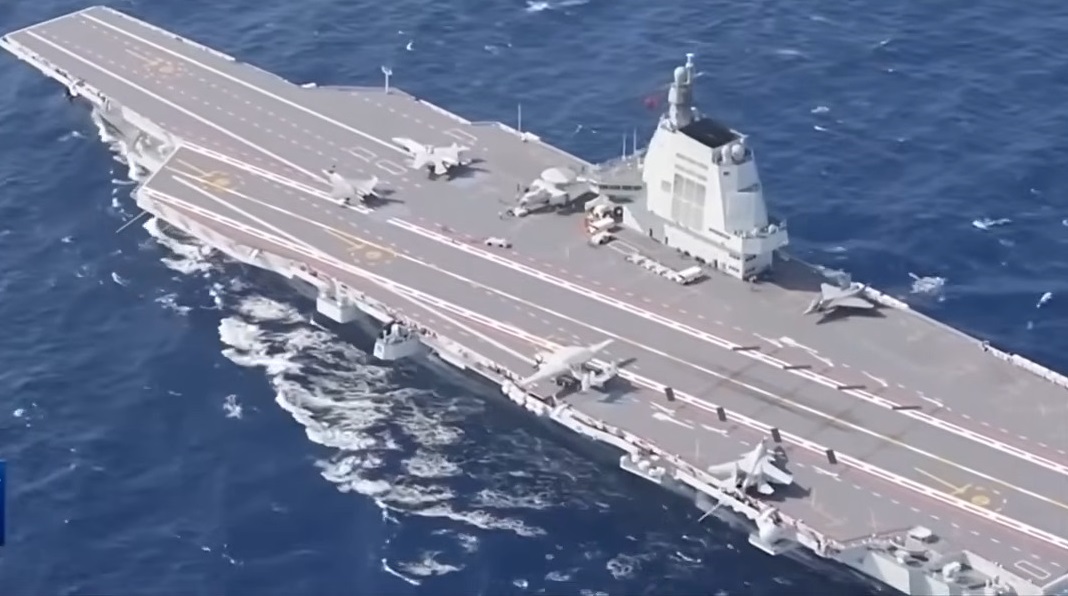
Chinese aircraft carrier Fujian flight deck. China News Service,
The images conveyed speed, confidence and readiness. Yet the machines themselves tell only part of the story. China is not simply replacing older tanks, ships and aircraft with newer models. It is changing the organising principle of its armed forces by connecting sensors, commanders and weapons through an intelligent combat network in which information can move more quickly than an adversary can respond.
The robotic wolf matters not merely because it can carry a weapon, but because it can scout for artillery, exchange information with an aerial drone, enter ground too dangerous for a soldier and operate within a distributed formation. The missile launcher matters because it can receive coordinates from sensors beyond its own horizon. The Type 076 matters because it can carry this reconnaissance and strike network far out to sea.
From mechanisation to intelligent warfare
The centenary objective is sometimes described outside China as a deadline for military action against Taiwan. That is not the official Chinese formulation. Beijing presents 2027 as a modernisation milestone by which the PLA should have made decisive progress towards becoming a force capable of protecting China’s sovereignty, security and development interests.
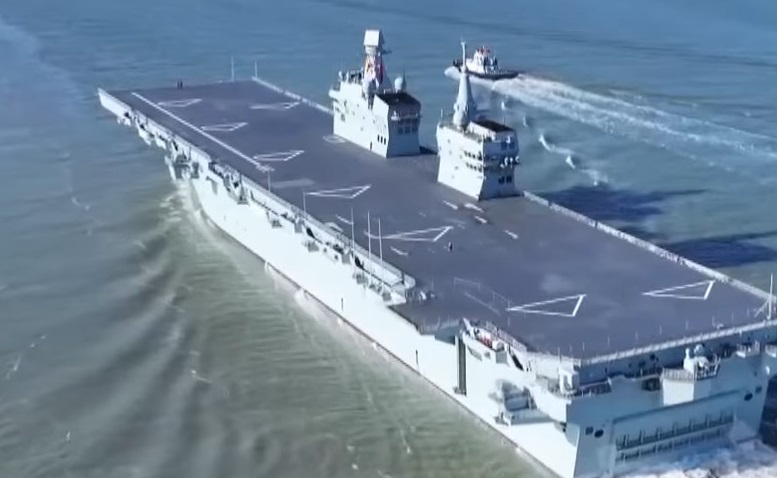
China’s Type 076 amphibious assault ship Sichuan during its first sea trial in November 2025. China News Service
Presiding over a Political Bureau study session immediately before Army Day, President Xi Jinping called for stronger political guidance and deeper innovation-driven development. He urged the armed forces to fulfil their centenary objectives and make decisive progress towards the basic modernisation of national defence and the military.
The language reflects a progression shaping Chinese military development for more than a generation. The PLA first pursued mechanisation, replacing an infantry-heavy mass army with mobile armoured, aviation and missile forces. It then pursued “informatization”, linking those forces through digital communications, reconnaissance and command systems. It is now moving towards “intelligentization”, in which artificial intelligence, automated analysis and unmanned platforms are incorporated throughout the force.
Recent writing in PLA Daily makes clear that this is not conceived as an equipment programme alone. It has described unmanned intelligent warfare as a reconstruction involving technology, operational theory, organisation and military thinking. High-end platforms are to be combined with inexpensive and expendable systems capable of sharing their picture of the battlefield, planning tasks and reorganising when conditions change.
Data becomes the fuel of the force, algorithms help organise it and computing capacity supports continuous perception, decision and action. Chinese doctrine nevertheless retains the principle that human commanders should exercise final control over firepower, while machines undertake repetitive, dangerous and data-intensive work.
Wolves, swarms and the new infantry
The robotic wolves provide the most visible expression of this change on land. PLA exercises have employed them in three broad categories: reconnaissance machines carrying sensors, transport machines carrying ammunition and combat machines providing fire support. Chinese state media has described this as a robotic adaptation of the PLA’s traditional three-unit tactical organisation.
During the China-Mongolia Steppe Partner 2026 exercise, Chinese forces demonstrated manned-unmanned offensive operations involving robotic wolves, aerial reconnaissance, obstacle crossing and trench clearance. The machines were presented not as replacements for soldiers but as forward elements of a combined formation, extending what troops could see, carry and strike.
The concept reaches beyond the robots. Chinese military theorists envisage an “infantry swarm” in which large linear formations are divided into smaller, semi-independent units. Connected by tactical terminals, unmanned platforms and data links, they would disperse to avoid detection, concentrate their effects at the required moment and separate before an adversary could retaliate.
This reflects lessons drawn from recent conflicts, where dense concentrations of troops and vehicles can be detected by drones and struck by precision artillery. Smaller formations accompanied by robotic scouts can distribute their risk, preserve soldiers for tasks requiring judgment and send machines into minefields, buildings, tunnels or contaminated ground.
Drones that find and strike
The KVD002 armed reconnaissance aircraft represents the same transition in the air. The Army’s first publicly identified reconnaissance-strike drone can locate targets, pass information to helicopters and ground formations, guide weapons and conduct attacks of its own.
In footage released during the Army Day commemorations, at least 13 KVD002 aircraft appeared together during an operation against an unmanned surface vessel off China’s southeastern coast. Chinese commentary presented the formation as evidence that medium and large drones were being incorporated into the Army’s wider combat system rather than employed as isolated aircraft.
A formation containing reconnaissance, electronic warfare, decoy and strike aircraft could distribute functions across the group. Some machines could expose or overwhelm an air-defence system while others attacked the target, allowing the formation to absorb losses without abandoning its mission.
The exercise also illustrated the continuing role of human skill. When the KVD002’s onboard system reportedly had difficulty maintaining a lock on the moving vessel against the visual clutter of the sea, an operator took manual control and guided the weapon to its target. Intelligentization does not mean that China expects algorithms immediately to replace commanders. It means using machines to accelerate reconnaissance and calculation while humans retain responsibility for critical decisions.
A new tank for a drone-filled battlefield
The Type 100 tank, unveiled at the September 2025 Victory Day parade, marks a corresponding transformation in armoured warfare.
Earlier generations of tanks were built around a contest between armour and penetration: thicker protection was answered by a larger gun. The Type 100 reflects a battlefield on which survival may depend instead upon seeing first, sharing information first and defeating an incoming weapon before it reaches the vehicle.
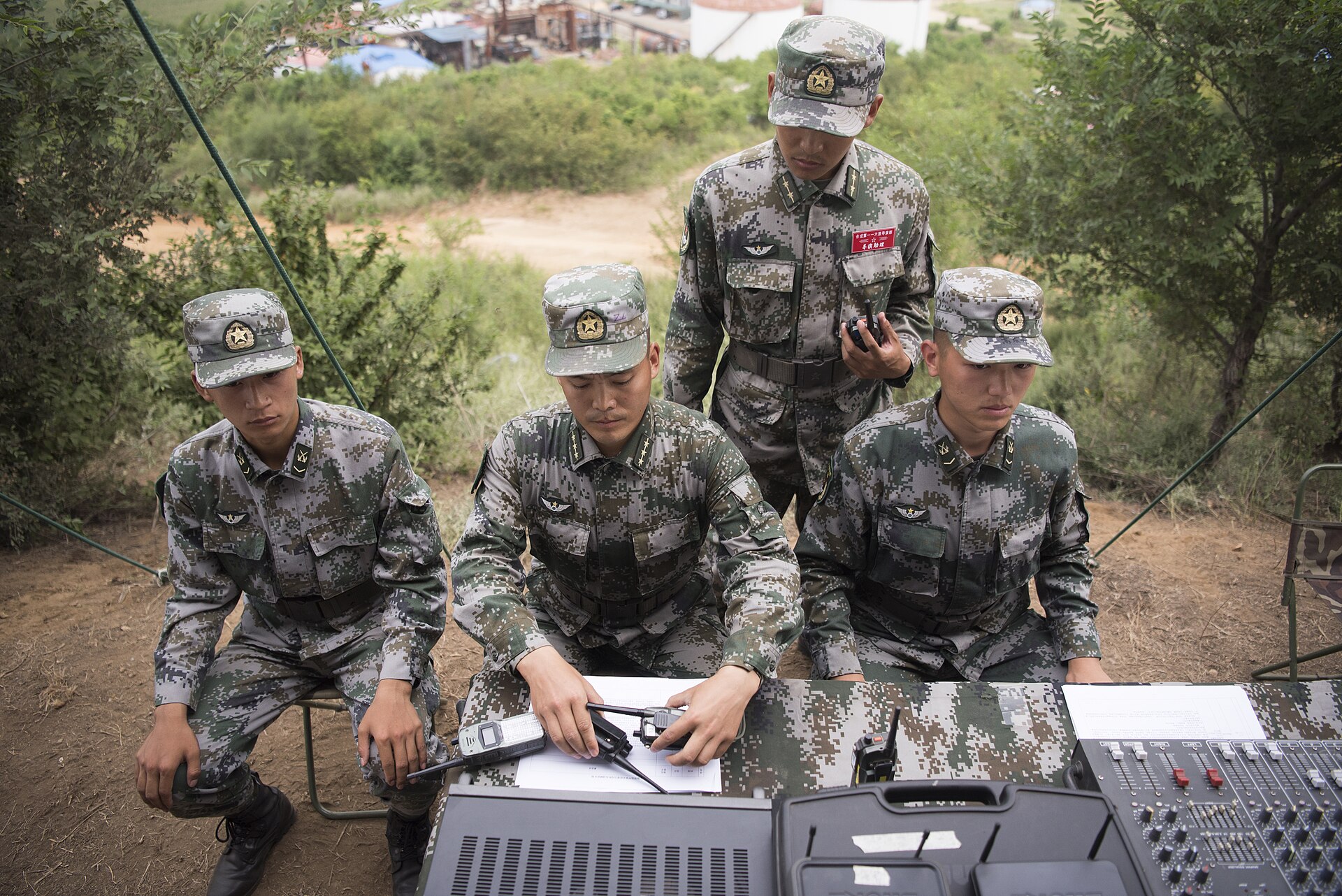
People’s Liberation Army soldiers prepare for an assault exercise at a training base in Shenyang photo credit US Navy/Petty Officer 1st Class Dominique Pinero
Its crew sits in the hull beneath an unmanned turret. A four-sided phased-array radar provides all-round threat detection, while an active-protection system is intended to intercept incoming rockets and missiles. Cameras and electro-optical sensors cover the vehicle, and its intelligent crew helmets display operational information in a manner compared by Chinese media to systems used by fighter pilots.
The tank was displayed with a Type 100 support vehicle and the upgraded Type 99B. China presented the three as a combined ground-assault group: the heavier Type 99B supplies firepower, while the Type 100 family contributes mobility, reconnaissance, protection and coordination with unmanned systems.
The result is not simply a lighter tank. It is a vehicle conceived as a participant in a networked battle rather than as a self-contained steel fortress.
The ship between a carrier and an assault vessel
At sea, the Type 076 Sichuan may be China’s most original new platform. Displacing more than 40,000 tonnes, it has a full-length flight deck, twin islands and a well deck for amphibious equipment. Its defining feature is the combination of an electromagnetic catapult and arresting gear, making it the first amphibious assault ship designed to operate catapult-launched fixed-wing aircraft.
Chinese television commentators have called it a “quasi-aircraft carrier”. Unlike a conventional helicopter assault ship, it is expected to launch large fixed-wing drones and potentially crewed aircraft, giving an amphibious formation its own extended reconnaissance, electronic-warfare and strike capacity.
The Sichuan began sea trials in November 2025 and subsequently conducted experimental training in the South China Sea. By the summer of 2026, publicly released images showed its deck markings, electromagnetic launch track and arresting equipment in place.
Official computer-generated footage has depicted it launching the GJ-21, understood to be a naval development of China’s tailless GJ-11 stealth attack drone. The precise composition of its future air group has not been disclosed, but its larger importance is already evident. It brings the unmanned air formation to sea and places it within an amphibious force.
Reconnaissance aircraft could search ahead of the fleet, electronic-warfare drones could interfere with hostile sensors, strike aircraft could attack coastal positions, and helicopters and landing craft could then move troops under the protection of the same information network.
Fujian and the complete carrier air group
The commissioning of the carrier Fujian in November 2025 marked another step in the transformation of the PLA Navy. It is China’s first carrier equipped with electromagnetic catapults, permitting the launch of heavier aircraft carrying more fuel and weapons than was possible from China’s earlier ski-jump carriers.
China has assembled a new carrier aviation package around the J-35 stealth fighter, the catapult-compatible J-15T and the KJ-600 airborne early-warning aircraft. The KJ-600 is especially important because it can extend the carrier group’s ability to detect aircraft and missiles beyond the horizon and coordinate engagements across a much wider area.
China has therefore moved from proving that it can build and sail aircraft carriers to developing the aviation, sensing and command structure required for a carrier group to operate as a coherent formation.
The shield against the drone age
China’s unmanned development is accompanied by an equally systematic investment in defeating unmanned weapons. At the 2025 parade, the PLA displayed what Chinese media called an anti-drone “iron triangle”: vehicle-mounted lasers, high-power microwave weapons, and systems combining cannon with air-defence missiles.
A laser directs concentrated energy against an individual target without expending a conventional projectile. A microwave system can attack the electronic components of drones across a wider area, making it potentially valuable against swarms. Guns and missiles remain available against targets that cannot be defeated electronically or by directed energy.
This layered approach addresses one of the central economic problems exposed by recent conflicts. Repeatedly using an expensive missile to destroy an inexpensive drone is unsustainable. The PLA is seeking responses whose cost per engagement is closer to the cost of the threat.
Chinese military writers recognise that attack and defence are evolving together. Navigation deception and electronic interference encourage more autonomous navigation, resilient communications and distributed control. Attack and defence systems must therefore be tested continuously against one another, with exercise data returned to engineers and commanders to improve algorithms and tactics.
Missiles and strategic deterrence
Alongside unmanned systems, China has continued to strengthen the conventional and nuclear missile forces forming the hard edge of its deterrence.
The 2025 parade displayed land-, sea- and air-based strategic systems together, publicly presenting China’s nuclear triad as an integrated capability. The liquid-fuelled DF-5C intercontinental missile was described by Chinese military media as possessing global coverage and forming part of a strategic counterattack system maintained at readiness.
Four YJ-series anti-ship missile types demonstrated a separate objective: creating several approaches by which surface ships, submarines and aircraft can threaten a hostile naval formation. The Type 191 long-range rocket launcher applies the same principle on land. Its full value emerges when it receives targeting information from drones, satellites and forward reconnaissance units.
The missile is the final instrument in a chain beginning with detection and passing through communication, assessment and command. China’s modernization is increasingly concerned with shortening that entire chain.
The invisible force behind the weapons
In 2024, China reorganised the former Strategic Support Force and established a structure consisting of the Aerospace Force, Cyberspace Force, Information Support Force and Joint Logistics Support Force alongside the Army, Navy, Air Force and Rocket Force.
Of these, the Information Support Force may prove as important as any ship or missile. Its role is to support the networks and communications through which joint operations are coordinated. The Aerospace Force provides space-related capabilities, while the Cyberspace Force operates across the network and electromagnetic domains.
Together they form the nervous system of the modern PLA. A robotic wolf can observe a position, an aerial drone can confirm it, a command system can evaluate the information, and a rocket battery, aircraft or ship can be assigned to strike it. The ambition is to remove the institutional and technical walls that once separated the services.
Recent Chinese military writing calls the resulting structure a “kill web”: a resilient and increasingly decentralised network capable of reorganising itself if individual communications links or command nodes are destroyed. Success is measured through calculation, mass, speed, economy and resilience rather than the isolated superiority of a single weapon.
A transformation still being tested
None of this means that every system displayed by China has completed operational testing or that technology has abolished the difficulties of war. Electromagnetic catapults must work repeatedly at sea. Drone formations must retain communications in a hostile electronic environment. Artificial intelligence must distinguish genuine targets from deception. Robotic vehicles must negotiate mud, rubble, water and sand rather than only prepared demonstration grounds.
Nor has the PLA fought a large modern war in which all these components could be tested together against an enemy actively trying to disable them. That absence of combat experience limits what can presently be proved, but it is not evidence that the systems would fail. Every new military capability must enter service before it can be validated in war. Exercises, sea trials and adversarial testing are intended to close as much of that gap as peacetime permits.
China’s central achievement is that the direction of development has become coherent across its armed forces. The Type 100 tank, KVD002 drone formations, robotic wolves, the Sichuan, the Fujian, the anti-drone iron triangle and the strategic missile forces are different expressions of the same project.
The PLA reaching its centenary will bear little resemblance to the manpower-heavy army from which it developed. Its strength will increasingly be measured not simply by the number of ships, aircraft or missiles it possesses, but by whether it can connect them, distribute them, protect them and act upon their information at machine speed.
The wolves crossing the beach are the dramatic image of that transformation. The true innovation is the largely invisible network moving with them.