Eight years after Meng Wanzhou was seized while changing aircraft in Canada, the United States is preparing to portray Huawei as a criminal enterprise before a New York jury. From Beijing, the prosecution is not an isolated exercise in law enforcement but the latest stage of a relentless campaign to contain a Chinese technological rival and its timing threatens to cast a shadow over Xi Jinping’s visit to Washington.
Related analysis: Custody Without Protection: How Canada Learned That Enforcing American Power Does Not Buy American Shelter
The United States has already expelled Huawei from its telecommunications networks, deprived it of advanced Western semiconductors, pressured allied governments to remove its equipment and attempted to cripple its international smartphone business. It is now preparing to do something more theatrical: place China’s most important technology company in the dock as an alleged racketeering enterprise.
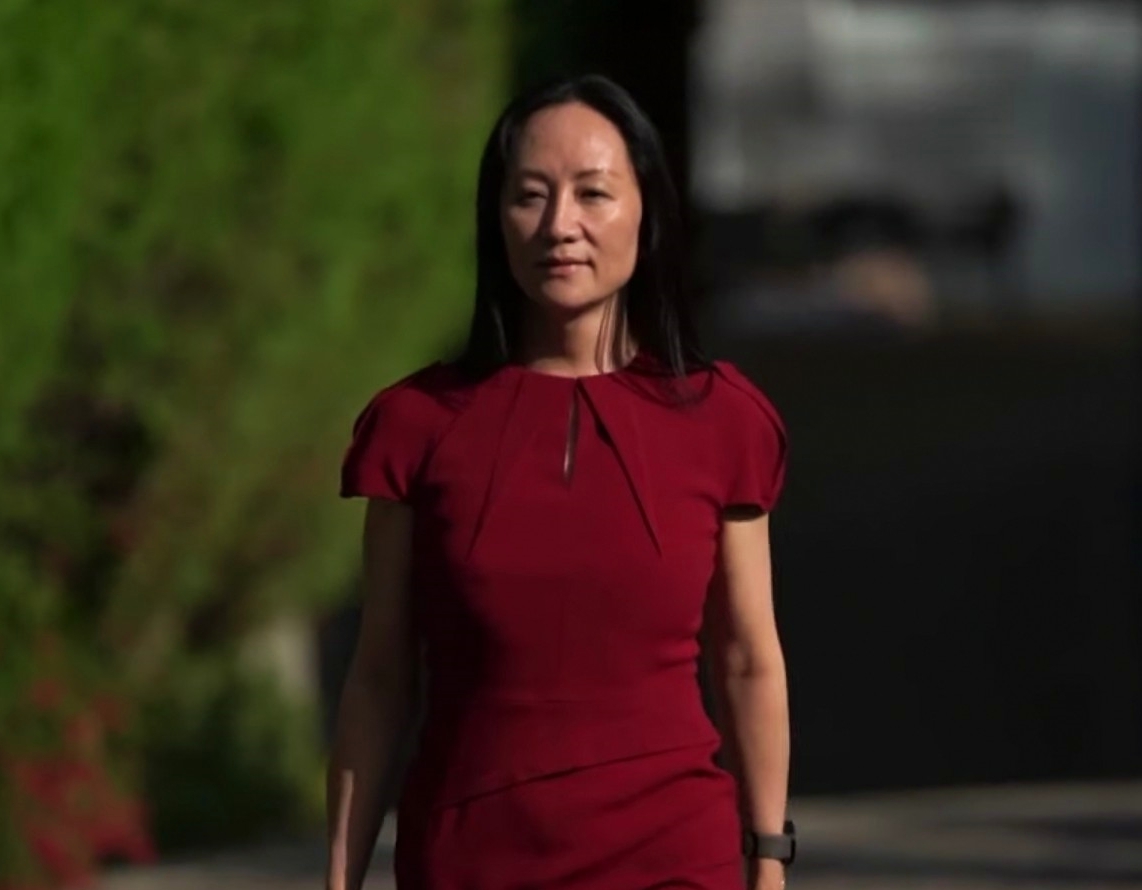
Huawei chief financial officer Meng Wanzhou in Vancouver in 2021, during her nearly three-year battle against extradition to the United States. Her detention became a symbol in China of Washington’s willingness to use its legal and financial reach against a strategic technological rival.
Jury selection is due to begin in Brooklyn on September 8. American prosecutors accuse Huawei and several subsidiaries of bank and wire fraud, sanctions evasion, obstruction of justice and a long-running conspiracy to steal trade secrets. The allegations stretch across almost two decades, from Huawei’s relationship with an Iranian company called Skycom to an employee’s removal of a component from a T-Mobile testing robot.
Huawei denies the charges and calls itself “a prosecutorial target in search of a crime”. Its lawyers contend that Washington has collected a series of old and legally distinct commercial disputes, some involving individual employees, and combined them under the Racketeer Influenced and Corrupt Organizations Act—the legislation popularly associated with organised crime.
The language is not incidental. The prosecution is not merely alleging that particular Huawei employees acted dishonestly. It is preparing to invite an American jury to conclude that Huawei’s global rise was itself built upon an organised system of criminal conduct.
That premise has already travelled from the indictment into Western reporting. The Financial Times introduced the coming trial with the question: “Was Huawei’s rise built on crime?” Before the jury has been selected, the prosecution’s preferred narrative has effectively become the headline.
A trial timed for Xi’s arrival
The trial is expected to last for months, but its opening has particular diplomatic significance. President Xi Jinping is expected to visit Washington on September 24, only 16 days after jury selection begins.
Xi is reportedly preparing to bring an unusually large delegation of Chinese business leaders. The purpose is partly to demonstrate that Beijing remains interested in investment and commercial engagement despite tariffs, sanctions and the steadily expanding American blockade on Chinese technology.
Against that background, the Huawei prosecution is more than an embarrassment. It strikes directly at the credibility of any American claim that Chinese companies will receive impartial treatment if they invest, trade or operate in the United States.
Xi will be invited to discuss economic cooperation while an American courtroom prepares to describe one of China’s greatest commercial successes as a criminal conspiracy. Chinese executives accompanying him will be entitled to ask a more personal question: if Meng Wanzhou could be detained while changing aircraft in Vancouver, what guarantees exist for them?
There is no evidence that Washington scheduled the trial deliberately to sabotage Xi’s visit. The date emerged from a long-running judicial process. Nevertheless, diplomacy is governed by consequences as well as intentions. The timing is needlessly provocative and, from the Chinese perspective, distinctly vindictive.
It will reinforce the suspicion that Washington wants Chinese investment only while China remains technologically subordinate. A Chinese company may sell inexpensive goods, employ American workers or purchase American components, but once it begins to challenge Western control of a strategic industry, it becomes a security threat, a sanctions target or, in Huawei’s case, an alleged criminal organisation.
The daughter who became bargaining power
The prosecution cannot be understood without returning to December 1, 2018.
Meng Wanzhou, Huawei’s chief financial officer and the daughter of its founder, Ren Zhengfei, landed at Vancouver International Airport intending to change aircraft. Canadian border officials questioned her and obtained her electronic devices and passwords before the Royal Canadian Mounted Police formally arrested her on an American extradition warrant.
Washington accused Meng of misleading HSBC about Huawei’s relationship with Skycom, a company conducting business in Iran. American prosecutors said those representations caused international banks to process transactions that exposed them to liability under United States sanctions.
To Washington, it was a fraud case. To Beijing, it was an extraordinary exercise in extraterritorial power: a Chinese citizen detained in Canada for statements concerning a Chinese company’s dealings in Iran, because transactions might have passed through the American financial system.
Meng was eventually released on highly restrictive bail. She was required to wear an electronic ankle monitor, observe a curfew, surrender her passports and pay for private guards who followed her whenever she left her Vancouver residences. She remained under these conditions for almost three years while contesting extradition.
The fact that Meng was Ren Zhengfei’s daughter made the operation particularly inflammatory. This was not an obscure compliance officer detained after an ordinary investigation. It was the public seizure of the founder’s child and the financial chief of the company at the centre of China’s confrontation with America.
The appearance of political coercion did not originate in Chinese propaganda. President Donald Trump provided the most damaging evidence himself.
Only days after Meng’s arrest, Trump told Reuters that he would intervene in her case if he thought doing so would help secure a trade agreement with China. With that statement, the American president blurred the boundary between prosecution and diplomacy. A person whom the Justice Department described as a criminal defendant was simultaneously presented by the White House as a negotiable asset.
Meng’s detention had become leverage.
She was allowed to return to China in September 2021 after entering a deferred prosecution agreement. Meng accepted the accuracy of a statement saying that she had made knowingly false representations to a financial institution about Huawei’s relationship with Skycom. She did not plead guilty. The charges against her were eventually dismissed after she complied with the agreement.
The distinction is important. Western reports frequently say that Meng “admitted misleading HSBC”, implying something approaching a conviction. In reality, she accepted a negotiated statement of facts to conclude a case that had kept her under restrictive bail for nearly three years. The statement is significant evidence, but it was never tested at her trial because no such trial occurred.
A Brooklyn judge has now ruled that prosecutors may show that statement to the jury trying Huawei. Meng is no longer a defendant, yet the document that secured her freedom will be deployed against her father’s company.
From Beijing, it will appear that America first used Huawei to obtain concessions from Meng and is now using Meng to prosecute Huawei.
Turning commercial disputes into racketeering
The allegations against Huawei are serious and should not simply be dismissed.
The Department of Justice alleges that Huawei concealed its control of Skycom, misrepresented its operations in Iran and North Korea and induced banks to process transactions they might otherwise have rejected. It also accuses Huawei of systematically acquiring competitors’ trade secrets.
One allegation concerns a T-Mobile robot called Tappy, which was used to test the durability of mobile phones. An employee of Huawei’s American subsidiary allegedly removed part of the robot’s arm from a laboratory and supplied photographs and measurements to colleagues.
If proved, such conduct would warrant legal consequences. Being Chinese does not confer immunity from American law when a company operates inside the United States.
The more controversial step was turning these different episodes into a racketeering conspiracy. The Justice Department introduced its RICO theory in 2020, more than a year after Meng’s arrest. It alleges that Huawei maintained a system that encouraged employees to obtain confidential information from competitors and rewarded particularly valuable acquisitions.
Huawei says the prosecution is joining “categorically different alleged crimes” in the hope that their accumulation will create an appearance of systemic corruption. Some of the trade-secret allegations, it argues, are too old to prosecute; others resemble the civil intellectual-property disputes routinely fought between large technology companies.
The company also challenges America’s attempt to impose criminal liability on a non-American company for overseas conduct merely because international payments travelled through the dollar-clearing system.
A New York jury will decide whether these defences succeed. But the essential political context cannot be excluded from the courtroom merely by calling the case law enforcement.
Huawei was identified as a strategic enemy before it was presented as a racketeering enterprise. It was excluded from the American market, placed on the Commerce Department’s Entity List and cut off from advanced semiconductors. Washington then pressured its allies to restrict or remove Huawei equipment.
The criminal prosecution became one instrument within a much larger programme of technological containment.
Britain followed the path Washington created
Britain’s role has been quieter, but it cannot be described as wholly independent of American pressure.
For years, the British government maintained that the risks arising from Huawei equipment could be managed. The company was excluded from the most sensitive parts of the telecommunications network, while its products were subjected to specialised inspection through the Huawei Cyber Security Evaluation Centre.
Britain did not discover conclusive proof of a Huawei-controlled espionage system and suddenly reverse its position. The decisive development was Washington’s imposition of new sanctions on Huawei’s semiconductor supply chain.
The British National Cyber Security Centre concluded that the American measures would force Huawei to use unfamiliar replacement components whose reliability and security could no longer be adequately guaranteed. Britain then prohibited the purchase of new Huawei 5G equipment and ordered its removal from 5G networks by the end of 2027.
The British decision therefore possessed a technical rationale. But it also demonstrated the reach of American economic power.
Washington disrupted Huawei’s access to semiconductors. The disruption caused by those sanctions was then cited by Britain as the reason Huawei could no longer be trusted as a supplier. America created the technological uncertainty that altered the British security assessment.
London did not originate the campaign against Huawei. It ultimately accepted the environment Washington had engineered.
Huawei and the American pattern
Chinese commentators frequently compare Huawei with the French engineering company Alstom.
In 2013, Alstom executive Frédéric Pierucci was arrested after arriving in New York and prosecuted over bribery connected with a power contract in Indonesia. Alstom eventually pleaded guilty and agreed to pay a $772 million penalty. At roughly the same time, the company’s energy business was acquired by America’s General Electric.
In China, the episode is often presented as an earlier version of the “American trap”: use the global reach of United States law against a foreign industrial competitor, prosecute its executives and weaken the company until its strategic assets pass into American hands.
The comparison must be treated carefully. Alstom admitted criminal conduct, several executives pleaded guilty, and an Indonesian politician was convicted of receiving bribes. There is no conclusive evidence that the prosecution was secretly manufactured to facilitate General Electric’s acquisition.
Nevertheless, the case demonstrated Washington’s willingness to arrest foreign executives for conduct taking place largely outside America whenever a sufficient connection to American jurisdiction could be established.
France’s BNP Paribas was similarly compelled to plead guilty and pay almost $9 billion for processing transactions involving countries under American sanctions.
The closest comparison is China’s ZTE. It pleaded guilty in 2017 to shipping American-origin products to Iran, obstructing justice and making a materially false statement. It paid a substantial penalty and accepted corporate monitoring.
Huawei chose not to capitulate on comparable terms. It contested the charges and attempted to preserve its independence. What followed was not merely a prosecution but a sustained assault on its markets, components, banking relationships, reputation and senior leadership.
That cumulative response distinguishes Huawei from an ordinary sanctions defendant.
How the East reads the case
Chinese vernacular newspapers rarely treat the Huawei prosecution as an isolated question of corporate compliance. They place it within the wider struggle over which country will control telecommunications, semiconductors, artificial intelligence and the digital infrastructure of the developing world.
The recurring Chinese expressions are 长臂管辖, or long-arm jurisdiction; 科技霸权, technological hegemony; and 打压遏制, suppression and containment.
These terms undoubtedly reflect Beijing’s political vocabulary. But they also describe observable American policy. Washington is not merely preventing Huawei equipment from entering the United States. It has used American technology rules to restrict what companies in Taiwan, South Korea and elsewhere may manufacture for Huawei, even when those products are made outside America.
Russian coverage has generally accepted the Chinese interpretation, presenting Meng’s detention and Huawei’s blacklisting as parts of an American effort to preserve technological supremacy through sanctions that market competition alone could not guarantee.
The view from South-East Asia is more nuanced but increasingly sceptical of Washington. Indonesian reports describe the American restrictions as having damaged Huawei while forcing it to develop HarmonyOS, cultivate domestic suppliers and reduce its vulnerability to Western pressure.
Malaysian commentary has argued that politicising technology and attempting to obstruct China’s development have not stopped its progress. Instead, the restrictions have accelerated Chinese investment in indigenous semiconductors, artificial intelligence and software.
For countries in Asia, Africa and Latin America, Huawei also represents something largely missing from the American account: an alternative supplier. Its telecommunications equipment, cloud systems and digital infrastructure have allowed developing countries to build networks at costs they could afford.
Washington describes that presence as a security danger. Many countries in the East see an attempt to force them back into dependence on a smaller and more expensive group of Western suppliers.
The campaign that made Huawei stronger
The American campaign badly injured Huawei. Its international smartphone sales collapsed, its access to advanced chips was constricted and its equipment was removed from several Western networks.
But Washington failed in its larger objective.
Huawei survived. It built a more independent supply chain, developed its own operating system, returned to advanced smartphones and expanded into cloud computing, electric vehicles and artificial intelligence. It became more important to the Chinese state and more admired by a Chinese public that regarded its survival as a national technological achievement.
American sanctions accomplished what years of Chinese industrial policy could not have achieved so quickly: they convinced Beijing, Chinese companies and the Chinese public that dependence on Western technology was an intolerable strategic risk.
The Brooklyn jury must judge the evidence, not the geopolitical contest. If prosecutors prove fraud, theft or obstruction beyond reasonable doubt, Huawei can properly be convicted.
But nobody in Beijing—and few serious observers elsewhere—will believe that this is merely an ordinary criminal trial.
The American president who presided over the case’s beginnings publicly contemplated trading Meng’s liberty for a commercial agreement. His government then used export controls, financial power, telecommunications regulation and allied pressure against her company. Eight years after seizing the founder’s daughter, Washington is still pursuing Huawei through allegations reaching back nearly two decades.
The law supplies the courtroom. American power selected the target.
That is the message Xi Jinping will receive when he arrives in Washington. He will be told that America wants stable relations and greater commercial cooperation while, a few miles away, the United States attempts to prove that China’s greatest telecommunications company was built on crime.
Washington may regard those positions as compatible. Beijing will see the contradiction clearly.