In Asia Pacific, the next crisis will not arrive with a declaration of war. It will arrive as a procurement line item, an export licence decision, a sanctions list, a customs rule change, a digital compliance requirement, or a sudden repricing of shipping and insurance. Interdependence has not ended. But it now runs with tripwires built into the plumbing.
There is a measurable marker for this shift. The same policy moves now speak, in the same breath, in the language of deterrence and in the language of trade administration, industrial capacity, and compliance architecture. The region is not choosing between guns and growth. It is fusing them.
You can see the machine taking shape in a small set of hard anchors. Japan has approved a record fiscal year 2026 defence budget of more than ¥9 trillion, continuing a multi year push into long range standoff capability and unmanned systems. China has normalised retaliatory sanctions as routine signalling over Taiwan related moves. Beijing is revising trade law to accelerate digital trade, including mutual recognition of digital certificates and electronic signatures, and to formalise green trade standards and certification systems. ASEAN and China have agreed an ACFTA 3.0 upgrade protocol, with phased implementation extending into 2026, adding commitments in the digital economy, the green economy, and supply chain connectivity. India is racing to close logistics gaps along the Himalayas after 2020 exposed how mobilisation speed becomes strategy in high altitude confrontation.
Read those as separate headlines and you miss the story. Together they describe a single operating system. The region is building the economic and technological rails on which security competition will travel.
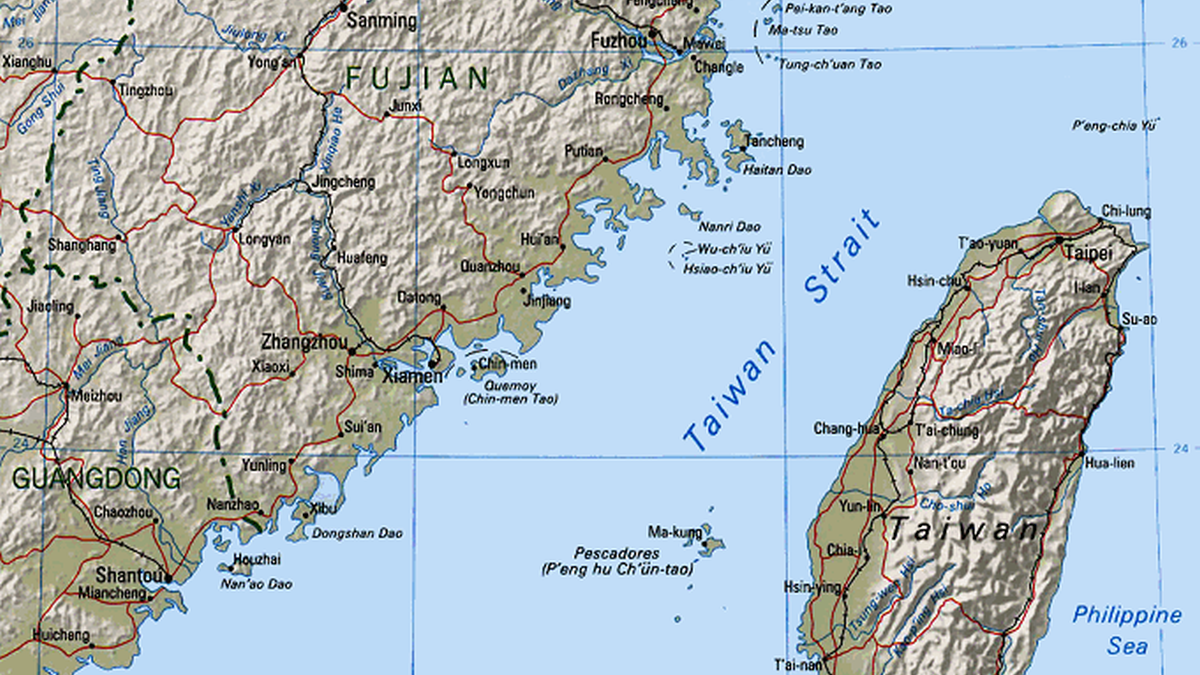
Detailed geographic map of the Taiwan Strait region, highlighting the narrow waterway separating Taiwan from mainland China. Source: Public domain via Wikimedia Commons.
The system map: three levers, three motifs
To understand the Asia Pacific security economy nexus, stop thinking in categories and think in levers. In 2026 the region is increasingly governed through three levers that now operate as one.
Military posture. Defence budgets are no longer mere signalling. They are tied to specific contingency assumptions and denial capabilities. What matters is not only how much is spent, but what is bought, where it is deployed, and what industrial capacity it anchors.
Industrial capacity. The contest is not simply who fields the most advanced platform. It is who can scale, sustain, and replace capability under pressure. This is why defence procurement has become industrial policy in practice, and why industrial policy is increasingly written with security assumptions embedded from the start.
Trade and finance rules. Trade law, customs procedures, standards, and digital compliance systems are no longer neutral administration. They are access and denial instruments. Read narrowly, digital certificates and green labelling facilitate commerce. Read structurally, they expand state capacity to steer and discipline flows under stress.
The shock transmission chain
A sanctions episode triggers compliance changes. Compliance changes trigger rerouting and delays. Rerouting triggers price spikes and shortages. Shortages trigger emergency industrial measures. Emergency measures trigger retaliation. The system does not require open war to produce coercion effects. It requires chokepoints, leverage, and bureaucracies trained to use them.
Three motifs explain why 2026 is likely to feel sharper than 2025: leverage, chokepoints, and hedging. States extract leverage from interdependence, chokepoints convert technical control into strategic power, and hedging preserves autonomy when clean alignment is costly.

Location map of the South China Sea. Source: Wikimedia Commons.
Japan: procurement as path dependency
Japan’s record FY2026 defence budget will be reported as a dramatic number. The number is not the point. The point is what procurement does to a state’s future options.
Procurement creates path dependency. Production lines, stockpiles, training pipelines, basing upgrades, maintenance contracts, and allied interoperability bind policy long after domestic politics has moved on. Once a state builds the industrial and operational scaffolding, walking it back becomes expensive and slow.
The obvious objection is real. Money does not instantly become usable combat power. Japan faces demographic constraints, industrial bottlenecks, and the reality that the United States still underwrites much of the regional deterrence posture. But readiness is the wrong metric for this story. The strategic effect is commitment and industrial binding.
Standoff and unmanned capabilities are cheaper to scale than exquisite platforms, and they are designed to contest the maritime and air approaches that carry the region’s trade. Corridors are the economy.
China: trade law and the normalisation of sanctions
China’s move to revise trade law belongs in the same frame as its sanctions retaliation over Taiwan. Both are instruments of state capacity, one administrative and long term, the other sharp and immediate.
The proposed trade law revisions are presented as modernisation: digital trade development, mutual recognition of digital certificates and electronic signatures, and green trade certification and labelling systems. Taken at face value, this is facilitation. Taken as part of a system, it is also governability. It makes flows more legible, and it allows intervention with more precision when the state chooses.
Sanctions over Taiwan illustrate how quickly military moves translate into economic measures. Even when direct pain is uneven, the system effect is normalisation and risk shaping. Markets learn to price political risk into compliance, insurance, contracts, and supply chain design.
India: logistics as deterrence
India’s Himalayan infrastructure push is a clear case where logistics becomes strategy. Roads, tunnels, landing strips, and helipads compress mobilisation time, improve sustainment, and remove seasonal bottlenecks. After 2020, the priority has been to reduce vulnerability in a theatre where altitude and weather punish slow logistics.
India can credibly describe this as defensive catch up. That counterpoint is plausible. But the system effect remains: infrastructure increases contact density, and contact density increases incident probability. More encounters compress decision windows. Politics has less time to cool a situation down.

Map showing competing border claims in Aksai Chin. Source: Wikimedia Commons.
ASEAN: contradiction management as strategy
ASEAN is often described as indecisive. That is an analytical error. Its function is to keep optionality while extracting investment, trade access, and strategic attention.
The ACFTA 3.0 upgrade protocol deepens architecture in the domains that matter in a politicised interdependence environment: digital economy, green economy, and supply chain connectivity, alongside tighter trade facilitation disciplines. ASEAN’s institutional skill is to lock in trade rules while keeping security policy modular. It separates legal integration from strategic allegiance.

Map of the Strait of Malacca corridor. Source: Wikimedia Commons.
Malaysia: governance as strategic capacity
If the nexus is about leverage and capacity, governance is the substrate. States that cannot credibly execute policy lose bargaining power. Capital reprices risk. In a world where high value investment is being repositioned under political risk, jurisdictions with weaker institutions pay a premium and lose strategic positioning.
UK relevance: why this matters in Britain
For the United Kingdom, the Asia Pacific nexus shows up first in prices and delays, not in speeches. A sanctions episode or compliance crackdown can reroute shipping and tighten supply in weeks. Insurance pricing for key corridors feeds directly into import costs. Chokepoint disruption in chips or critical minerals cascades into consumer electronics, automotive supply chains, and defence procurement. The strategic contest may be Asian. The inflation impulse and the investment repricing hits British households and British industry early.
The 2026 watchlist: five tripwires, ranked
If this lens is right, 2026 will not look like a single front. It will look like repeated bargaining episodes that travel through chokepoints.
Tripwires
- Most likely: sanctions episodes tied to Taiwan, used for signalling and risk shaping.
- Most disruptive: standards and digital compliance that quietly become conditionality tools.
- Most structurally costly: defence industrial pressure in constrained inputs, with delays and cost overruns.
- Most dangerous: faster crisis tempo on contested frontiers as contact density rises.
- Most politically decisive: ASEAN hedging under strain as integration meets external demands.
The hardest truth is the simplest. Multipolarity does not mean constant war. It means constant negotiation under latent coercion. The instruments of that coercion are increasingly economic, legal, and technical rather than purely military.
If you still think geopolitics is something that happens “over there,” 2026 will correct you at the checkout, on the invoice, and in the interest rate.
References and source base
This analysis draws on a synthesis of primary government documents, official statements, treaty texts, and reporting from international financial and geopolitical media, cross-read against defence, trade, and regional security research. Key source categories include:
- Japan defence policy and budgeting: Cabinet approvals and Ministry of Defense materials relating to Japan’s FY2026 defence budget, capability reinforcement plans, and procurement trajectories, as reported by Japanese and international financial press.
- China trade and sanctions policy: Draft revisions and official summaries of the People’s Republic of China Foreign Trade Law; statements and reporting on sanctions imposed on US defence entities following Taiwan arms sales; analysis of China’s digital trade and green trade certification initiatives.
- India border infrastructure and deterrence posture: Reporting on India’s Himalayan road, tunnel, and airfield construction following the 2020 Ladakh clashes, including assessments of logistics, mobilisation speed, and deterrence implications.
- ASEAN–China economic architecture: Publicly released materials and reporting on the ASEAN–China Free Trade Area Upgrade Protocol (ACFTA 3.0), including its digital economy, green economy, and supply chain connectivity provisions, with attention to phased implementation into 2026.
- Southeast Asian security context: Regional reporting on border incidents, ceasefires, and intra-ASEAN security volatility relevant to economic integration and strategic hedging.
- Malaysia governance and institutional risk: Court rulings and reporting related to the 1MDB corruption cases, assessed in terms of institutional credibility and investment risk rather than domestic political narrative.
- Global trade, sanctions, and chokepoints: Analysis from international financial media, shipping and insurance reporting, and policy research on sanctions enforcement, supply-chain rerouting, compliance costs, and strategic chokepoints in Asia Pacific.
Where interpretation is offered, it is explicitly framed as analysis rather than attributed intent. Visual materials embedded in this article are sourced from Wikimedia Commons and other open-licence repositories.