As fuel prices rise and urban transport strains, Europe may find that the decisive electric vehicle is not the car but the cheap Chinese two-wheeler.
The electric scooter is easy to mock until the petrol bill arrives.
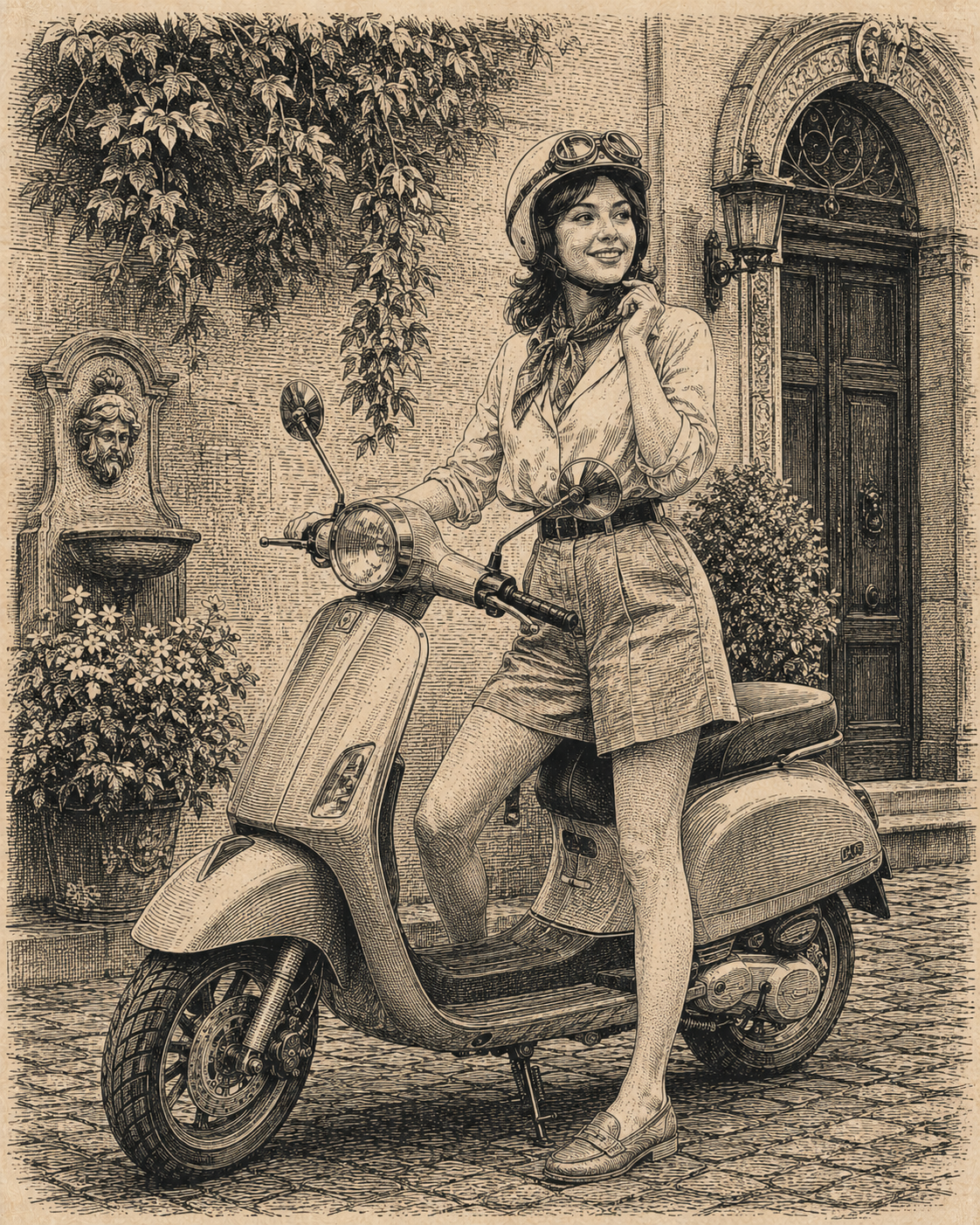
It does not announce itself as the future. It has no showroom theatre, no ministerial ribbon-cutting, no executive launch film set against a desert road. It appears instead beside railway stations, outside delivery kitchens, leaning against lampposts, chained to railings, abandoned on pavements, or moving quietly through traffic with a rider hunched against the wind.
For years, Europe imagined the electric transition as a car story. The petrol car would become the electric car. The driveway charger would replace the fuel pump. The family saloon would be reborn with a battery under the floor. Governments subsidised it. Carmakers advertised it. Brussels regulated for it.
That story made sense while oil was expensive but manageable. It becomes less convincing when crude starts behaving like a geopolitical weapon.
Brent crude has already been trading at about $109 a barrel. Some market scenarios now contemplate prices moving towards $160 a barrel if disruption around the Strait of Hormuz continues. More extreme projections have warned that oil could approach $200 if the crisis becomes prolonged enough to exhaust the market’s ability to reroute supply. Those are scenarios, not certainties. But they are enough to change the transport argument.
At $100 oil, the electric scooter is a convenience. At $160 oil, it becomes a household calculation. Near $200, it becomes something harder and more political: the vehicle of a squeezed society.
That is why this has become a story. Europe is not merely watching another Chinese clean-tech export arrive at its ports. It is facing the possibility that a prolonged energy shock will push many families towards a transport pattern already familiar in India, Indonesia and Malaysia, where two-wheelers are not marginal machines but everyday family transport.
Europe will not simply become Asia. Its roads, incomes, weather, laws and urban forms are different. But under fuel stress, behaviour changes. Families that once treated a second car as normal may begin to treat it as a luxury. The replacement may not be a Tesla, a Volkswagen ID model or a subsidised electric SUV. It may be a Chinese electric scooter, bought because the petrol car has become too expensive for the journey it is being asked to make.
The missing vehicle
Europe’s electric vehicle argument began with the car because Europe is a car continent.
The car is employment, tax revenue, industrial pride, export machinery and domestic politics. It is Wolfsburg, Stuttgart, Turin, Paris and Coventry. It is the motorway, the company fleet, the family holiday and the suburban commute. No serious European government could think about transport electrification without thinking first about the car industry.
But the car also narrowed the imagination.
A full-sized electric car is an expensive answer to many small journeys. It carries too much weight, too much battery and too much cost into the daily routines of urban life. It is a grand solution to a modest problem: one person travelling a short distance through a crowded city.
The electric two-wheeler begins from the opposite assumption. It does not try to preserve the car as the basic unit of movement. It asks what people actually need for the journey in front of them.
Often the answer is not a cleaner car. It is a cheaper way to move.
That is the industrial lesson China grasped earlier than Europe. The small electric vehicle does not require the consumer to buy into the mythology of the EV revolution. It does not need a household to spend tens of thousands of pounds or wait for a national charging network to become credible. It needs a battery, a motor, a charger, a narrow frame and a price low enough for the decision to feel practical rather than ideological.
In Chinese cities, the electric two-wheeler became ordinary. It entered the rhythm of work, shopping, school runs, delivery and short commuting. It did not need to win a culture war. It simply worked.
Europe now faces the same pressures by a different route. Fuel costs are rising. City roads are slower. Public transport is crowded and expensive. Car ownership is becoming harder to justify for some households, especially where the car is used for short urban trips that punish the driver with congestion, parking and insurance.
The gap between bicycle and car is no longer marginal. It is becoming one of the most important spaces in urban transport.
Yadea is the signal
Yadea matters because it turns the scooter from a street object into an industrial fact.
The company is one of China’s dominant electric two-wheeler manufacturers. Its scale is the point. China is not improvising this category. It has spent years building factories, suppliers, batteries, motors, controllers, dealer networks and service systems around vehicles that Europe still too often treats as clutter or novelty.
Yadea’s overseas push shows where the market is moving. The company says foreign demand is rising sharply and is targeting a large expansion in overseas sales. Its proposed Hungary factory is the more important development. That is the moment when export becomes settlement.
Hungary is not incidental. It is becoming one of the entry points for Chinese electric mobility into Europe. BYD has already chosen Hungary for European car production. Battery-related investment has flowed into the country. A Yadea plant would extend the same pattern down the vehicle hierarchy, from electric cars to electric scooters and mopeds.
The geography carries the strategy.
A scooter shipped from China is an import. A scooter assembled or produced in Hungary becomes something else. It is a local investment, a European job, a supplier relationship, a tax base and a political fact. It becomes harder to treat purely as a foreign object.
That is particularly important because Europe has already shown that it will use trade defences against Chinese electric two-wheelers. Chinese e-bikes have been subject to anti-dumping and countervailing duties. The lesson for manufacturers is clear. If the market becomes large enough, production must move nearer to the consumer and, where possible, inside the tariff wall.
Why the Hungary factory matters
Hungary is not just a convenient assembly site. A European factory would help Yadea shorten supply chains, serve EU consumers more directly and reduce exposure to tariff measures aimed at Chinese imports.
It also changes the politics. A Chinese scooter shipped from China is an import. A Chinese scooter assembled in Hungary becomes part of the European employment and investment story.
That is the strategic move: from exporter to embedded producer.
This is how industrial power migrates. It begins with exports. It moves into assembly. It builds local distribution. It creates service networks. It recruits dealers. It embeds itself in the economy that first imagined it was merely buying a product.
Yadea’s Hungary plan should therefore be read as a warning. Europe is not only about to receive cheap Chinese electric two-wheelers. It may receive the production system behind them.
London has already rehearsed the shift
London has already shown what happens when small electric mobility arrives before the city is ready for it.
The rental e-bike is now part of the street scene. It appears outside Tube stations, on corners, outside office blocks and across residential pavements. It is useful, irritating, convenient and disorderly. It offers freedom to one person and obstruction to another.
That contradiction is not accidental. It is the first stage of adoption.
The street absorbs the machine before the law, the kerb, the pavement and the borough plan catch up. Councils then have to invent rules around something already in use. Parking bays appear. Codes of conduct follow. Operators are warned, fined or licensed. Badly parked bikes are removed. Residents complain. Riders continue.
That is not failure in the simple sense. It is evidence of demand.
Londoners use rental e-bikes because they solve real journeys. They cover the awkward distance between public transport and destination. They shorten the trip that would otherwise require a bus. They make the late or broken connection survivable. They turn a thirty-minute walk into a ten-minute ride.
The same logic will pull people towards electric scooters and mopeds if the price and legal structure allow it. The appetite has already been trained. The city has learned the convenience of small electric movement. What it has not yet done is build a settled framework for ownership, safety, parking and enforcement.
The scooter will intensify that unresolved problem.
An e-bike still belongs, however awkwardly, to the bicycle tradition. A seated electric scooter or moped belongs closer to powered road transport. It raises sharper questions about speed, insurance, licensing, helmets, road space, charging and battery safety. It is more useful than a rental bike for some journeys, but also harder to absorb casually into the street.
That is why London is a rehearsal for Europe. The city shows the demand. It also shows the disorder that follows when the machine arrives before the regime.
Britain’s confused electric street
Britain is not dealing with one vehicle.
A pedal-assist e-bike can be legal if it meets the rules. A rental e-scooter can be lawful inside an authorised trial scheme. A privately owned kick e-scooter remains illegal on public roads, pavements and cycle lanes. A seated electric moped or scooter may be lawful if it is properly approved, registered, insured and ridden by someone with the right licence and helmet.
The public sees battery-powered two-wheelers. The law sees separate categories. That gap is where confusion, weak enforcement and grey-market behaviour grow.
The law is behind the street
The British position on private e-scooters is formally strict and practically unstable.
Privately owned e-scooters are not legal for ordinary public road use. Yet they are visible in cities. The result is a legal fiction familiar to anyone who watches urban transport closely: the rule says one thing, the pavement says another.
That is not a sustainable position.
When demand exists but the law refuses to organise it, the market does not disappear. It becomes untidy. People buy machines online. Riders misunderstand the rules or ignore them. Police enforcement becomes selective. Councils complain about obstruction. Insurers hesitate. Unsafe products enter through weak channels. The state eventually confronts a worse version of the market than the one it could have shaped earlier.
Europe has made this mistake before. It often writes rules after behaviour has already hardened.
The issue is not whether every electric scooter should be welcomed onto every road. That would be foolish. Speed, weight, braking, lighting, rider competence, insurance and road design all matter. The issue is whether governments can create a lawful category that matches the journey people are already trying to make.
If they cannot, the category will be shaped by manufacturers, platforms, importers and consumers instead.
For Chinese companies, that uncertainty is both obstacle and opportunity. It slows formal adoption but increases the pressure for affordable, recognisable, compliant products once the rules settle. A firm with scale, supply chains and local European production will be ready when that moment comes.
That is why the production story matters more than the street clutter. The clutter is visible. The factory is decisive.
The danger is real
The case for small electric transport should not be confused with enthusiasm for an uncontrolled market.
The battery risk is real. So is the problem of chargers, cells, illegal conversions, damaged packs and cheap imports with weak traceability. A safe electric scooter is an engineered vehicle. A bad one is a lithium-ion battery on wheels, charged overnight in a hallway.
Fire brigades have warned repeatedly about e-bike and e-scooter fires. These incidents are not merely inconvenient. Lithium-ion battery fires can spread quickly, burn intensely and produce toxic smoke. They are especially dangerous in flats, stairwells and shared buildings where escape routes matter.
The danger is not the electric two-wheeler itself. The danger is the disorderly version of the market.
The battery problem
The weakest point in the cheap electric two-wheeler market is not the idea of the vehicle. It is the quality chain.
Risk rises when batteries are poorly made, damaged, modified, overcharged or paired with the wrong charger. Illegal conversions are especially dangerous because they may combine motors, controllers, batteries and chargers never designed to work together.
A serious market needs traceable batteries, approved chargers, repair standards, import checks and enforcement against unsafe products. Without that, the cheapest vehicle becomes the most dangerous one.
This is where Europe must be cold-eyed. A ban on reality will not work. A flood of unsafe products would be worse. The answer is not panic. It is standards.
Type approval matters. Charger standards matter. Battery labelling matters. Repairability matters. Insurance clarity matters. Parking control matters. Enforcement against illegal conversions matters. So does the distinction between a toy, a bicycle, a moped and a road vehicle.
Handled properly, the electric two-wheeler could become a useful part of the European transport system. Handled badly, it becomes a fire risk, a pavement war and a public-order nuisance.
That is the line policymakers have to hold.
The real choice
Europe’s choice is not between scooters and no scooters.
That choice has already been overtaken by fuel prices, congestion, household pressure and the daily inconvenience of city life. People will keep looking for cheaper movement. The only question is whether the market that answers them will be regulated, safe and partly European, or whether it will arrive through a disorderly chain of imports, apps, grey-market sellers and late official reactions.
Yadea’s Hungary plan sits at the centre of that question.
If Europe develops the category intelligently, Chinese production inside Europe could be made to serve European rules. Vehicles could be built to local standards. Batteries could be traceable. Dealers could be responsible. Repairs could be regulated. Consumers could get cheaper mobility without turning tower blocks into charging hazards.
If Europe drifts, the result will be uglier. Cheap machines will arrive faster than the law. Unsafe products will damage the reputation of safe ones. Pavements will carry the political cost. Domestic producers will complain after scale has already been lost. Regulators will discover, once again, that the market moved while they were still defining the category.
The electric scooter is not a gadget story. It is a systems story.
It touches energy security because it reduces dependence on petrol for short journeys. It touches industrial policy because China has built the production base. It touches urban planning because streets and pavements must absorb the machine. It touches housing safety because batteries are charged indoors. It touches trade because factories follow tariffs. It touches sovereignty because dependence rarely arrives wearing the clothes of dependence. Sometimes it arrives as a cheap solution to an immediate problem.
Europe spent years imagining the electric future through the windscreen of a car. China looked at the same future and built the vehicle for the shorter, poorer, more crowded journey.
The car was the prestige front of electrification. The scooter may become its mass front.
Europe thought the EV transition meant replacing the car. China understood something harsher and more practical. In a crisis, many people do not need a cleaner car.
They need a cheaper way to move.