Listen to a Summary of This Article
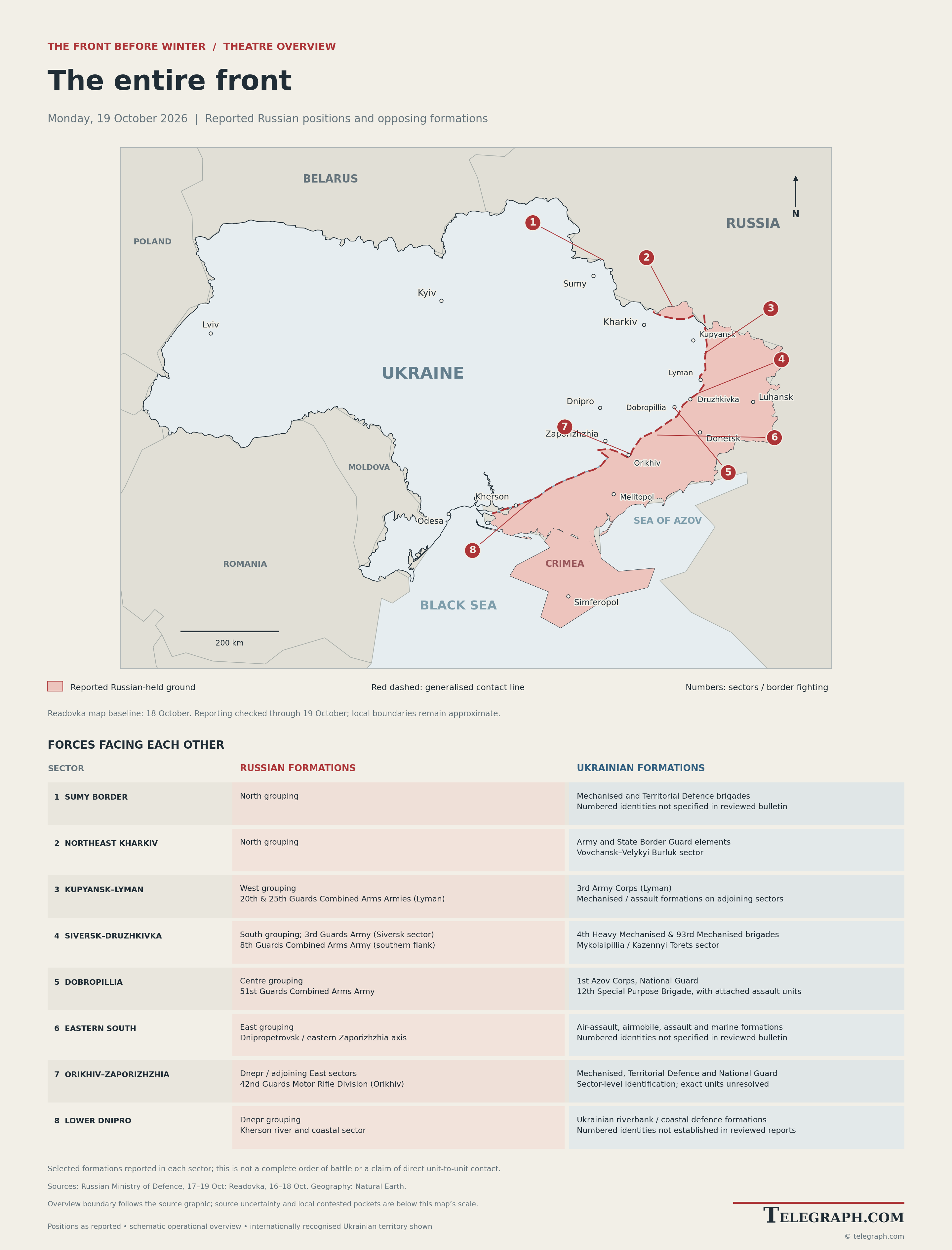
Russian accounts describe a campaign to isolate towns, threaten supply routes and force Ukrainian reserves between competing emergencies. The autumn fighting will shape the positions both armies carry into winter.
In the fog around Dobropillia, a road can be impassable to military traffic in daylight and usable again before dawn. Russian accounts describe drones watching the approaches when visibility permits, while Ukrainian troops exploit mist to move through gaps that cannot be sealed continuously from the air.
The battle is entering the interval between autumn’s rasputitsa and the deeper cold traditionally personified as General Winter. The rasputitsa is the season when persistent rain saturates the ground, turning fields and unpaved tracks into deep, clinging mud that can bog down vehicles venturing off surfaced roads. Supply trucks, troop carriers and ambulances become more dependent on firm routes, concentrating movement where drones can watch and artillery can strike. Sustained frost can harden the ground again. Neither arrives everywhere at once, and neither guarantees a pause in the fighting.
Along the southern and eastern fronts, Russia is trying to improve the position from which it will fight through that transition. Its reported advances threaten several Ukrainian defensive systems at once: the approaches to Zaporizhzhia, the southern flank of the Sloviansk–Kramatorsk belt and the remaining positions in northeastern Kharkiv.
Dobropillia: the battle for the approaches
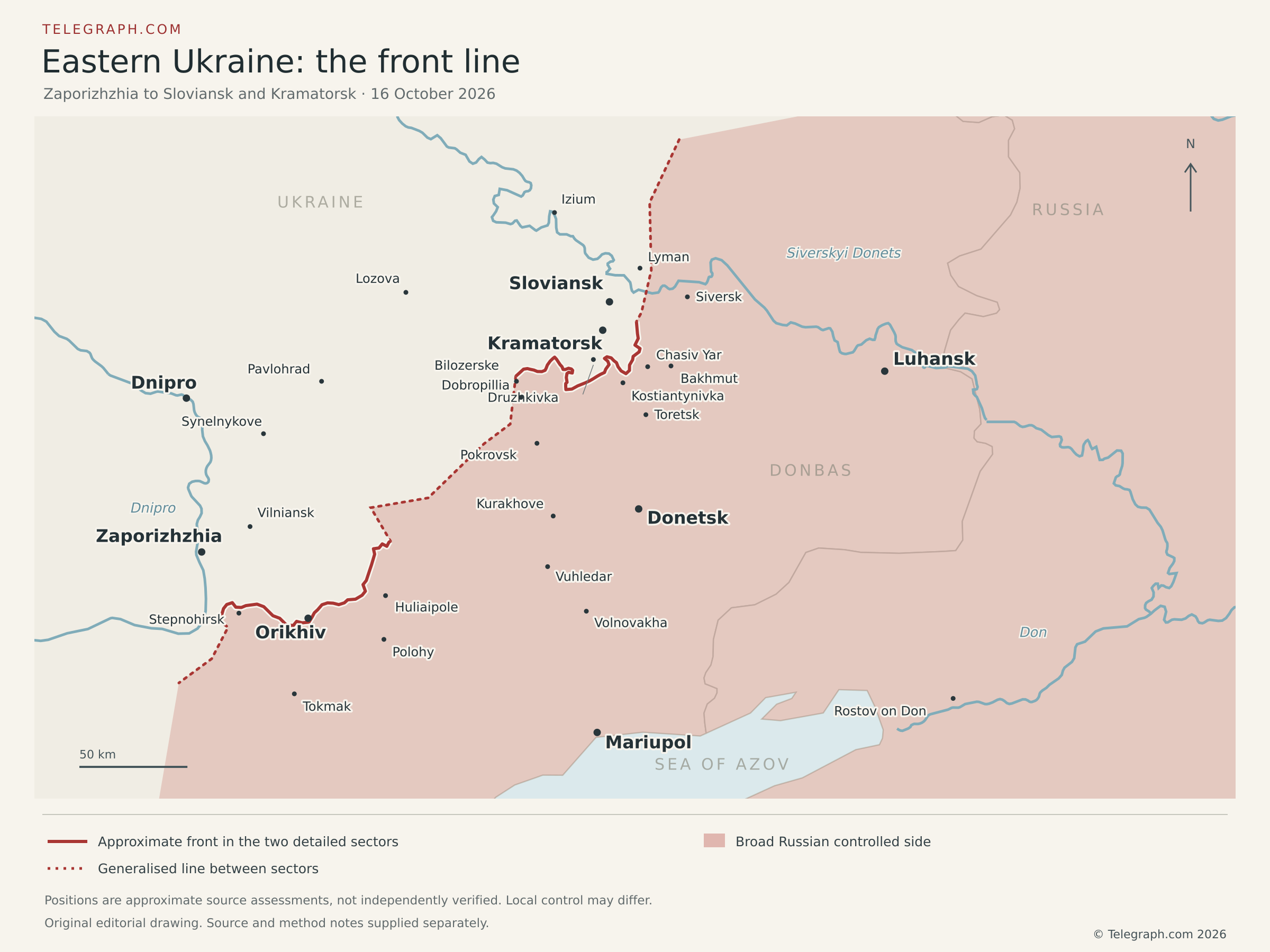
The Russian Ministry of Defence announced Dobropillia captured on 17 October. Russian battlefield accounts describe a campaign in which persistent drone coverage restricted vehicles entering the town, while assault troops advanced behind attacks on Ukrainian positions and drone operators.
One account, drawing on a Russian officer’s description, explains how neighbouring units maintained overlapping aerial coverage. Operators followed the infantry forward and searched for opposing crews through antennas and the movements of their aircraft. The objective was to interrupt the defenders’ supply and reinforcement before completing the ground assault.
The latest reporting nevertheless describes Ukrainian troops remaining in northern districts, despite the ministry’s announcement. Autumn fog helps explain why possession and isolation can be uneven: a route exposed to observation in clear weather may become usable when visibility falls.
Outside the town, fighting around Hannivka, Novovodiane and Zolotyi Kolodiaz concerns attempts to restore access and cut into the Russian advance. Bilozerske is the next immediate pressure point. Russian accounts describe troops on its southern outskirts and movement around its flanks. Ukraine must reinforce that defence while managing the fighting farther south.
Reporting · Latest ground account · Weekly assessment
Druzhkivka: pressure on the southern flank
East of Dobropillia, the Russian Ministry of Defence reports Oleksiievo-Druzhkivka captured. It is a separate settlement from Druzhkivka itself, whose approaches remain a major focus of the fighting.
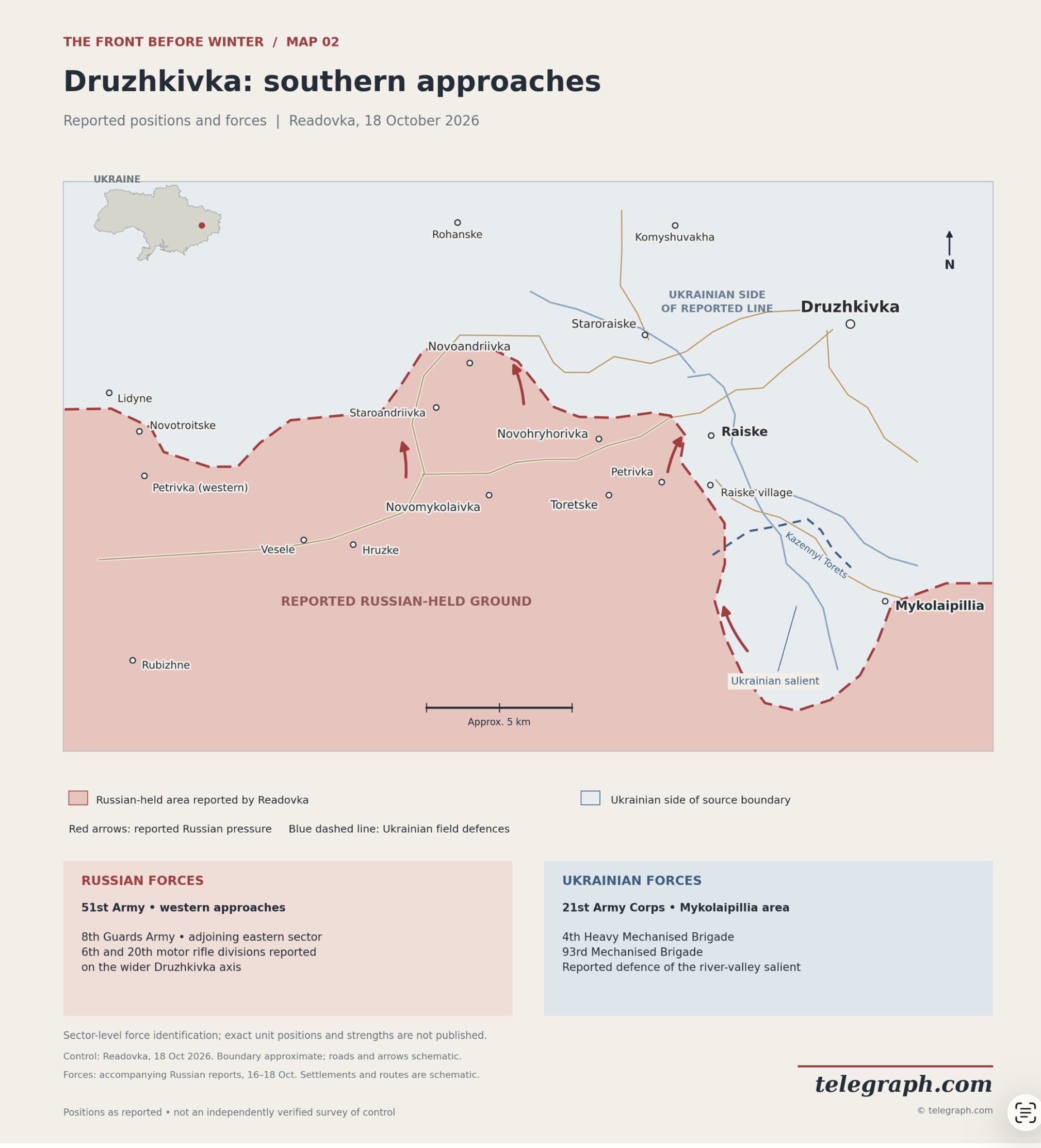
Russian dispatches place offensive action around Raiske and report expanded control near Kurtivka, north of Oleksiievo-Druzhkivka. Other accounts describe attacks designed to threaten Druzhkivka from the south-west, alongside Ukrainian efforts to cut back the projecting Russian positions.
The military purpose is to put the southern approaches to the Sloviansk–Kramatorsk defensive belt under pressure from more than one direction. A defence organised around towns becomes harder to sustain when the roads between them are threatened.
Russian commentary links the sectors by arguing that pressure around Dobropillia drew Ukrainian reinforcements away from the Kramatorsk–Druzhkivka area. The available reports do not establish the scale of those transfers. They describe the intended effect of simultaneous attacks: make the defence of one position compete with the survival of another.
Frontline dispatch · Morning update · Operational account
Zaporizhzhia: across the Konka, around Orikhiv
The Russian Ministry of Defence also announces the capture of Malokaterynivka, near the mouth of the Konka. Russian accounts describe airborne troops crossing the river after mobile fighting south and west of it, then advancing northwards.
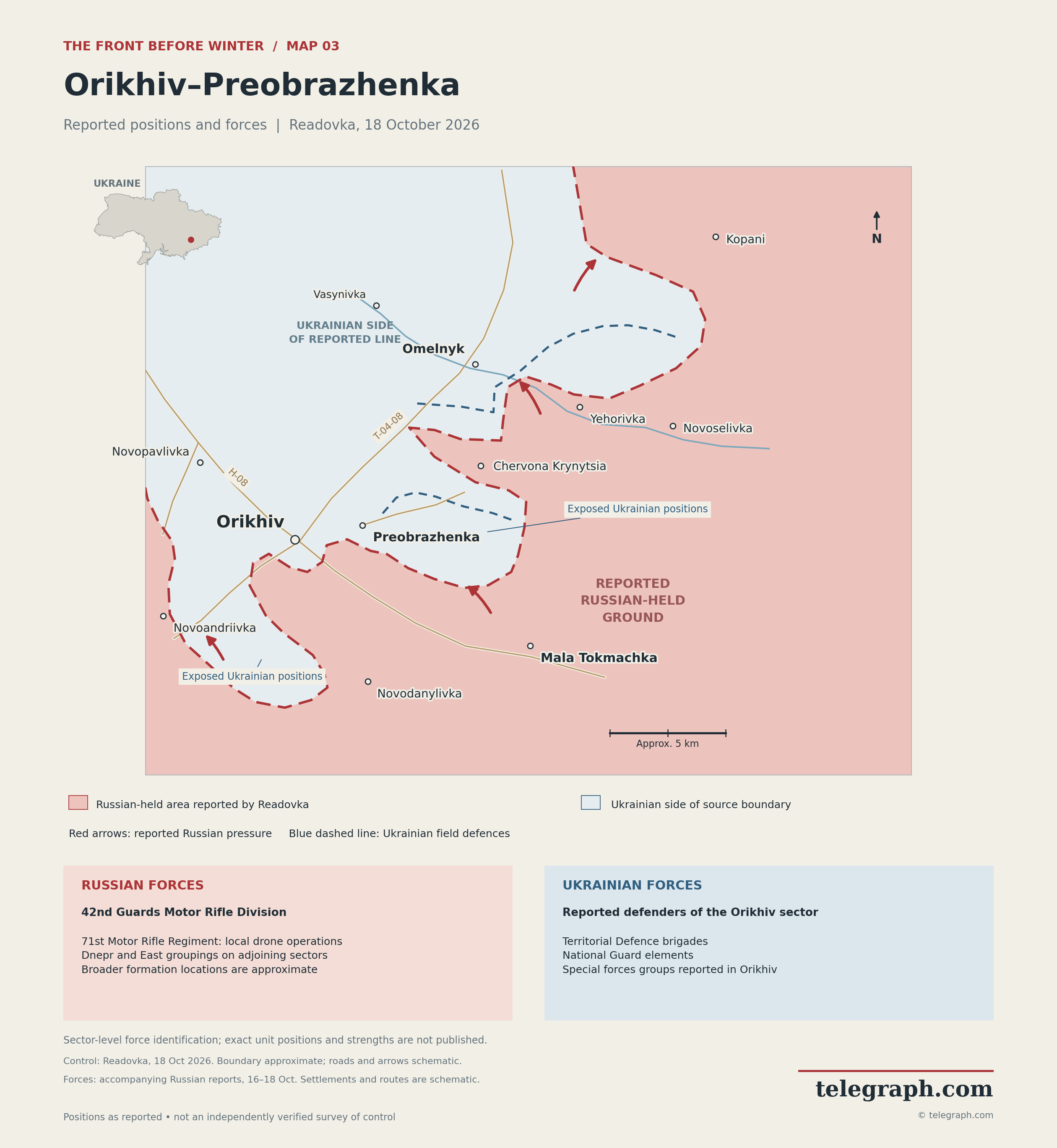
This is the western part of a broader southern campaign. Farther inland, Orikhiv remains contested. Russian reports describe Ukrainian troops holding northern districts and much of Preobrazhenka while positions remain exposed between Novodanylivka and Novoandriivka, and between Mala Tokmachka and Chervona Krynytsia.
The danger is that troops delaying the Russian advance could lose their opportunity to withdraw intact. An early withdrawal gives up fortified ground; a late one risks movement along routes already watched by drones and covered by artillery.
Omelnyk, north-east of Orikhiv, figures prominently in Russian assessments because further advances there could tighten pressure on the remaining defence. These accounts still describe fighting for the settlement, rather than a completed encirclement.
There have also been Ukrainian recoveries. Russian reporting on 18 October describes Ukrainian troops regaining positions near the T-04-08 between Orikhiv and Mala Tokmachka, complicating Russian access to the town. Holding Preobrazhenka allows Ukraine to strike lower ground to the south. Russian assault groups must therefore secure their own approaches while trying to disrupt those of the defenders.
Russian Ministry of Defence bulletin · Operational reporting · Orikhiv assessment · Latest sector report
Lyman: the counterattack that changed the northern battle
Around Lyman, the picture is different. Russian reporting acknowledges that Ukraine’s 3rd Army Corps pushed Russian forces back from Lyman and Sviatohirsk during Operation Vivaldi. It argues that the operation did not achieve its wider objectives, but the recovered ground complicates Russian efforts to threaten the defensive belt from the north.
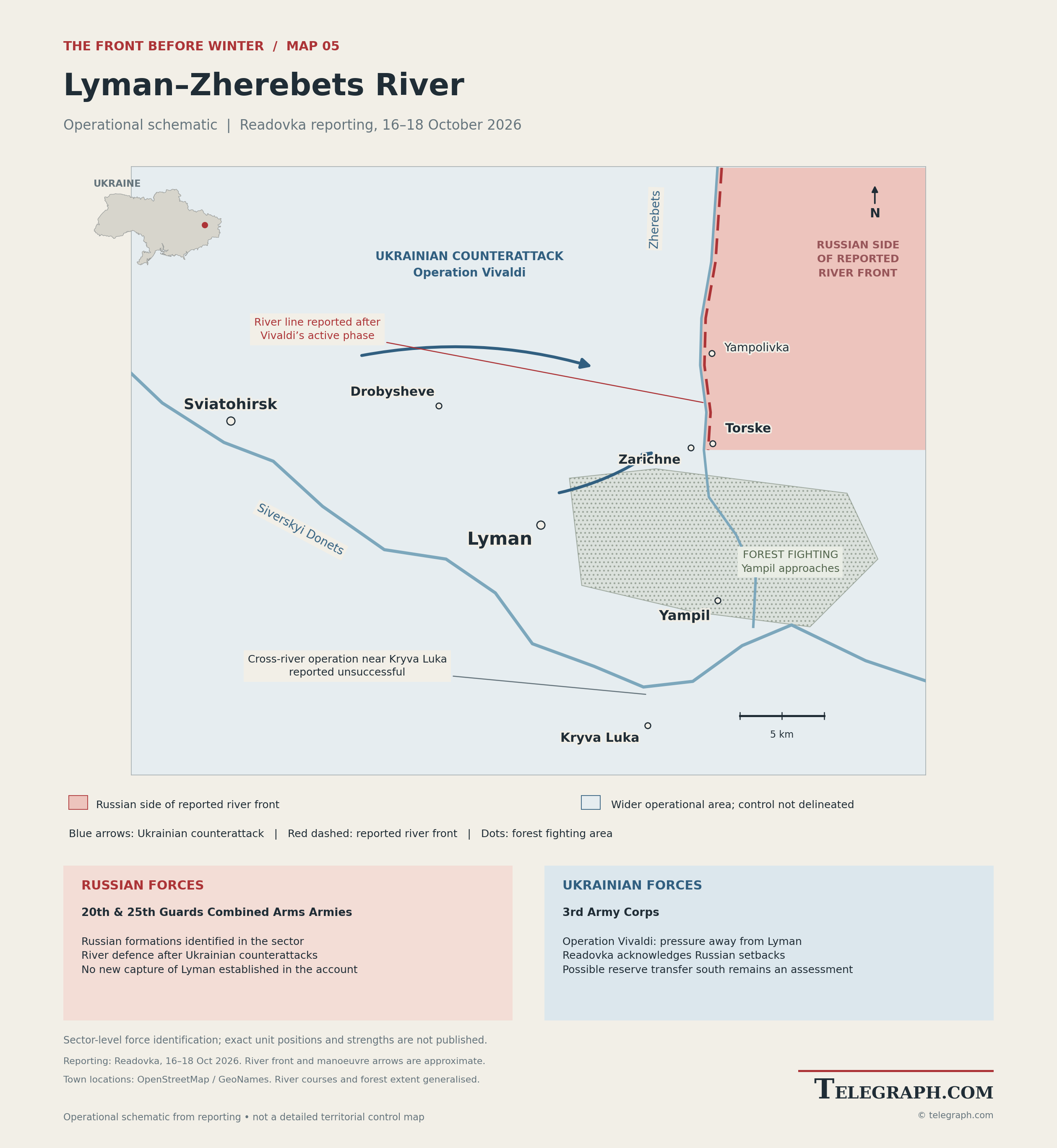
The reported fighting now centres on the Zherebets River, the approaches to Zarichne and the forests around Yampil. The accounts reviewed do not establish a new Russian capture of Lyman.
The National Guard’s 1st Azov Corps is engaged farther south around the Dobropillia sector. Russian assessments raise the possibility that the end of Vivaldi’s active phase could allow elements of the 3rd Army Corps to reinforce it. Such a move would connect the northern and southern battles through Ukraine’s allocation of reserves, although the transfer remains an assessment rather than an established deployment.
For the winter campaign, the significance is immediate. Reducing the northern threat gives Ukraine greater freedom to resist pressure elsewhere. Russia must either restore that threat or gain enough ground in the south to offset the setback.
Sector reporting · Assessment of reserves
Northeastern Kharkiv: forces for the next objective
In northeastern Kharkiv, the Russian Ministry of Defence reports that an encircled Ukrainian force has been eliminated, while searches for scattered groups continue.
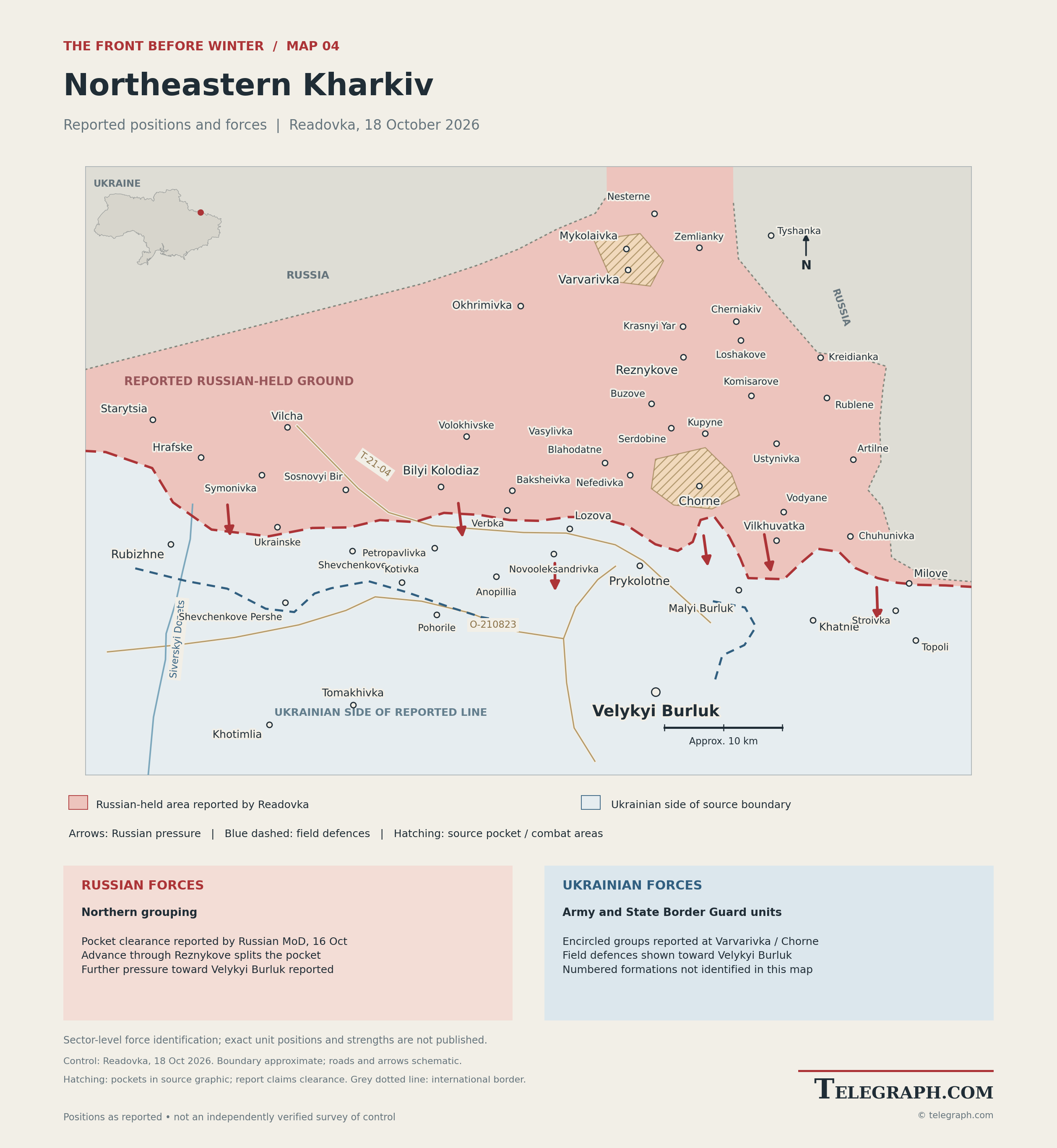
Russian accounts describe the capture of Reznykove splitting the remaining pocket into areas around Varvarivka and Chorne. The method was to wear down the isolated defence, separate its positions and clear the remaining pockets in succession.
The prospective next objective identified in those accounts is Velykyi Burluk. Completing one operation could release troops for another, but the reports do not announce the town captured or establish the strength available for a new assault.
Russian Ministry of Defence bulletin · Sector assessment
The positions that winter will inherit
The seasonal change puts a premium on usable roads, sheltered positions and supply routes that can survive interruption. Fog may conceal a reinforcement column, but it can also conceal the assault group approaching a defensive position. Mud can obstruct an advance while making a threatened withdrawal equally difficult.
Russia’s reported campaign seeks to turn local gains into a wider loss of Ukrainian freedom of movement. Ukrainian counterattacks around Lyman and Orikhiv show that this sequence can still be disrupted.
The decisive result before General Winter will be measured in more than settlement names. It will be visible in which army holds the road junctions, can rotate exhausted troops and can keep supplies moving when the weather closes in.