Listen to a Summary of This Article
Russia and Ukraine are combining cheap surveillance, precision weapons and industrial production on a scale that is changing the battlefield. The advantage increasingly belongs to the side that can learn, manufacture and replace its losses fastest while keeping the machinery behind its army alive.
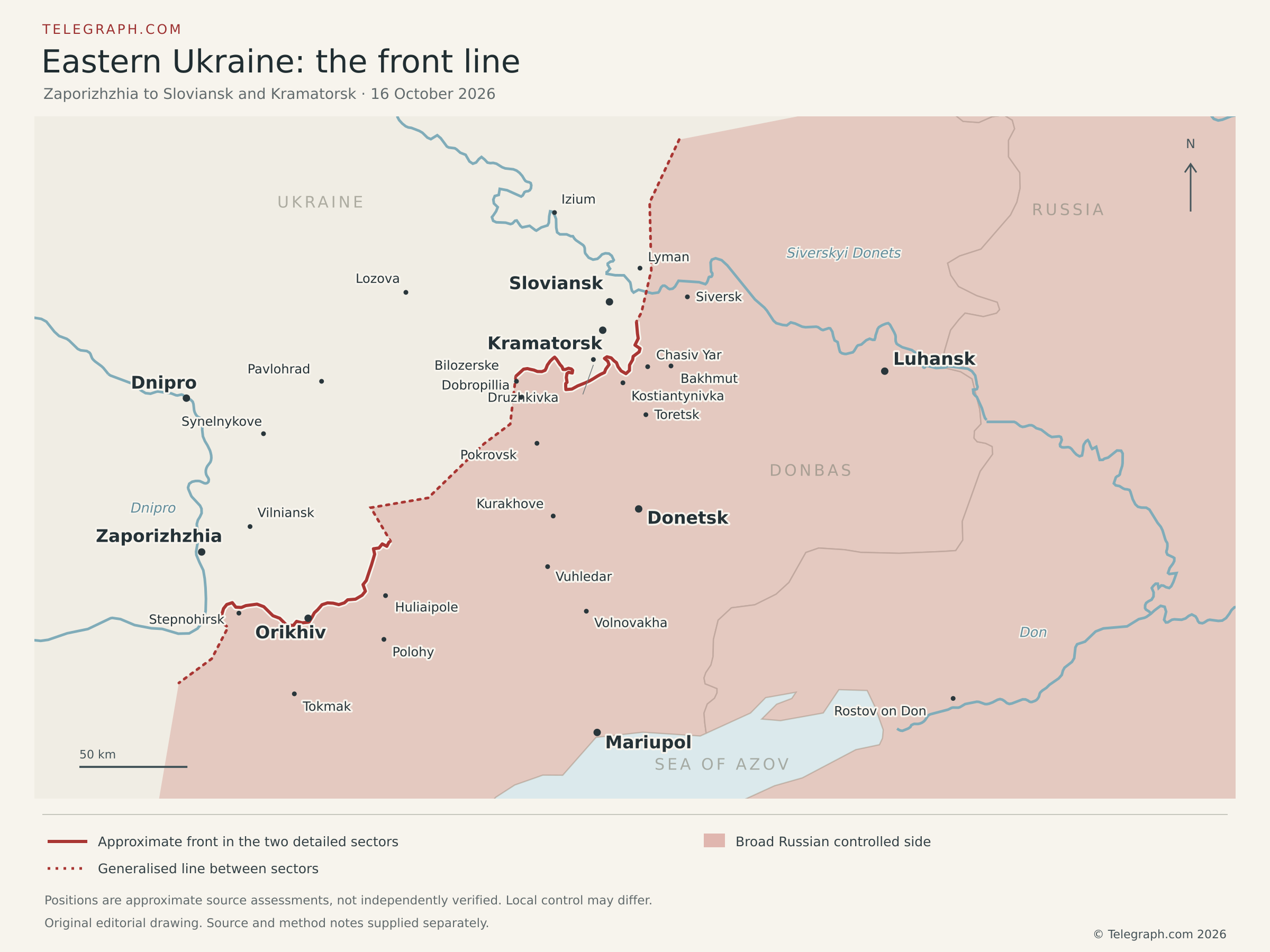
Russian forces are pressing towards Druzhkivka and extending their positions around the southern approaches to Ukraine’s Sloviansk and Kramatorsk defensive belt. Telegraph Online’s assessment of the fighting on 16 October, drawing on Russian battlefield reporting, identifies tactical gains south of Raiske. We also describe advances through Petrivka and Novotroitske towards Vesela Hora, alongside continued pressure around Bilozerske.
The immediate picture is one of local advances and Ukrainian counterattacks. We question the Russian high command’s much larger claims of reaching Kramatorsk’s outskirts and advancing to within five kilometres of Zaporizhzhia: the reports reviewed do not substantiate those claims. Ukrainian counterattacks in the south also complicate the picture of an uninterrupted Russian advance.
These battles concern the ground around the towns as much as the buildings inside them. Each advance can bring another approach road, supply route or supporting position within closer reach. The operational question is whether Russia can make Ukrainian positions progressively harder to sustain while protecting its own troops against the same surveillance and precision weapons.
Behind that contest lies the wider transformation of the war. Roads, drone operators, artillery positions and communications links help determine whether a defensive line survives. Farther back in UKRINE electricity, fuel, factories and foreign financing determine whether the army can replace what it loses.
The conflict is bringing precision technology into industrial attrition. Its distinctive features are the persistence of observation, the spread of accurate weapons to smaller units and the speed at which equipment changes in response to battlefield failure.
Russia has joined the innovation race
Eric Schmidt, Google’s former chief executive and now a participant in Ukraine’s drone industry, described the change bluntly in an interview with The Economist in Kyiv.
“It’s always been presumed that Ukraine was the innovator, and Russia was big and slow,” he said. “And something changed.”
His assessment was that Russian improvement had reached a pace comparable to Ukraine’s, backed by greater resources. Schmidt is an interested participant: in July 2025, he signed a production agreement with Ukraine as chief executive of the American drone company Swift Beat.
Beyond a faster Shahed
Jet propulsion complicates interception, but navigation and communications may prove equally consequential.
On 5 October, Ukrainian military intelligence reported a modified Geran 4 carrying optical navigation that compares observed images with reference imagery stored onboard. It also identified improvements to inertial navigation and a Russian engine replacing the previously documented Chinese turbojet. Related optical navigation, it said, appeared in the Geran 5 K5.
These changes point towards aircraft with several means of navigating through electronic interference. Disrupting satellite positioning becomes less decisive when other systems can maintain the route.
Ukraine’s intelligence catalogue separately identifies a mesh modem in the Geran 5. Such equipment can support communications relayed through other aircraft, allowing information and operator direction to reach drones after launch.
Russian military channels describe an expanding network of sensors, relays and weapons. Rybar also acknowledges that Ukrainian interceptor drones have caught jet powered Geran 3s. The advantage depends on how quickly each side’s answer reaches combat units in sufficient numbers.
How Ukraine fights back
Ukraine has combined mass production with efforts to shorten the distance between soldiers, designers and buyers.
Its defence ministry reported supplying more than one million first person view drones between January and July 2025, against contracts for more than two million that year. A new marketplace allowed participating brigades to choose equipment suited to their requirements. These official delivery figures describe an industrial effort far beyond isolated workshops.
Among more effective Ukrainian formations, reconnaissance and attacks on supporting systems are combined with electronic warfare, artillery and protected infantry movement. This is unevenly developed across the army.
Ukraine’s reliance on drones also reflects shortages of soldiers and other weapons. Innovation can reduce the consequences of scarcity without removing the underlying constraint.
The cost of staying in the fight
The deeper danger for Ukraine is depletion. A high interception rate can consume scarce missiles, disperse crews and leave other places exposed. The comparison that matters is what each side can keep deploying and replacing.
Schmidt identifies shortages of Patriot interceptors as a particular Ukrainian vulnerability. His wider argument is that missiles, more capable drones, glide bombs and Russia’s resource advantage can together overwhelm an opponent able to answer any one of them separately.
The Ukrine rear is becoming harder to protect
A damaged railway delays military and commercial freight. Electricity serves weapons production, hospitals and water systems. Repair crews need supplies and protection while further attacks remain possible.
The international network behind these weapons adds political risk. Russia can interpret foreign finance, components, communications and intelligence as participation in the conflict. That interpretation does not establish the legality of retaliation, but it influences escalation.
Western money, weapons and intelligence have enabled Ukraine to sustain the fighting without overcoming Russia’s material advantages. Ukraine bears the cost in dead and wounded soldiers, displaced families and devastated infrastructure. Western governments have helped prolong the war without establishing a credible route to victory or securing a negotiated settlement. On the present trajectory, it is Russia that will bring it to an end by military means.