Indicators of Intent: How Converging U.S. Military Posture Around Iran Has Changed the Strategic Equation
by Jaffa Levy
·
Published
· Updated
The United States has constructed much of the operational architecture required for sustained air operations against Iran.
This does not mean a strike has been ordered. It means the machinery required for one is increasingly in place. Since mid January, refuelling aircraft have accumulated at forward bases, heavy lift flights have increased measurably, advanced fighters and airborne command aircraft have staged closer to theatre, Patriot missile systems have shifted to mobile posture, and at least one carrier is already operating within strike relevant waters. When these layers align in sequence, the strategic question changes. It becomes less about capability and more about political choice.
Military intent is rarely announced in words. It is inferred from posture, sequencing and logistics. The United States has not declared an intention to strike Iran. What it has done is assemble the enabling layers that make sustained air operations technically feasible.
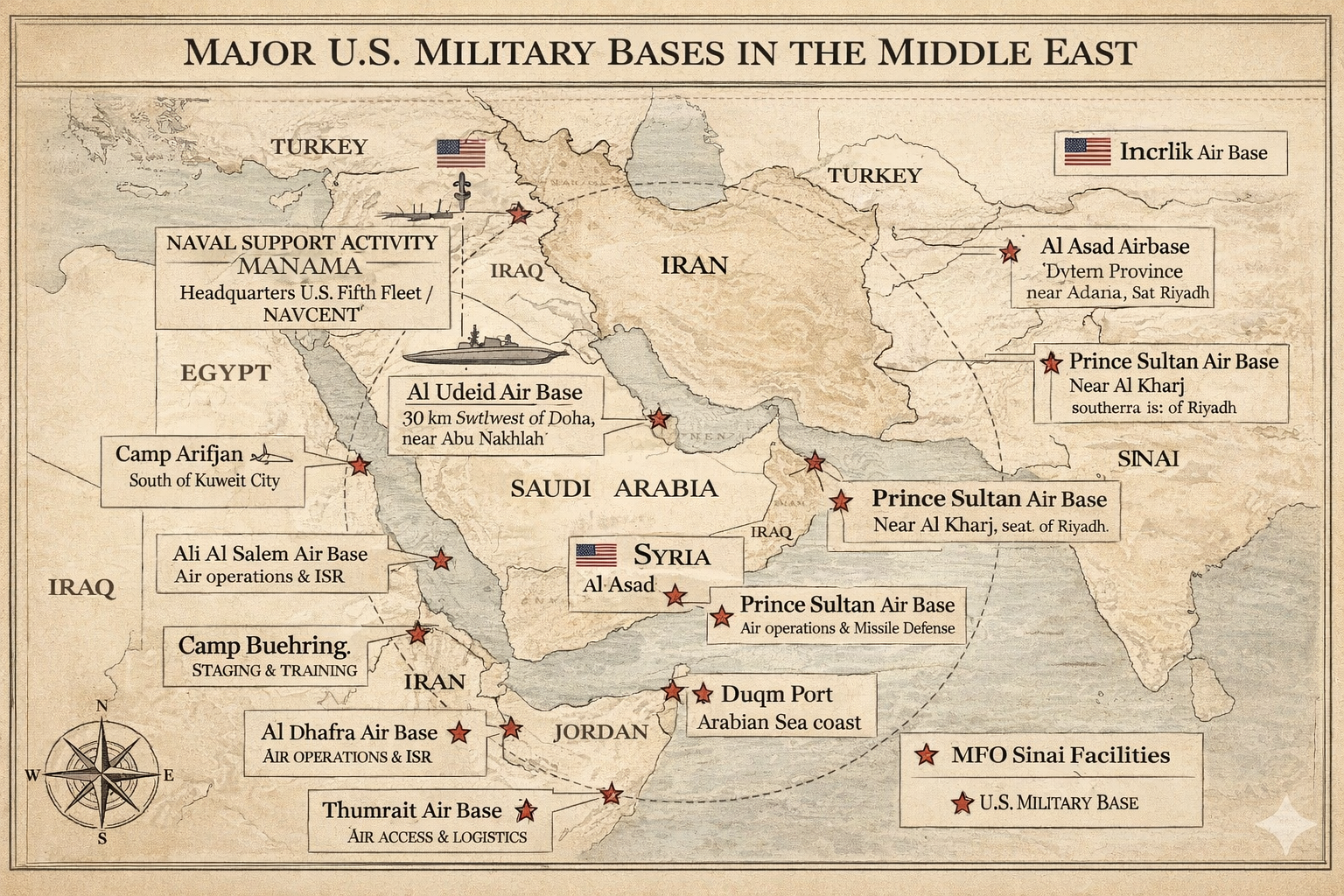
Major U.S. bases and operating locations that support strike options against Iran. Air bases inside the region can generate sorties directly; aircraft staged further out generally require aerial refuelling to reach Iranian targets and to sustain tempo. That is why tanker movements matter: they are the fuel bridge that turns deployments into endurance. The same logic applies to carrier aviation, including USS Abraham Lincoln (CVN-72) operating in the Red Sea region and USS Gerald R. Ford (CVN-78) moving toward theatre, as well as to Israeli long range strike profiles and any bomber operations from Diego Garcia, all of which depend heavily on tanker support for range, loiter time, and repeat attacks.
Over the past six weeks, observable US military posture across Europe and the Middle East has tightened across four operational domains: aerial refuelling capacity, strike package assembly, sustainment throughput and defensive hardening, and carrier strike geometry. Each layer is defensible as contingency planning. The significance lies in their convergence and timing.
Aerial refuelling: operational mathematics
Air campaigns are governed by mathematics. A combat aircraft’s range without refuelling determines how long it can remain over target, how far it can penetrate defended airspace, and how many sorties it can generate in a given period. Tankers therefore determine persistence. Without a forward based refuelling layer, even advanced strike aircraft are constrained by fuel and time. With it, the scale and tempo of operations change fundamentally.
Between late January and early February, at least 39 US aerial refuelling aircraft were recorded repositioning eastward within a three day window. An additional 29 C 17 heavy lift aircraft entered Europe during the same period. More significant than the surge itself was the accumulation that followed.
Satellite imagery comparing January 17 with February 1 showed KC 135 tankers at Al Udeid Air Base increasing from approximately two visible aircraft to seven. That shift is not symbolic. It alters sortie mathematics. A forward based tanker can extend a fighter’s range by hundreds of nautical miles and allow repeated waves rather than single passes. It allows strike aircraft to loiter, retask and return.
Additional transit activity through RAF Mildenhall and Ramstein indicates the construction of a transatlantic air bridge rather than isolated redeployment. Tankers moved, arrived, and remained. That persistence is the early indicator of intent.
Refuelling and lift timeline
Jan 17: approx 2 KC 135 aircraft visible at Al Udeid
Feb 1: approx 7 KC 135 aircraft visible at Al Udeid
39 tanker aircraft repositioned eastward within 72 hours
29 C 17 heavy lift flights recorded into Europe
Transit bridge via RAF Mildenhall and Ramstein
Without tankers, sustained operations collapse into short duration strikes. With them in theatre, tempo becomes scalable. That distinction matters.
Strike package assembly: layered capability
Air superiority, airborne command and strike assets must function together. Open source aviation reporting documented F 22 aircraft arriving at RAF Lakenheath in late January. The F 22 is deployed when planners anticipate contested airspace. Its presence is not routine when tensions are low.
Simultaneously, a substantial portion of the remaining US E 3 AWACS fleet was deployed forward. AWACS aircraft coordinate airspace, assign targets and manage dynamic operations. Their presence signals preparation for sustained, multi aircraft activity. These aircraft are not required for symbolic demonstrations. They are required for complex campaigns.
Six C 17 flights from Fort Hood, home to the 69th Air Defence Artillery Brigade, were recorded entering Europe in the same window. At least one continued onward to Jordan. The 69th operates Patriot and THAAD systems, linking air operations to missile defence reinforcement. This connects the offensive air layer to a defensive ground layer.
Strike layer components observed
F 22 aircraft staged at RAF Lakenheath
Expanded E 3 AWACS deployment
C 17 flights from Fort Hood linked to 69th ADA Brigade
Patriot and THAAD systems associated with movement
When air superiority fighters, battle management aircraft and missile defence reinforcement move in parallel, the structure resembles campaign preparation rather than symbolic signalling.
Sustainment and interceptor depletion logic
Campaigns endure only if logistics sustain them. Between January 17 and February 1, C 17 transport aircraft at Al Udeid increased from roughly two to seven visible aircraft. That represents elevated throughput. Heavy lift aircraft transport maintenance equipment, spare parts, personnel and potentially munitions. Throughput is the quiet indicator of seriousness.
Public imagery has not confirmed expanded munitions stockpiles. That absence must be stated clearly. However, throughput increases coincide with defensive posture changes.
Satellite imagery shows Patriot systems repositioned onto mobile launchers between January 17 and February 1. Mobile posture indicates anticipation of retaliation and a desire to preserve base survivability under missile threat. Offensive capability and defensive hardening rising together is a pattern seen before major operations.
Missile defence interceptor inventories are finite. High end interceptors such as THAAD are expensive and limited in number. If inventories have been drawn down in prior engagements, elevated readiness becomes costly to maintain. This introduces compression pressure. Once posture is raised, leaders face a narrowing window between signalling and decision.
Carrier strike geometry
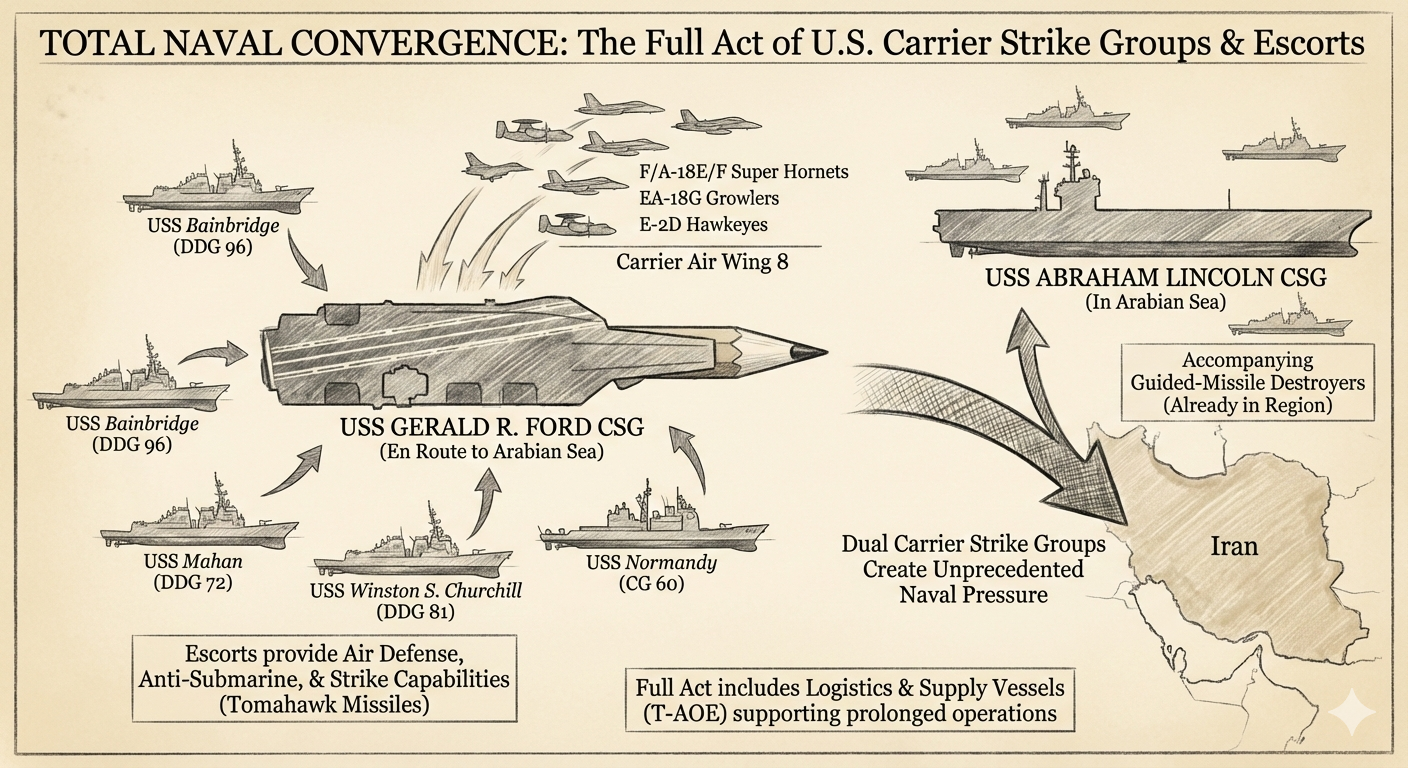
USS Abraham Lincoln is operating in the Arabian Sea. From this position, its air wing falls within plausible strike radius of Iranian targets when supported by forward tankers. Geography converts presence into capability.
USS Gerald R Ford has transited Gibraltar and is operating in the Mediterranean. Should it enter the Arabian Sea, redundancy and sortie density would increase materially. Two carriers within strike relevant waters significantly expand operational flexibility.
Approximately a dozen US naval vessels are reported in the broader region, including destroyers capable of launching Tomahawk cruise missiles with ranges approaching 900 nautical miles. Cruise missile capability extends strike options beyond carrier aviation and allows operations from significant standoff distance.
Total Naval Convergence: Dual U.S. carrier strike groups — USS Gerald R. Ford (CVN-78) en route to join USS Abraham Lincoln (CVN-72) in the Arabian Sea, with escorts providing air defence, anti-submarine and strike capabilities.
Naval positioning snapshot
USS Abraham Lincoln in Arabian Sea
USS Gerald R Ford in Mediterranean
Approx 12 US naval vessels in region
Destroyers equipped with Tomahawk missiles approx 900 nm range
Layered convergence
Refuelling capacity increased. Heavy lift throughput rose. Missile defence shifted to mobile posture. Air superiority fighters staged forward. AWACS deployments expanded. Carrier geometry tightened.
Individually, these movements are defensible. Together, within a compressed January 17 to February 1 window, they indicate layered preparation. Convergence reduces execution latency. It transforms theoretical capability into practical readiness.
Miscalculation risk
Visible military architecture alters perception. Iran may interpret the same posture as imminent preparation rather than deterrent signalling. When timelines compress, the margin for misreading shrinks. Incidents at sea, airspace encounters, proxy actions or missile launches could escalate more rapidly under conditions of heightened readiness.
History shows that wars sometimes begin not from intention but from misinterpretation under pressure.
Alternative interpretation
The build up may primarily serve deterrence and negotiation leverage. Military capability often shapes diplomatic outcomes without being used. By assembling the machinery of sustained operations, Washington strengthens its negotiating position and signals resolve.
Yet deterrence and execution share infrastructure. Once assembled, the same architecture that strengthens leverage also enables action. Feasibility changes the psychology of decision making.
Escalation thresholds to monitor
Confirmed forward munitions stockpiling imagery
Second carrier entering Arabian Sea strike waters
Expanded interceptor resupply shipments
Sustained strike related refuelling corridors near Iranian airspace
Conclusion
The evidence now visible is layered and sequential. Tanker numbers increased at Al Udeid from roughly two to seven within a two week period. Thirty nine aerial refuelling aircraft repositioned eastward in a concentrated window. Twenty nine heavy lift flights entered Europe. C 17 throughput rose at key hubs. Patriot systems shifted to mobile posture. F 22 aircraft staged at RAF Lakenheath. AWACS deployments expanded. One carrier operates within strike relevant waters while another has moved closer to theatre. Destroyers with cruise missile capability are in region.
Taken together, these developments form an operational structure capable of sustaining air operations against Iran for an extended period. None of these indicators alone confirms intent. Their convergence reduces the distance between political decision and military execution.
The United States has not crossed the threshold into action. It has crossed the threshold into feasibility. That distinction is critical. Architecture precedes decision. The architecture is now visible. Whether it is used remains a matter of political judgement. The capability, however, is no longer abstract.