Attacks on the East–West pipeline and Ansar Allah’s advance towards Bab al-Mandab have exposed the limits of the kingdom’s alternative export route. Restoring the flow of oil may prove easier than restoring confidence in its security.
Saudi Arabia’s insurance against a crisis in the Persian Gulf runs for 1,200 kilometres across the desert. The East–West pipeline carries crude to Yanbu on the Red Sea, allowing exports to bypass the Strait of Hormuz. Now the pipeline has been struck, deliveries disrupted and the southern shipping route from its terminal placed under greater Yemeni military pressure.
The attacks coincide with Ansar Allah’s advance along Yemen’s western coast and onto islands overlooking Bab al-Mandab. They need not have been centrally coordinated to produce a combined effect: damage to the infrastructure carrying Saudi oil west, and increased danger along the shortest onward passage to Asian customers.
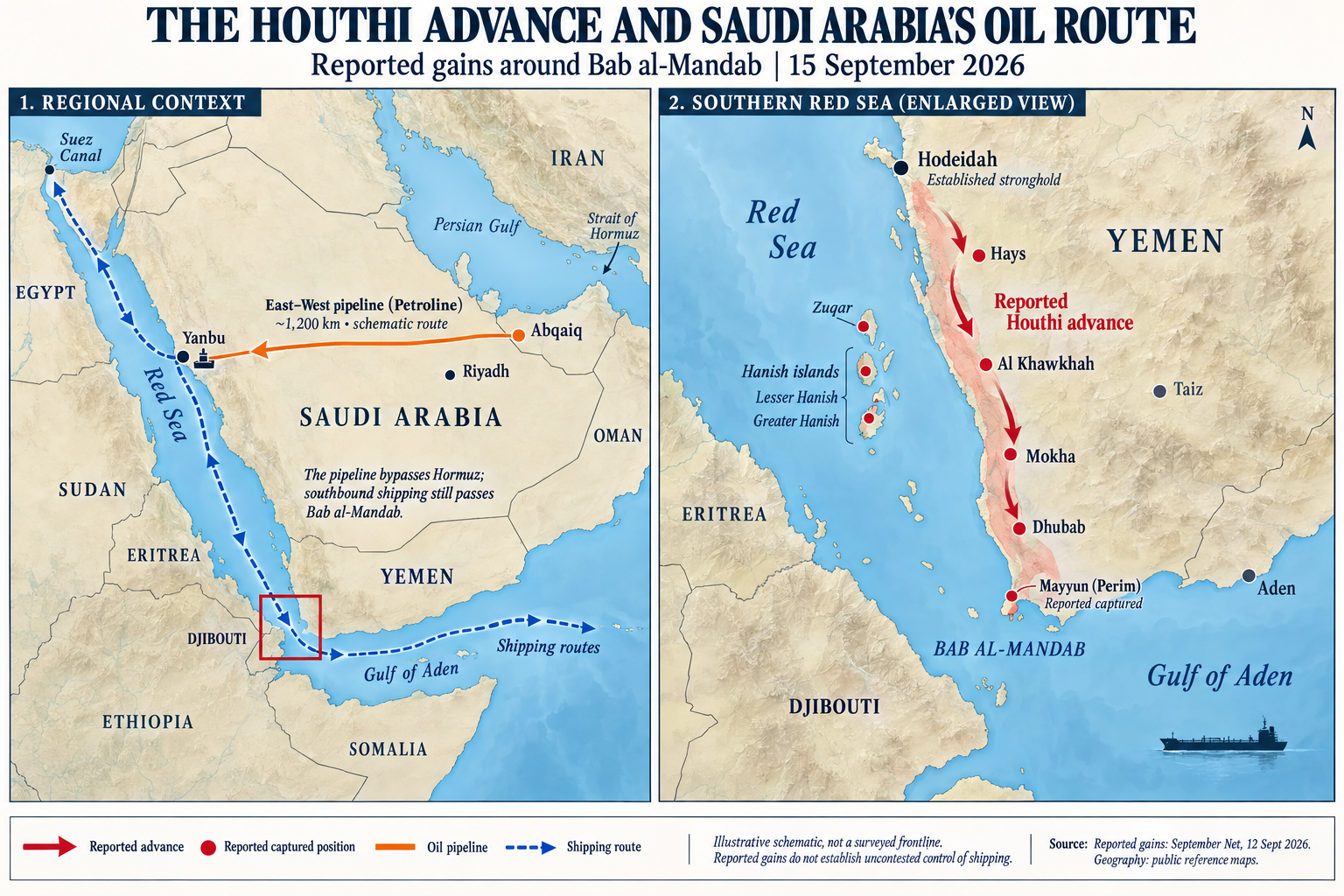
The kingdom is not demonstrably approaching an export shutdown. But its alternative route has been drawn into the conflict it was supposed to circumvent.
The interruption reaches customers
The Saudi Foreign Ministry says drones launched from Iraqi territory struck the pipeline in the Riyadh and Medina regions. At Baghdad’s request, Riyadh withheld immediate retaliation while reserving its right to respond. Its statement identified the launch territory without establishing who ordered the operation. Saudi statement reported by Reuters.
Saudi authorities described the shutdown as precautionary but have not published a detailed damage assessment. Aramco has cancelled or delayed some European cargoes, prompting customers including Poland’s Orlen to seek replacement supplies. Reuters on disrupted deliveries.
Restoration estimates range from days to several weeks. US Energy Secretary Chris Wright has offered the shorter forecast; other sources suggest five to six weeks, with partial operations potentially returning sooner. None establishes when previous throughput will be recovered. Reuters on repair estimates.
The geography imposes a separate constraint. Europe-bound tankers can sail north from Yanbu towards Suez without entering Bab al-Mandab. The usual route to Asia runs south through the strait. Longer alternatives may remain available, but at additional cost and with more shipping capacity tied up in transit.
A threat to Bab al-Mandab therefore does not close every exit from Yanbu. It compromises a major outlet from a terminal whose inland supply has already been interrupted.
The value of the coast
Sanaa’s Arabic-language military press describes the capture of Mokha, Dhubab and Mayyun, also known as Perim, alongside other coastal and island positions. These gains bring Ansar Allah closer to shipping lanes, improving observation and widening the potential use of shorter-range weapons and small craft. 26 September’s account.
The historical roots of this struggle, from colonial partition to Saudi intervention and Ansar Allah’s emergence, are explored in our earlier article, How Yemen’s Houthis Reached the Gate of the Red Sea.
The coastal gains confer a significant advantage, not uncontested command of an international waterway. The capacity to threaten passage is different from the ability to control every vessel or withstand a sustained naval challenge.
Sanaa says its restrictions apply to ships connected with Saudi ports, not international commerce generally. Its Transport Ministry reported 73 transits on September 10 and 11, although that figure requires independent vessel-tracking verification. The ministry’s statement.
Selectivity offers limited reassurance to insurers. A ship’s owner, flag, charterer and cargo may belong to different jurisdictions; its previous port calls introduce further ambiguity. Commercial decisions will reflect the risk of misidentification and changing rules as much as declared intentions. A blockade need not stop every ship to make passage substantially more expensive.
Retaliation without a stopping point
In a September 14 statement published by Al-Thawra, Ansar Allah’s armed forces claimed to have attacked hangars, radars, runways and ammunition stores at King Khalid Air Base in Khamis Mushait with dozens of missiles and drones. It presented the operation as retaliation for more than 300 Saudi airstrikes over five days and promised further attacks until the air campaign and blockade ended. Neither its strike count nor its claimed damage has been independently established. Al-Thawra’s publication of the statement.
Saudi authorities reported 13 civilian injuries and damage to seven houses and two vehicles following attacks on Khamis Mushait, Abha and Taif. Alerts extended to several other cities, including Mecca. An alert, however, is not evidence of an impact: the material reviewed does not substantiate claims that the holy city was struck. Arab News’s account of the Saudi announcement.
Responsibility for the pipeline operation remains a separate question. Ansar Allah has claimed attacks on southern Saudi military and energy facilities, but the Sanaa statements reviewed contain no claim for the East–West pipeline strike. The theory of a coordinated Iranian, Iraqi and Yemeni operation goes beyond the available evidence.
The humanitarian consequences are less speculative. UNHCR says renewed fighting has displaced more than 100,000 people inside Yemen and driven thousands abroad. Accounts celebrating a strategic breakthrough on the coast must be read alongside the experience of those fleeing it. UNHCR figures reported by Arab News.
Riyadh’s military problem
Saudi Arabia can inflict extensive damage on identified targets. Its harder task is to translate that destructive capacity into protection for dispersed infrastructure and commercial traffic.
An expanded air campaign could suppress some launch sites while provoking attacks elsewhere. Retaking coastal territory would require effective ground forces, reliable logistics and cohesive Yemeni partners—requirements that additional aircraft cannot fulfil.
Diplomacy is consequently central to Riyadh’s response. During Mohammed bin Salman’s visit to Cairo, Egypt backed Saudi security and freedom of navigation while supporting a political settlement in Yemen. The published account contains no commitment to send Egyptian combat forces. Arab News on the Cairo talks.
Negotiations would have to address air operations, cross-border attacks, support for armed formations, restrictions on Yemeni trade and guarantees for shipping. They would also need to accommodate Yemenis who reject Ansar Allah’s authority. A bilateral bargain cannot resolve the country’s internal divisions by treating Sanaa as its sole political voice.
The asymmetry is not that Yemen can endure unlimited suffering. It is that an armed movement can retain a disruptive capability while the population around it pays an appalling price. Saudi Arabia must protect an extensive commercial system whose reliability is itself a source of power.
Beyond the repair bill
For oil markets, the relevant measure is the volume unavailable, the duration of the interruption and the capacity to substitute other supplies. Pipeline design capacity is not a measure of actual losses. Partial repairs, inventories and alternative loading arrangements could materially reduce the shortfall.
The longer-term cost will depend on whether buyers expect attacks to recur. Restored pumping stations do not guarantee secure loading at Yanbu or an uneventful voyage from it. Freight, insurance and replacement purchases can remain expensive after the physical damage has been repaired.
The pipeline was not a strategic mistake. It provided a valuable alternative to Hormuz. The events of the past week expose something narrower but consequential: two geographically distinct routes can still be vulnerable to the same war.
Saudi Arabia can replace equipment and reorganise deliveries. Securing those investments will require a political settlement, effective deterrence or some combination of the two. The engineering question is when oil can flow again. The strategic question is what will prevent the next interruption.
[…] geography matters. As our earlier examination of Saudi Arabia’s alternative oil routes explained, tankers leaving Yanbu for Europe can sail north towards Suez without passing through Bab […]