Listen to the summary of this article
Saudi Arabia’s borders are younger than many of the loyalties they enclose. The achievement of the House of Saud was to make those older loyalties compatible with the state. The question raised by Yemen is not whether they have disappeared, but what happens if the state can no longer keep them politically separate.
From the sea, the latest advance in Yemen appears to be a struggle over ports and passage. Ansar Allah’s September capture of Al Makha, the port also known as Mokha, brought the movement closer to the Bab al Mandab, where the Red Sea narrows towards the Gulf of Aden. Ships, cargoes and the vulnerability of a maritime route give the conflict an immediate international meaning. For Saudi Arabia, however, another geography lies behind the shipping map: the communities, territories and allegiances over which the kingdom was built.
Alastair Crooke, the former British diplomat and founder of Conflicts Forum, places that geography at the centre of his interpretation. Mohammed bin Salman, he argues, faces a credibility trap. Conceding to Ansar Allah could strengthen a Yemeni revolutionary movement whose example resonates beyond Yemen. Escalation could draw the monarchy into a confrontation touching the historical foundations of its own authority.
Crooke sees a challenge to the regional order that elevated the Gulf monarchies and made Saudi Arabia a principal Arab partner of Western power. Beneath the kingdom’s modern institutions remain communities whose political autonomy diminished as the monarchy expanded, but whose identities survived. A movement asserting sovereignty and independence from one of the poorest countries in the region might give those older histories a new political meaning.
The histories are established. Whether the war in Yemen can bring them into a common political present remains an open question. To understand what is at stake, it is necessary to look first across the peninsula, towards the old Shia towns beside the infrastructure of Saudi wealth.
The other Saudi Arabia
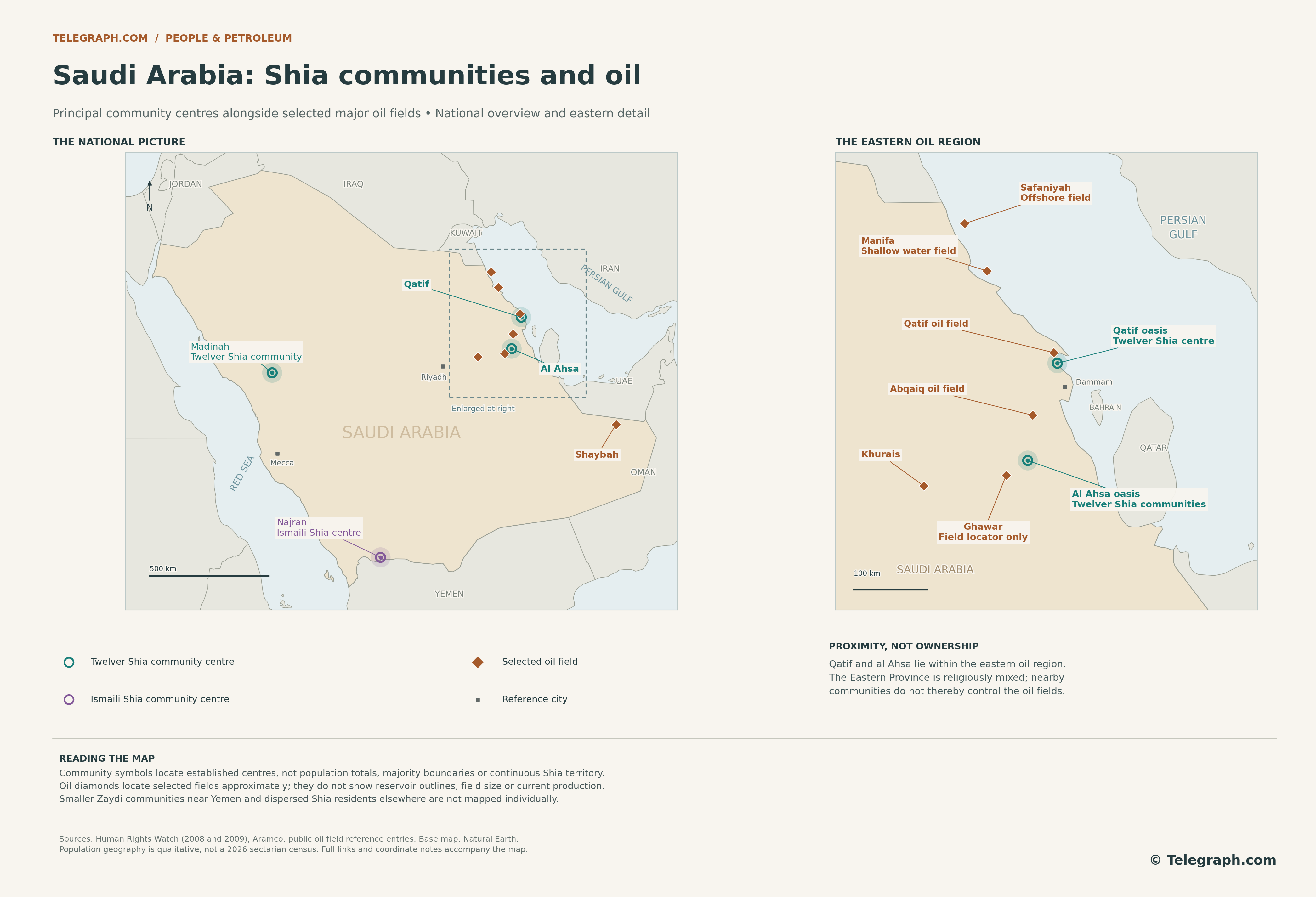
Around Qatif and al Ahsa, the geography of petroleum overlays an older geography of belonging. Pipelines connect the province to the machinery of the Saudi state; families and religious institutions connect it to histories extending beyond that state’s borders.
These centres of Saudi Arabia’s Twelver Shia population possessed religious institutions, commercial relationships and family networks long before the modern monarchy. Their connections reached across the Gulf to Bahrain, north towards southern Iraq and Najaf, and, at different moments, towards Iran. In Toby Matthiesen’s history of Saudi Shiism, they emerge as an indigenous community with a political life of its own, rather than an appendage of the rivalry between Riyadh and Tehran.
Ibn Saud incorporated the territory into his expanding domain in 1913. A generation later, oil transformed its relationship with the centre.
Exploration began in the 1930s under the enterprise that became Saudi Aramco. Commercial oil was discovered at Dammam in 1938. Fields, pipelines, processing plants and export terminals subsequently made the east one of the most concentrated petroleum landscapes on earth. A region with its own religious and commercial inheritance became indispensable to the power of the monarchy that had absorbed it.
Ghawar, much of which runs through al Ahsa, is the world’s largest discovered conventional onshore oil field; Safaniyah is its offshore counterpart. Abqaiq stabilises roughly half of Saudi daily crude production. Qatif names both an old Shia oasis community and an oil producing area. Dhahran, Ras Tanura and Jubail complete a geography in which the machinery of national wealth stands alongside communities with a distinct experience of national power.
The Eastern Province is not uniformly Shia, and local religious communities do not control its oil installations. The consequential fact is more precise: a historically distinct minority lives in the province that became the economic foundation of the state. Geography gave its grievances strategic importance far beyond its numbers.
In November 1979, those grievances erupted.
Earlier that year, the Iranian monarchy had collapsed. Ayatollah Ruhollah Khomeini’s revolution offered an example of a Western backed ruler overthrown by a movement speaking in the name of Islam. Some Saudi Shia activists drew encouragement from it. Their complaints, however, were older: restrictions on religious observance, discrimination, unequal access to institutions and the dominance of a religious establishment hostile to their beliefs.
The immediate confrontation concerned public Ashura commemorations. In historian Toby Craig Jones’s account, efforts to suppress them helped ignite seven days of unrest involving thousands of demonstrators. Government property was attacked, buildings burned and weapons seized. Protesters fought security forces in Qatif and Awamiyah. The state responded with extensive force; an uncertain number were killed and many more injured.
Iran supplied a revolutionary example. It did not manufacture the local dispute.
Repression drove activists abroad, where Saudi Shia political networks developed in Iran, Syria and elsewhere. Exile widened their regional connections, but it did not fix their politics permanently in the revolutionary moment. By the early 1990s, a significant part of the organised opposition had abandoned that confrontation. In 1993, King Fahd reached an understanding with leading opposition figures. Exiles returned, and many pursued reform within Saudi Arabia or entered civil society.
The return mattered. It demonstrated that the monarchy could negotiate a place for former opponents and that opposition itself could change direction. Yet accommodation left the underlying relationship unequal. The question became how much political expression the state would permit from communities whose religious distinctiveness it continued to regard through the lens of security.
Dissent and the limits of accommodation
Across the Gulf, religious connections made that question more complicated. Saudi Shia clerics had studied abroad for generations, particularly in Najaf. After 1979, Qom acquired greater importance, and some activists developed ties to Iranian revolutionary institutions. Networks emerged from which Hezbollah al Hijaz would develop. Saudi concerns about Iranian cultivation of Gulf Shia organisations had a real foundation.
Religious authority, however, travelled along routes that could not be translated neatly into political allegiance. Following a cleric in Najaf or Qom did not itself make a Saudi believer loyal to Iraq or Iran. For many Gulf Shia, Najaf and Ayatollah Ali al Sistani have been at least as important as Iran’s clerical establishment.
The monarchy thus confronted a domestic political dispute and a regional rivalry that sometimes overlapped. The 1996 bombing of Khobar Towers, which killed 19 American airmen, intensified fears of that overlap. American prosecutors subsequently charged members of Saudi Hezbollah and alleged Iranian support. The gravity of the case did not make a clandestine organisation representative of the wider population of Qatif and al Ahsa.
When the Arab uprisings revived protest in the Eastern Province, these competing explanations of dissent returned with them. Was the state confronting citizens demanding change, a security threat encouraged from abroad, or different activities being brought under the same description? The career and execution of Sheikh Nimr Baqir al Nimr made the dispute impossible to contain within Saudi Arabia.
A cleric from Awamiyah, Nimr became a prominent voice in the renewed protests. His denunciations of discrimination and the ruling establishment attracted younger activists. Arrested in 2012, he was accused of breaking allegiance to the ruler, inciting sectarian discord and encouraging unrest.
The authorities presented him as a threat to public order and national security. Human Rights Watch reported that important elements of the prosecution concerned sermons, political statements and support for demonstrations, and raised serious concerns about his trial.
On January 2, 2016, Saudi Arabia executed Nimr alongside 46 other prisoners, many convicted of offences related to Al Qaeda terrorism.
Protests followed in several countries. In Iran, demonstrators attacked Saudi diplomatic premises; Riyadh severed relations with Tehran. A prosecution rooted in domestic Saudi politics had become a regional crisis. The boundaries between internal dissent and external confrontation, so important to the monarchy’s security, had broken down around a single case.
For the authorities, the episode illustrated the danger of opposition becoming entangled with foreign rivalry. For many Saudi Shia and their supporters, it exposed the limits of the accommodation reached two decades earlier. The same event reinforced two accounts of the relationship, each making reconciliation more difficult.
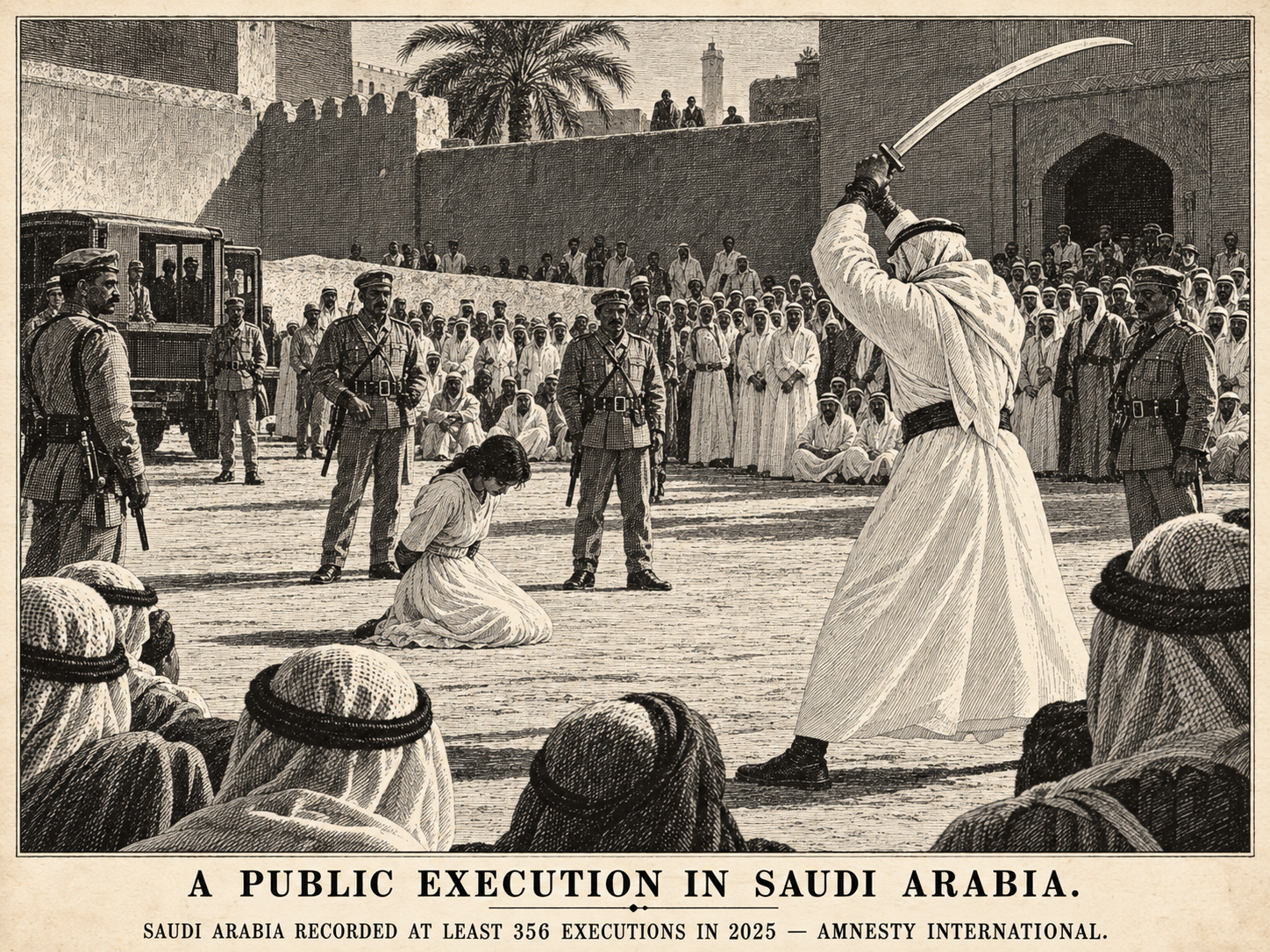
Subsequent mass executions deepened the dispute. The cases involved allegations ranging from armed attacks and espionage to protest and religious organisation. Their differences matter, as do the allegations of torture and coerced confessions in the proceedings used to establish guilt.
Serious violence was alleged; so were grave failures in establishing responsibility for it. Treating every defendant as a peaceful protester obscures the charges. Treating every case as an equivalent act of terrorism obscures both the conduct at issue and the disputed proceedings. The difficulty of distinguishing these categories within the same security system is part of the political history, rather than a detail outside it.
Meanwhile, Mohammed bin Salman was presenting a rapidly changing country to the world. Vision 2030 promised diversification, technological modernisation, tourism and entertainment. The old religious establishment was losing public influence. Saudi Arabia invited visitors and investors to look towards its future, but in the east the limits of political expression remained closely connected to the methods of its past.
The Shia experience reveals a state combining participation and accommodation with surveillance and coercion. Across other parts of the peninsula, the monarchy faced a different task. It had to find a place within its institutions for communities whose fighters had helped make the kingdom, and whose understanding of their own authority did not necessarily end with its creation.
The warriors who made the kingdom
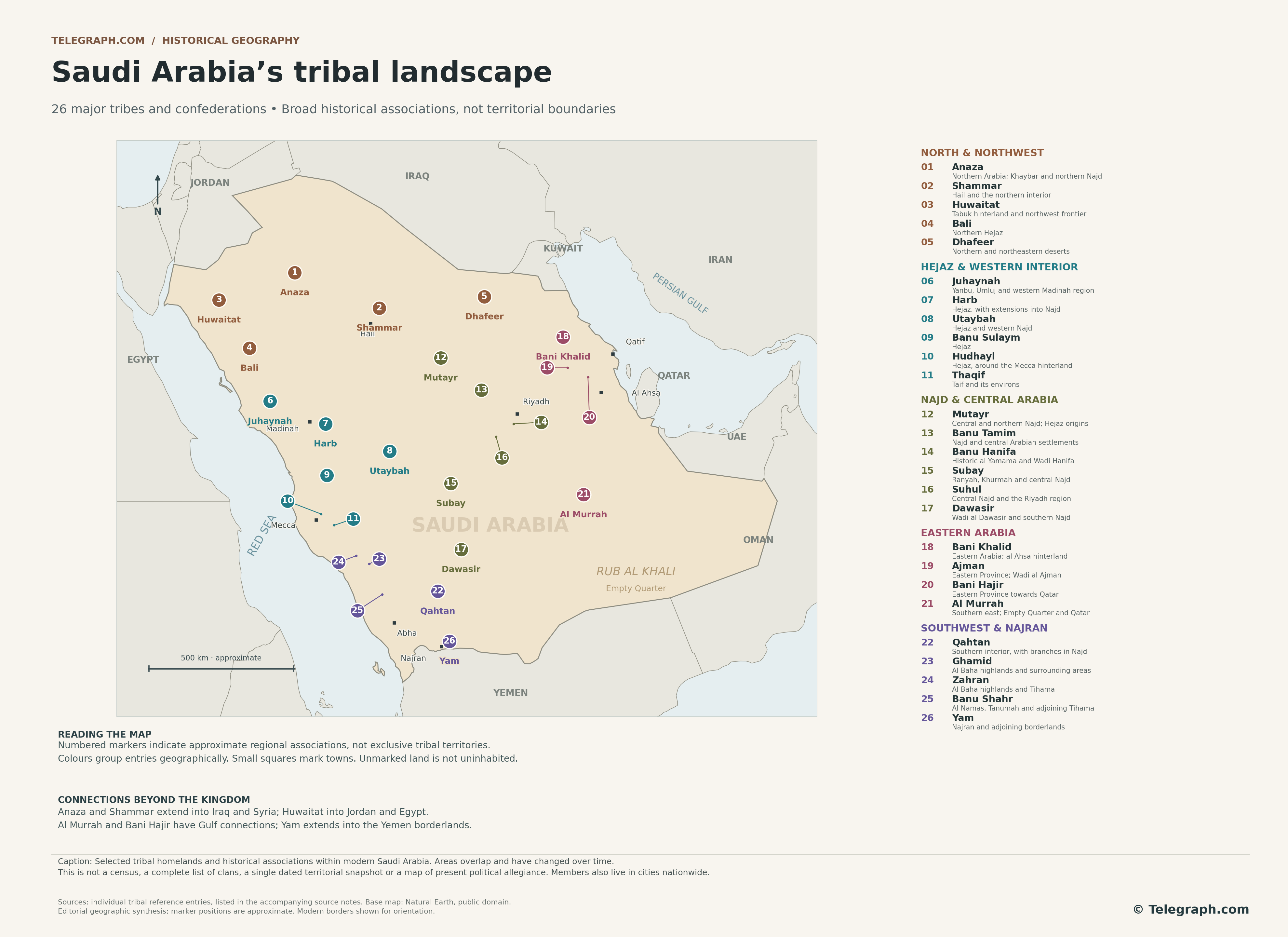
Before Saudi Arabia existed, much of the peninsula’s political geography was expressed through tribes. Pasture, water, trade, marriage and protection bound communities whose movements often crossed the borders that would later separate states. The desert was not empty political space awaiting a ruler. It contained relationships, rivalries and claims that any expanding authority had to negotiate.
Tribes were not uniform political organisations. They contained branches, rival sheikhs and competing interests. Anaza’s connections extended towards Syria, Iraq and Jordan; Shammar had deep roots in Iraq and Syria. Al Murrah moved through territory subsequently divided between Saudi Arabia and Qatar. Huwaitat networks reached through north western Arabia towards Jordan and Sinai.
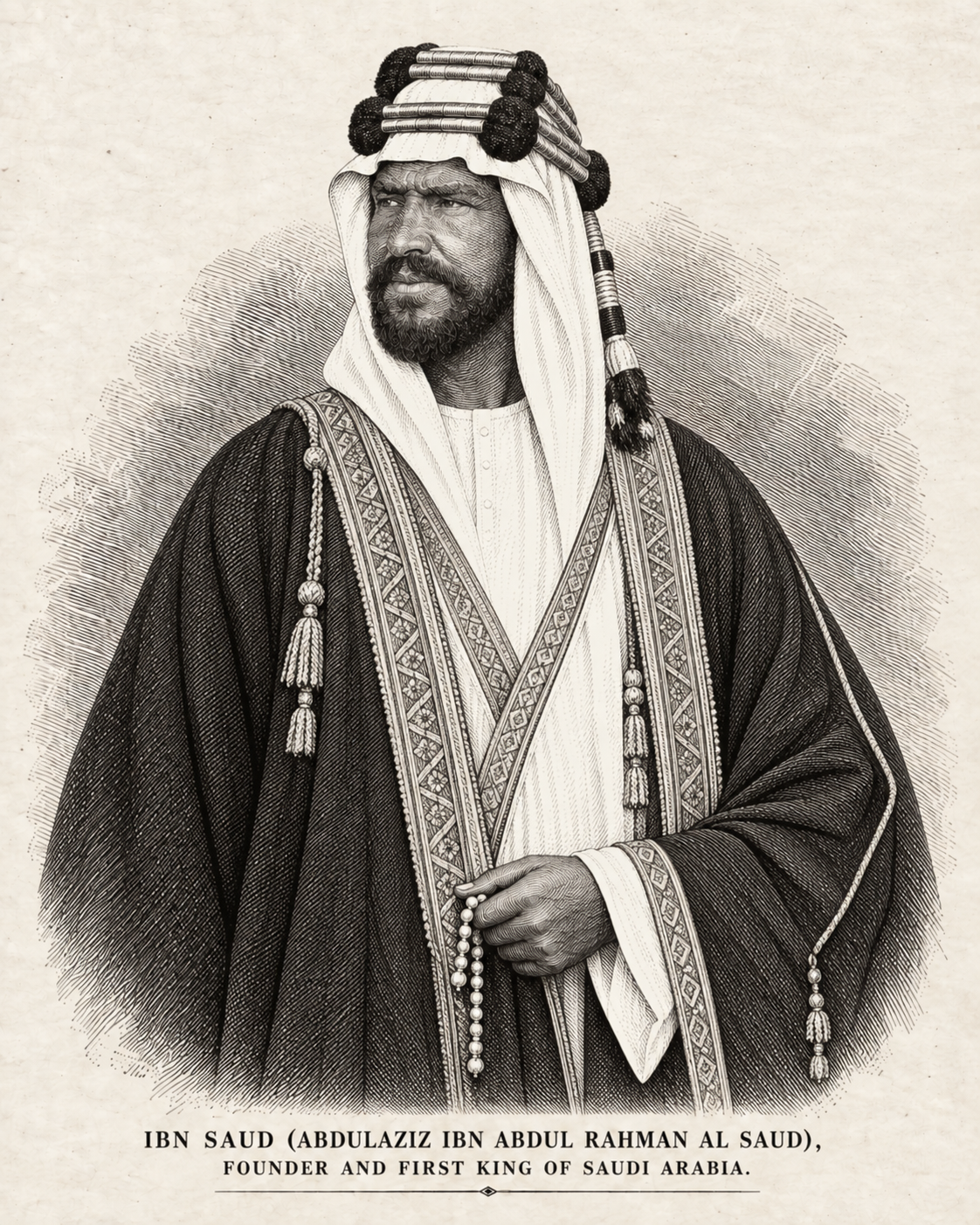
Ibn Saud’s achievement grew out of bargains and struggles within this world. Joseph Kostiner’s history follows the transition from chieftaincy to monarchy through the relationships among tribes, settled communities, rival rulers and Britain. The state emerged from those relationships before it acquired the power to stand above them.
When Ibn Saud recaptured Riyadh in 1902, he possessed neither a modern bureaucracy nor a national army. Over the following three decades he expanded into al Ahsa, consolidated Najd, defeated the Rashidis of Hail, conquered the Hejaz and extended his power towards Yemen.
Much of that expansion depended on tribal fighters. A decisive instrument was the Ikhwan, distinct from the later Muslim Brotherhood despite the shared Arabic name.
The Saudi Ikhwan developed through the settlement of sections of nomadic tribes in agricultural and religious communities known as hijar. Settlement, religious instruction and military mobilisation served a common purpose. They brought warriors within closer reach of authority and directed their fighting capacity towards Ibn Saud’s enemies. Mutayr supplied important forces, as did sections of Utaybah and other tribes.
In Madawi al Rasheed’s account, the Ikhwan were one of two major social forces supporting expansion. The other was the settled population of Najd, for whom stronger rule promised greater security. The ruler could draw upon both the desire for order and the capacity for conquest, although those ambitions would not always lead in the same direction.
Britain supplied money and arms. Its officials understood that strengthening Ibn Saud could help him impose order, but they also expected restraint towards territories within Britain’s imperial sphere. London wanted a ruler capable of controlling central Arabia without allowing his fighters to spill into Kuwait, Iraq, Transjordan and the Gulf.
Churchill’s explanation was more revealing than the figures. The money, he told the Commons, helped Ibn Saud establish authority over nomadic tribes and restrain them. British assistance supported the ruler’s expansion while encouraging him to contain the forces on which that expansion depended.
For Ibn Saud, recognition and relations with neighbouring powers helped turn conquest into durable rule. Some of the men who had fought for him understood the bargain differently. They had helped create an expanding authority; they now faced its insistence that expansion must stop.
When conquest had to end
By the late 1920s, the contradiction had become rebellion. Faisal al Duwaish of Mutayr and Sultan bin Bajad of Utaybah were among the principal Ikhwan rebel leaders. Their grievances combined religious conviction, political authority and material interest. Some believed Ibn Saud was compromising with illegitimate practices, technologies and foreign powers. They also resisted his growing claim to decide when fighting was permitted and where conquest must end.
Emerging borders sharpened the dispute. Raiding, migration, grazing and access to water had crossed lands now divided by recognised frontiers. Ibn Saud’s relations with neighbouring governments required him to restrain activities that fighters regarded as customary or legitimate. What looked from the palace like the consolidation of a state could look from a tribal following like the surrender of rights and opportunities.
Religious conviction and political sovereignty were inseparable in this struggle. Who could authorise war? Who negotiated with outsiders? Who decided that a frontier previously crossed was now a boundary to be respected? The ruler’s answer required men who had made their power through fighting to accept that the permission to fight belonged elsewhere.
At Sabilla in March 1929, Ibn Saud’s forces defeated the rebellious Ikhwan. Resistance continued, but the battle broke their capacity to determine the direction of the Saudi project independently. Britain reinforced the constraints around them, defending Iraq and Kuwait against incursions with aircraft and armoured forces.
The defeat gave the emerging state something conquest alone had not secured: a decisive answer to the question of who controlled its military direction. Tribal identity could endure. Autonomous tribal warfare could no longer set the course of the kingdom.
Three years later, the Kingdom of Saudi Arabia was proclaimed.
Yet victory left the communities from which the rebels came in place. Their descendants, leaders and memories remained. The monarchy could defeat a military challenge without making the social world behind it disappear. To govern that world over generations, it needed relationships that extended beyond the battlefield.
A place within the monarchy
The Saudi state gradually turned tribal standing into an asset whose value depended increasingly on access to the centre. Sheikhs received recognition. Influential families developed ties to the palace. Stipends, administrative positions and government employment connected local prominence to royal resources. Oil later expanded the scale of these arrangements beyond anything the early monarchy could have afforded.
The change reached into the meaning of status itself. A leader’s ability to obtain recognition, employment or assistance from the state could help sustain his importance within his community. The centre acquired intermediaries; those intermediaries acquired resources. Older relationships survived, but increasingly operated through institutions and revenues controlled elsewhere.
Military service gave this transformation a particularly durable form. The Ministry of National Guard traces the institution’s origins to the Office of Jihad and Mujahideen, established under King Abdulaziz in the late 1940s. The subsequent development of the Guard gave tribal military manpower a future within the central state. This was a broader process of recruitment and incorporation, rather than a simple organisational continuation of the rebellious Ikhwan.
The fighter could retain the social identity from which he came while acquiring a salary, a uniform and a chain of command leading towards the monarchy. Service made belonging to the tribe compatible with serving the state. It also placed the resources needed to sustain organised military power firmly in the state’s hands.
A 1970 American government assessment described the Guard, then also called the White Army, as recruited from tribes traditionally regarded as loyal to the rulers and stationed near major cities. Its role in protecting the monarchy against a possible military coup was explicit.
Across the Arab world, officers had repeatedly overthrown governments. Saudi rulers maintained overlapping security institutions with distinct relationships and chains of command. Under Prince Abdullah, later King Abdullah, the Guard became a major military and political force. The monarchy’s security rested partly on ensuring that military authority did not accumulate within a single institution capable of displacing it.
Britain remained involved. Its military mission to the Guard began in 1964. Parliamentary accounts described assistance with officer training, basic military skills and specialist activities, including counterterrorism; a separate team supported communications. Parliament recorded the mission’s continuous operation in 2012, and the British defence secretary marked its sixtieth anniversary in 2024.
The relationship had outlived both the original conqueror and the world he conquered. Britain had helped Ibn Saud strengthen his authority over tribal Arabia. It later advised an institution that gave important elements of tribal fighting power a place within the monarchy.
Genealogy, meanwhile, retained its own value. In Of Sand or Soil, Nadav Samin describes how lineage persisted in a society transformed by oil, education, urbanisation and bureaucracy. Official classification, identity documents and political symbolism sometimes reinforced ancestry even as older ways of life receded.
His phrase “genealogical rule of governance” captures the paradox. The state diminished independent tribal authority while helping descent remain a source of recognition and status. Tribal belonging survived through marriage, family history, regional attachment and patronage. Modern government could preserve the significance of lineage while changing what lineage entitled a person to do.
The monarchy’s success depended partly on making these identities compatible with participation. It also rested on genuine national attachment, material improvement and the divergent interests of communities that had no necessary reason to act together. Saudi cohesion cannot be explained as a century of deliberate division alone. For many people, the state became a source of opportunity and belonging in its own right.
Land nevertheless exposes the limits of accommodation.
In north western Arabia, Huwaitat communities inhabit territory claimed for NEOM, Mohammed bin Salman’s vast Red Sea development. Here, the future imagined by the centre meets communities with an inherited claim to the same ground. Human Rights Watch reports that residents of several villages were told in 2020 to leave. Residents protested and petitioned; Abdulrahim al Huwaiti recorded videos resisting removal and was subsequently killed during a confrontation with security forces.
The episode bears little military resemblance to Sabilla. Its connection lies in the question of final authority. How much weight do established claims to land and community carry when they conflict with the ruler’s priorities? A state that once asserted its monopoly over war now asserts its authority to remake the landscape.
The border through the family
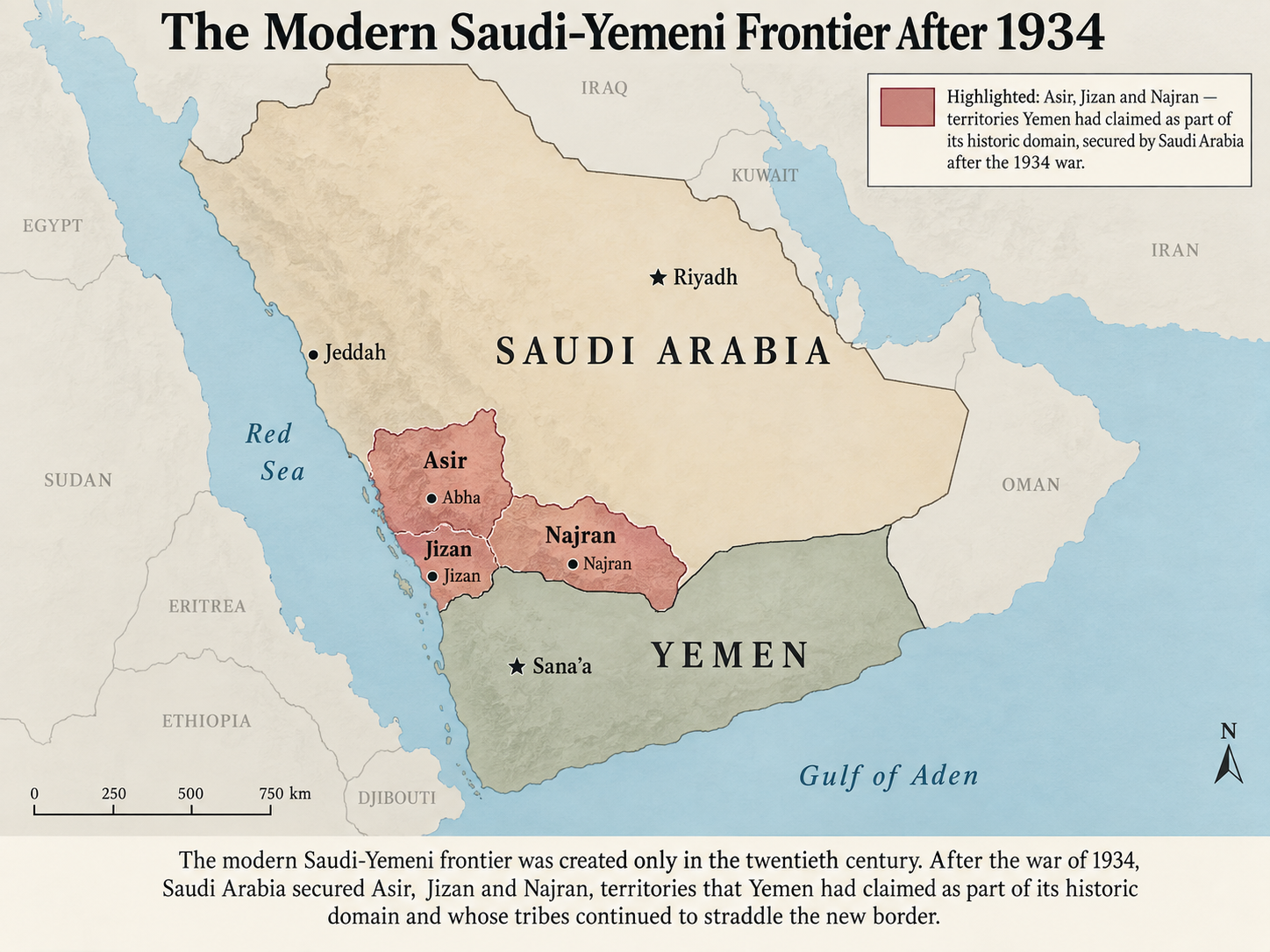
On the southern frontier, inherited connections run through the boundary itself. Carnegie research identifies Bani Marwan, Qays, Hamdan, Waela, Yam, Mashreq, Abidah, Manahil, Nahd, Balabid and al Saar among the important tribes of Yemen’s northern borderlands. Several have branches extending towards or across Saudi Arabia. Some Waela branches straddle the frontier; researchers have encountered families with connections to both nationalities.
The 1934 Treaty of Taif described parts of the boundary through tribes and tribal territories. The Khawlan bin Amr confederation was divided. Communities of the Tihama and Asir occupied a region that had functioned as a connected social and economic space. The treaty’s language itself preserved the order in which these things had arrived: the communities supplied the names through which the states defined their separation.
Najran adds religious distinction to this geography. Yam is its principal historic tribal force, and much of its population follows Ismaili Shiism, although Sunni branches also exist. Its inheritance differs from the Twelver communities of Qatif and al Ahsa, the Wahhabi tradition of Najd and the Zaydi communities of northern Yemen from which Ansar Allah emerged. These distinctions do not dissolve into a common political allegiance.
For decades, Riyadh managed relations across the Yemeni frontier through payments to sheikhs and intermediaries. Markets, grazing, trade, smuggling and family connections sustained movement. Saudi influence travelled through the people who could negotiate those relationships as well as through the formal institutions of the state.
As insecurity grew, fences, surveillance and security forces acquired greater importance alongside the older arrangements. Riyadh increasingly governed the frontier through its capacity to monitor and restrict movement, while the relationships that made movement valuable continued to exist. The boundary became more formidable without becoming socially complete.
What Yemen might change
This is where Crooke’s warning acquires its fullest meaning. Yemen confronts Saudi Arabia across a boundary that is also a network of relationships. A military development can travel through that network as news, family experience or a judgment about which power can protect, reward or intimidate. Beyond the frontier, its political example can be interpreted through other local histories of authority and resistance.
The possible connection is more specific than a general revival of tribal memory. Sustained Yemeni pressure could matter internally if it weakened confidence in Saudi protection, disrupted the rewards of cooperation or made resistance appear more effective than accommodation. Under those conditions, people whose interests currently bind them to the state might begin to calculate differently.
Crooke’s revolutionary interpretation adds the question of political language. A movement asserting independence against wealthier powers could offer a vocabulary through which separate grievances acquire wider meaning. In his account, the importance of Ansar Allah lies partly in its ability to challenge assumptions about who possesses power and who must accommodate it.
None of these possibilities establishes coordination between Qatif, Najran, Huwaitat communities and northern tribes. Their interests differ substantially. Religious affinity is not a political programme, and kinship across a frontier can coexist with loyalty to the country on either side. The point at which a distant example becomes a local political choice depends on circumstances that ancestry alone cannot explain.
What Saudi history does reveal is the achievement that would be tested. The monarchy gave enduring identities a place beneath a common authority, using different combinations of opportunity, recognition, negotiation and force. Oil financed the arrangement; institutions made it reproducible across generations. Its durability came from the ability to offer reasons for participation as well as consequences for defiance.
The record of survival is formidable. The Saudi political system endured the Ikhwan revolt, the transformation brought by oil, repeated royal successions, Arab nationalism, the upheavals of 1979, jihadist violence, the Arab uprisings and years of intervention in Yemen. Predictions of imminent fragmentation have repeatedly underestimated it. Any account of the kingdom’s vulnerabilities must also explain this capacity to absorb shocks.
Yet endurance does not erase the relationships through which a state was built. Around Qatif and al Ahsa, the oil economy and an older religious geography still occupy the same province. Along the Yemeni frontier, nationality and kinship describe different kinds of connection. In the Huwaitat villages claimed for NEOM, inherited belonging encounters the ambitions of a government intent on transforming the land. These are parts of modern Saudi life, not remnants existing outside it.
The question is whether the monarchy can continue to make that life cohere: whether communities find security, opportunity and a future within its institutions, and whether disputes over land, religion or authority remain disputes that those institutions can contain. Yemen matters to Crooke’s argument because it could change the setting in which those judgments are made.
The older map is still legible in names and marriages, in religious affiliations, in border communities and in the lineages of men serving the state. Its survival has long been compatible with the kingdom’s strength. What remains uncertain is whether pressure from Yemen will alter the terms of that compatibility.
Saudi Arabia’s rulers did not erase the older map. They built a state powerful enough to govern it.
Sources and further reading
| Source | Work | Relevance |
|---|---|---|
| Madawi Al-Rasheed | A History of Saudi Arabia, Cambridge University Press | Formation of the Saudi state, Ibn Saud’s conquest of Arabia, relations between the ruling family, religious establishment and tribes, the Ikhwan revolt, and the transformation of the kingdom following the discovery of oil. |
| David Commins | The Wahhabi Mission and Saudi Arabia, I.B. Tauris | The alliance between the House of Saud and the Wahhabi religious movement, Ibn Saud’s use and subsequent suppression of the Ikhwan, and the incorporation of Wahhabi authority into the modern Saudi state. |
| Alexei Vassiliev | The History of Saudi Arabia | A broad political history of the Saudi dynasties, the conquest of Najd and the Hijaz, relations with Britain and the Ottoman Empire, tribal politics and the creation of the modern kingdom. |
| Toby Matthiesen | The Other Saudis: Shiism, Dissent and Sectarianism, Cambridge University Press | The history and politics of Saudi Arabia’s Shia population, particularly Qatif and al-Ahsa in the Eastern Province, sectarian mobilisation and the strategic overlap between Shia population centres and the kingdom’s principal oil producing region. |
| Nadav Samin | Of Sand or Soil: Genealogy and Tribal Belonging in Saudi Arabia, Princeton University Press | Tribal genealogy, kinship, social hierarchy and the persistence of tribal identity within the institutions of the modern Saudi state. |
| Sultan Alamer | “From Paris to Ta’if: Sovereignty, Borders, and the Question of Minorities in the Arabian Peninsula”, Nationalities Papers | Najran, the Yam tribal confederation, Ismaili communities, competing Saudi and Yemeni claims and the settlement of the southern frontier following the 1934 Saudi Yemeni war. |
| Joseph Kostiner | The Making of Saudi Arabia, 1916–1936: From Chieftaincy to Monarchical State | The transition from tribal conquest to centralised monarchy, Ibn Saud’s relationship with tribal forces and the political construction of the Saudi state during its formative period. |
| Robert Lacey | The Kingdom: Arabia and the House of Sa’ud | Narrative history of Ibn Saud, the royal family, the Ikhwan, oil wealth and the institutional development of the Saudi monarchy. |
| Human Rights Watch | Denied Dignity: Systematic Discrimination and Hostility toward Saudi Shia Citizens | Detailed research on discrimination affecting Shia communities in Qatif, al-Ahsa and Medina, including religious restrictions, arrests and relations between the Eastern Province and the central state. |
| Human Rights Watch | “They Are Not Our Brothers”: Hate Speech by Saudi Officials | Background on Saudi Arabia’s Twelver Shia population in the Eastern Province and its Ismaili population around Najran, together with historical material on their incorporation into Saudi rule. |
| Amnesty International | Saudi Arabia death penalty and execution reporting | Execution totals, capital punishment practices, terrorism and drug related death sentences and cases involving members of Saudi Arabia’s Shia minority. |
| UK Parliament, Hansard | “Ibn Saud (Subsidy)”, House of Commons, 28 November 1922 | Contemporary British parliamentary evidence concerning the monthly subsidy paid to Ibn Saud during the period in which he was consolidating his power in Arabia. |
| Saudi Aramco | Corporate history and historical material on Dammam, Safaniyah and the Eastern Province | The development of the Saudi oil industry from Dammam No. 7, the growth of Eastern Province production and the development of Safaniyah and other major fields. Aramco records commercial oil production beginning at Dammam in 1938 and its subsequent expansion across the Eastern Province. |
| U.S. Energy Information Administration | Saudi Arabia country and energy infrastructure analysis | Independent data on Saudi crude production, export infrastructure, the Persian Gulf and Red Sea terminals and the strategic significance of the kingdom’s oil transport network. |
| Sana’a Center for Strategic Studies | Research on Yemen’s tribes, northern politics and Ansar Allah | The political organisation of northern Yemen, the Hashid and Bakil confederations, tribal relations with the state and the changing relationship between tribal actors and the Houthi movement. |
| Laurent Bonnefoy | Scholarship on Yemen, political Islam and the Houthi conflict | Historical and political context for northern Yemen, Zaydi politics, the rise of Ansar Allah and the relationship between local political structures and the regional conflict. |
| Associated Press | Yemen and Red Sea reporting, September 2026 | Contemporary reporting on Houthi territorial advances, Red Sea positions, pressure on Bab el Mandeb and the renewed Saudi Yemeni military confrontation. |
| Reuters | Saudi oil infrastructure and Yemen conflict reporting, September 2026 | Reporting on attacks affecting the Saudi East West Pipeline, damage to pumping stations, the consequences for Yanbu exports and the wider effect of the conflict on Saudi energy infrastructure and global oil supply. |
| Jane’s | Defence reporting on Saudi and Yemeni military operations | Technical assessment of military equipment, aircraft losses, missile and drone capabilities and claims made by the belligerents in the renewed fighting. |
Historical interpretation draws on the academic and archival works listed above. Contemporary battlefield and military claims are attributed to the governments, armed groups, specialist publications or news organisations reporting them and should be distinguished from independently established historical facts.