India’s AI Reckoning: When Intelligence Becomes Cheaper Than Labour
India’s post 1990s economic rise was built on a simple arbitrage. Educated, English speaking labour delivered remotely at scale. Business process outsourcing, IT services, call centres and back office professional work became the country’s comparative advantage in a globalised economy. That advantage is now under direct threat not from another low wage competitor but from the collapse of the price of intelligence itself.
Artificial intelligence is not approaching this disruption slowly or abstractly. It is already cheaper, faster and more reliable than human labour for large classes of screen based cognitive work. The cost of transforming language into output answering customers, writing code, reviewing documents, handling compliance is falling toward zero. When intelligence becomes cheaper than labour, an economy built on exporting intelligence faces a reckoning that cannot be postponed, retrained away, or managed with familiar policy scripts.
This article examines why India’s labour export model is structurally exposed to this shift, why the disruption is likely to arrive far sooner than policymakers publicly admit, and why the reflexive advice to learn to code now belongs to a vanishing economic era. What is at stake is not a distant technological future but the near term viability of the growth model that has underpinned India’s middle class, its urban employment base, and its global economic positioning for three decades.
This is not an abstract debate about future technology. It is a pricing shock already moving through global labour markets. Countries built on exporting cognition will feel it first.
The price collapse of intelligence
Every industrial shock announces itself through price. In this one the signal is unmistakable. Over the past three years the cost of machine intelligence has fallen by orders of magnitude. Tasks that once required teams of trained workers drafting documents, responding to customers, writing and debugging code are now executed for cents.
Within the next year the total amount of language an average person produces annually will cost less than a dollar to process. The equivalent of human thinking time will cost only a few dollars more. This is not speculation. It is the arithmetic of collapsing inference costs, more efficient models, and increasingly standardised tooling.
Once intelligence becomes cheaper than electricity and dramatically cheaper than labour, the economic logic flips. Firms do not need ideological commitment to automation. They need only basic cost discipline. For India this matters because its global role is not tied to a scarce physical resource or protected market. It is tied to cognition. When cognition is priced near zero the floor drops out.
Previous automation waves made labour more productive. This one makes labour redundant by making intelligence itself abundant.
Why India’s labour export model is exposed
India is not collateral damage in this transition. It is in the blast radius. The country’s services economy specialises in precisely the tasks artificial intelligence replaces first. Structured, repeatable, English language work performed through a screen.
Call centres, customer support, compliance processing, basic legal research, accounting checks, quality assurance, and routine software development now sit squarely in the zone where AI already performs at or above human benchmarks. In customer service modern systems score in the mid nineties on industry benchmarks handling volume without fatigue, accent issues, or error drift.
The economics are unforgiving. When an AI can perform a task for cents that costs a human ten, twenty or one hundred dollars the decision is not political. It is mechanical. Entire layers of India’s offshore services stack face compression simultaneously, not gradually.
The myth of reskilling and the end of learn to code
For more than a decade India’s standard response to disruption has been retraining. Learn to code. Move up the value chain. Become more technical. That advice is now obsolete.
Coding itself has become a callable function. In leading AI labs the majority of production code is already written by machines. On standardised software benchmarks AI systems outperform most human developers. What was once a scarce skill has become an abundant service.
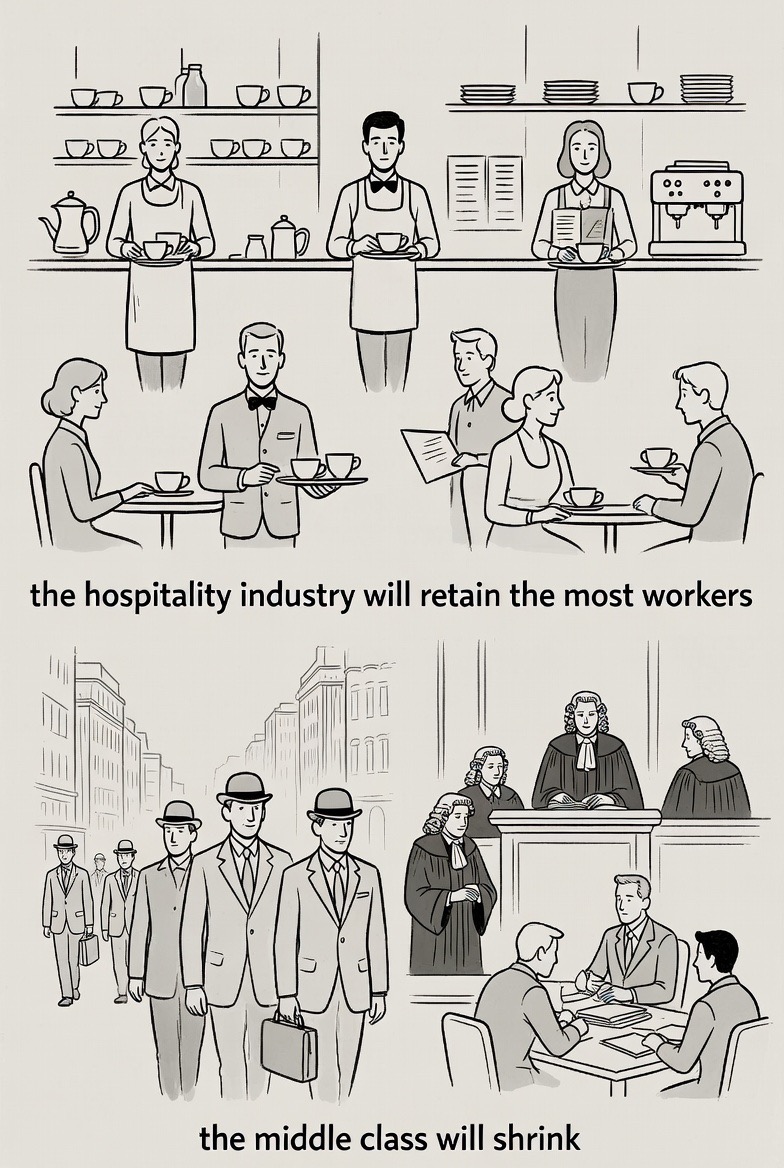
Telling displaced workers to retrain into a profession already being automated is not forward planning. It is denial. The uncomfortable truth is that AI is not removing only low skill work. It is removing the cognitive middle that India was climbing.
Reskilling narratives assume new rungs will appear. AI removes the ladder itself.
Why bigger models are the wrong focus
Public debate fixates on ever larger models and trillion dollar compute races. This misses where progress now occurs. Architectural innovation has slowed. Different model families converge toward similar performance.
The decisive gains now come from data quality, verification layers, and domain specialisation. Relatively small models trained on high quality datasets and paired with systems that verify their own outputs already outperform humans in medicine, law, mathematics and engineering while running on consumer hardware.
Training such systems no longer requires tens of billions of dollars. It requires coordination, clean data, and the willingness to focus narrowly rather than chase generality. For India this matters because it undercuts the belief that only Silicon Valley giants can compete. The barrier is not capital. It is organisation.
Constraint beats abundance
The global AI race has produced an unexpected lesson. Constraint breeds discipline. Chinese teams restricted by chip access were forced to optimise relentlessly producing smaller cheaper models deployed rapidly across domestic platforms.
American firms flush with resources scaled indiscriminately and bureaucratised innovation. Progress slowed not because of technical limits but because of organisational ones. India sits between these worlds. It has talent in abundance including many of the engineers leading global AI efforts but often abroad.
What it lacks is coordinated intent. Shared datasets. Focused mandates. Permission to take risks without immediate commercial justification. In this phase of the cycle that matters more than raw spending.
The real power shift is the AI closest to you
As models commoditise power moves up the stack. The most consequential AI system is not the most powerful one in a data centre. It is the one closest to the user. The agent that mediates daily decisions, remembers context, and learns preferences over time.
This layer shapes behaviour, consumption, and belief more effectively than search engines or social networks ever did. India recognised this logic when it restricted certain foreign attention algorithms. Personal AI agents will be far more persuasive. Whoever controls that interface controls influence at scale.
Cognitive colonialism by default
Free AI is not neutral. Systems trained, aligned, and monetised elsewhere carry assumptions about language, norms, risk tolerance, and priorities. When a country adopts those systems wholesale in education, healthcare, or administration it imports those assumptions invisibly.
This is not colonialism by force but by convenience. Defaults harden quickly. Once embedded these systems become difficult to dislodge because they are cheap familiar and deeply integrated. Avoiding this outcome does not require isolation. It requires open inspectable stacks that can be localised.
Labour is not just income
The danger ahead is not limited to unemployment statistics. Jobs organise time provide identity and anchor social networks. AI replaces roles wholesale not incrementally.
Unlike past technologies which destroyed some jobs while creating new ladders AI collapses entire cognitive categories at once. The result is a vacuum social before it is economic. History suggests that rapid identity loss produces political volatility long before it produces policy reform.
The window India cannot miss
India still has agency. The tools are affordable. The talent exists. The window remains open but it is narrowing. This is a coordination problem not a startup problem.
High quality national datasets open but sovereign AI stacks and a shared vision of India’s post labour economy must be built now not after displacement becomes visible in the data.
When the price of intelligence collapses the countries that move first do not merely adapt. They set the defaults.
You might also like to read on Telegraph.com
AI Will Not Just Take Jobs. It Will Break Identities
Why artificial intelligence threatens social meaning and personal identity long before it finishes replacing human labour.
Why Artificial Intelligence Is Breaking GDP and What Comes After
How collapsing intelligence costs undermine growth metrics, productivity models, and the economic language governments still rely on.
AI and London’s Future: The Erosion of the Middle Class
A case study in how generative AI hollow outs white collar labour markets that once looked structurally secure.
The Magnificent Indian People: Resilient, Ingenious and Let Down by Bureaucracy
India’s human capital strength contrasted with institutional bottlenecks that now collide with rapid technological change.
The Billionaires’ Empire of AI
How control over compute, data, and platforms concentrates power as intelligence becomes an industrial input.