Listen to a Summary of This Article
Ansar Allah says Saudi-backed forces have failed to break its hold on the approaches to Bab el-Mandeb. But the more important development may be happening far beyond the coast, as Sana’a tries to turn the fighting in Yemen into a wider campaign against Saudi airports, oil infrastructure and shipping.
Ansar Allah says the Saudi-backed offensive on Yemen’s western coast has failed to dislodge its forces from the approaches to Bab el-Mandeb, rejecting claims from southern Yemeni and government-aligned media that Dhubab, Mocha and positions around the strait have been retaken.
The dispute is unusually stark. Newspapers in Aden have described a rapid counteroffensive by the Southern Giants Brigades and allied formations, supported from the air, which they say pushed Ansar Allah back from some of the most strategically important ground on Yemen’s Red Sea coast. Sana’a describes essentially the same battle as a failed assault accompanied by inflated declarations of victory.
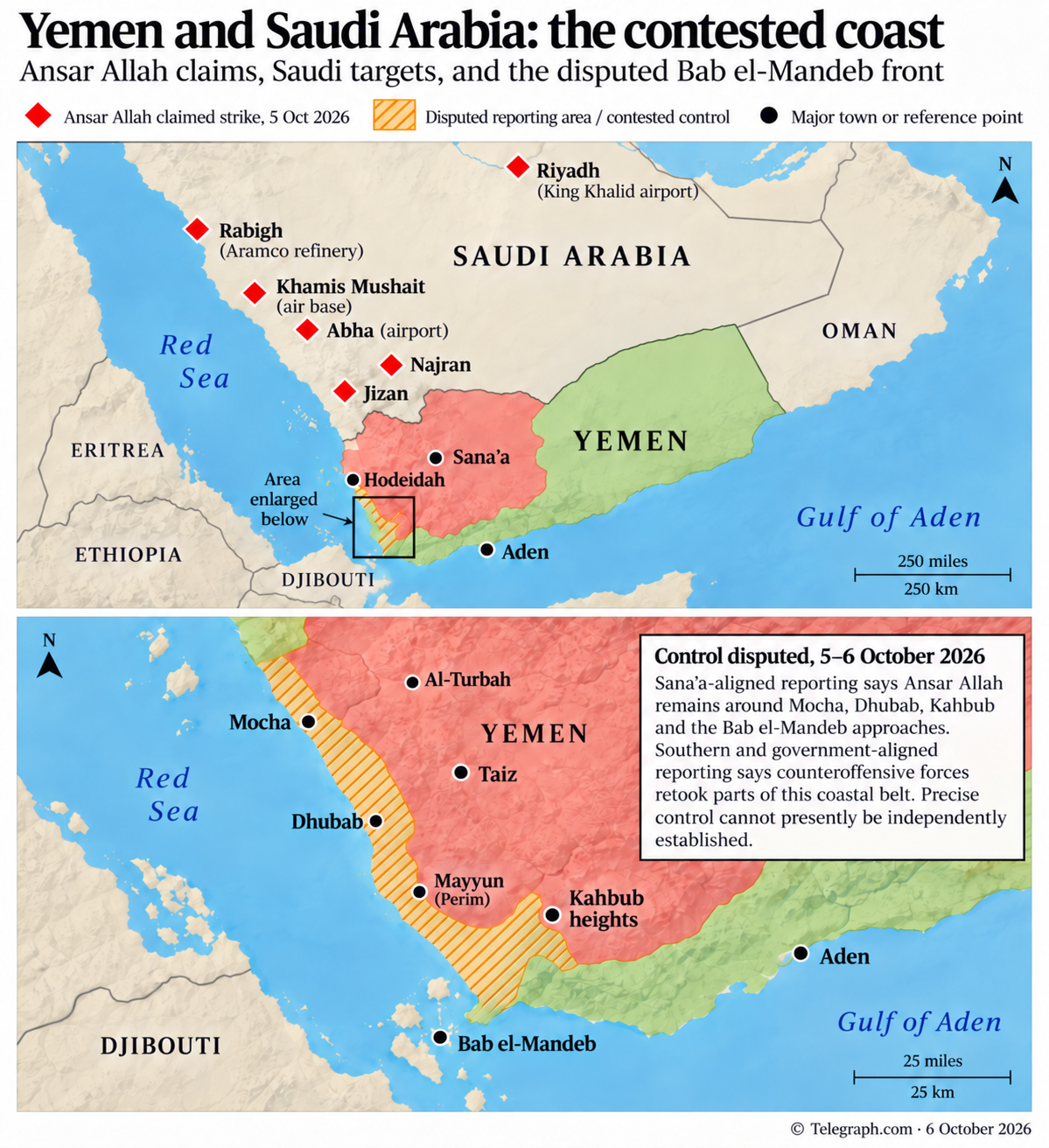
Military spokesman Yahya Saree said on Tuesday that Ansar Allah remained in possession of its recent gains and dismissed reports of defeat as “fictitious victories”. Sana’a-aligned media have gone further, saying opposing forces entered parts of Dhubab before being driven out and maintaining that Ansar Allah remains around Dhubab, the Kahbub heights and the approaches to Bab el-Mandeb. They have also circulated footage which they say demonstrates a continuing military presence around Mocha.
None of this yet provides a reliable front line. Casualty figures from both camps are difficult to verify, and the geography itself resists the neat blocks of colour used on military maps. Bab el-Mandeb is not one position whose capture settles control of the strait. Dhubab, Mocha, the Kahbub heights, the coastal road and Mayyun island matter in different ways. A force could lose a town while retaining commanding ground behind it, or be pushed away from part of the shoreline while preserving launch positions and surveillance farther inland.
The war moves north
That uncertainty on the coast is only part of the story. While Saudi-backed formations have concentrated their effort in western Yemen, Sana’a has been carrying the conflict northwards, announcing attacks against airports, oil infrastructure and military installations inside Saudi Arabia. Its 5 October statement named King Khalid International Airport in Riyadh, the Aramco refinery at Rabigh, Abha airport, Khamis Mushait and sites in Najran and Jizan. The extent of the damage claimed by Ansar Allah has not been independently established, but the choice of targets gives a clearer indication of what the movement is trying to achieve than the competing battlefield communiqués do.
Saudi Arabia possesses advantages that Ansar Allah cannot hope to reproduce: modern combat aircraft, extensive surveillance, sophisticated air defences, large logistical networks and access to foreign military support. The Yemeni movement has spent years finding ways around that imbalance. Instead of trying to reproduce Saudi power, it looks for places where a relatively cheap weapon can oblige Riyadh to spend far more defending itself, interrupt normal activity or spread military resources over a much larger area.
That is why an airport in Riyadh and an oil installation at Rabigh belong in the same campaign as a battle hundreds of kilometres away near Dhubab. King Khalid airport is part of the kingdom’s commercial life and its image of security. Rabigh sits inside the energy system from which Saudi power ultimately derives. Abha and Khamis Mushait are closely connected with the southern military theatre, while Najran and Jizan lie along a frontier where the Yemeni war has repeatedly crossed into Saudi territory.
Saudi Arabia’s wealth gives it formidable resilience, but also leaves it defending an immense amount of valuable infrastructure. Pipelines cross the desert. Refineries and pumping stations must remain operating. Airports handle civilian and commercial traffic. Ports connect the kingdom to global markets. Roads, bridges, power systems and military installations stretch across a country more than ten times the size of Yemen. A conflict that obliges Riyadh to protect more of those assets changes the economics of the confrontation even if most attempted attacks are intercepted.
Oil routes become part of the battlefield
The East-West pipeline illustrates the problem particularly well. It was developed partly to reduce Saudi dependence on the Strait of Hormuz by moving crude from the eastern producing regions to Yanbu on the Red Sea. In a Persian Gulf crisis, that gives the kingdom another route to international markets. Yet a system built to escape danger at one maritime chokepoint can become exposed if the pressure moves west: to pumping infrastructure inland, to the Red Sea itself, or towards the southern sea lanes through Bab el-Mandeb.
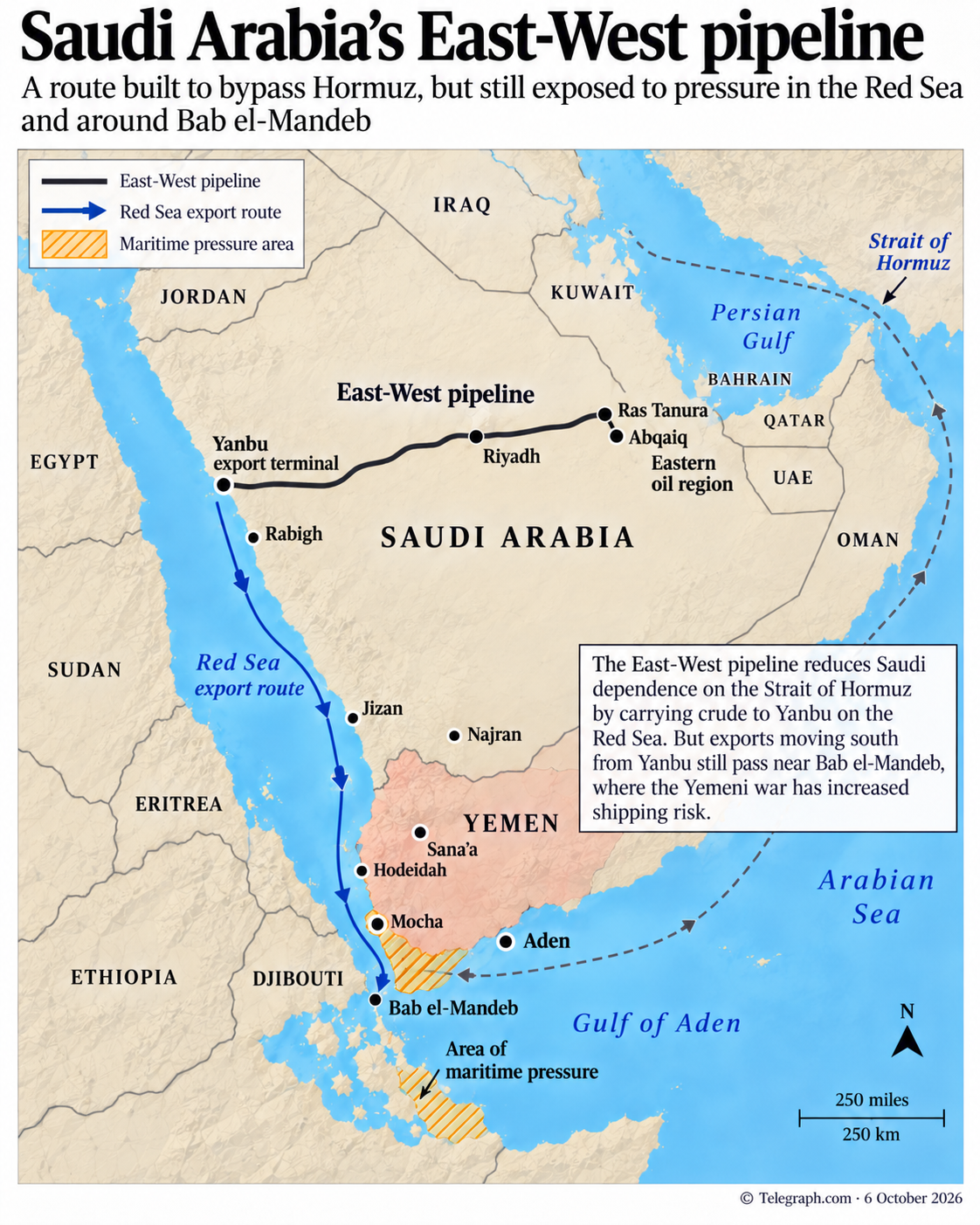
Sana’a-aligned reporting has repeatedly drawn attention to precisely this vulnerability. It does not need to demonstrate that Saudi oil exports have stopped, because they have not. A campaign of economic pressure works long before complete interruption. Pumping equipment has to be repaired. Air-defence missiles have to be replaced. Tankers face higher insurance costs. Airlines make decisions according to perceived risk rather than waiting for an airport to become unusable. Commercial systems respond to uncertainty much faster than armies lose territory.
This also helps explain the recent discussion in Sana’a’s press of Saudi bridges and transport infrastructure after attacks on bridges in Yemen. Al-Thawrah’s reference to thousands of Saudi bridges should not be inflated into an official threat to destroy them all; it was not such an announcement. But it shows how the range of imaginable targets is expanding. A war that began with military positions and border fighting is increasingly being discussed through the infrastructure that sustains movement, trade and military operations across Saudi Arabia.
Bab el-Mandeb is not a gate
At sea, the same transformation is visible in another form. The familiar description of Bab el-Mandeb as a strategic “chokepoint” can give the impression that one side must physically occupy the shore and close the passage before it has meaningful leverage over shipping. The experience of the Red Sea shows otherwise. Sana’a says normal commercial traffic has continued while restrictions are directed at Saudi-linked vessels, and whether or not shipping companies accept that distinction, the threat itself can change behaviour. Ships need not be sunk in large numbers for routes to become more expensive, crews more reluctant, insurers more cautious or naval protection more elaborate.
For that reason, even confirmed Saudi-backed gains around Dhubab or Mocha would not automatically resolve Riyadh’s maritime problem. Driving Ansar Allah away from the shoreline would deprive it of useful terrain. Removing it from high ground overlooking the approaches to the strait could make surveillance and shorter-range attacks more difficult. But missiles and drones launched farther inland do not disappear with the loss of a coastal town, and a movement that has already demonstrated long-range strike capability does not need permanent possession of Bab el-Mandeb in order to threaten traffic passing through it.
Riyadh therefore confronts two different military tasks at once. Its allies can try to recover territory inside Yemen, and may well succeed in doing so. The harder task is to prevent each advance from producing a new round of retaliation against Saudi targets farther north. Air power can make exposed Yemeni positions difficult to hold, but aircraft cannot permanently patrol every pipeline, road, refinery, port and airport. Air-defence systems can intercept incoming weapons, but interception itself consumes expensive munitions and cannot guarantee perfect protection over such a large territory.
The harder contest for Riyadh
Ansar Allah’s position has its own weaknesses. Territorial losses can narrow its options. Launchers can be hunted. Intelligence networks can be penetrated. Stocks of missiles and drones are not unlimited, and the movement’s media have every incentive to minimise defeats, just as government-aligned outlets have every reason to magnify victories.
The immediate battlefield question nevertheless remains unresolved. Saudi-backed forces may have broken through around parts of Dhubab and the Bab el-Mandeb approaches, while Sana’a insists that the core of its positions remains intact and that reported victories at Mocha and elsewhere have been exaggerated. Until better evidence emerges, the responsible description is of a contested coastal belt rather than a settled transfer of control.
What is much less ambiguous is the direction in which the war is developing. Ansar Allah is trying to ensure that a Saudi-backed advance in Yemen creates consequences far beyond Yemen: at an airport in Riyadh, an oil facility on the Red Sea, a military base in the south or a commercial vessel moving through regional waters. Saudi Arabia may still possess the means to win local battles, but local victories will matter less if every gain obliges it to defend another part of the kingdom.
That is the contest now emerging around Bab el-Mandeb. Not simply who holds the coast, but whether Saudi Arabia can turn superior military power into security while Ansar Allah keeps widening the area in which insecurity can be imposed.