For decades, the United States built the world’s most sophisticated military around technological superiority, precision weapons and the ability to project overwhelming force thousands of miles from home. Chinese military thinkers are developing a different equation for defeating it: make the enemy unable to afford the fight, unable to replace what it spends, and unable to endure longer than you can.
In 1944, America’s most formidable weapon was not a bomber, tank or aircraft carrier but the industrial system behind them. American factories produced almost 300,000 military aircraft during the war, shipyards launched thousands of merchant vessels, and tanks, trucks, artillery and ammunition emerged in quantities that Germany and Japan could destroy but never consume quickly enough.
That arithmetic became one of the foundations of American victory. Equipment lost today could be replaced tomorrow because behind the battlefield stood an industrial continent largely beyond the enemy’s reach.
Eight decades later, Chinese military writers are returning to much the same equation, except that America now appears on the other side of it.
A phrase running through recent Chinese analysis captures the idea with remarkable economy:
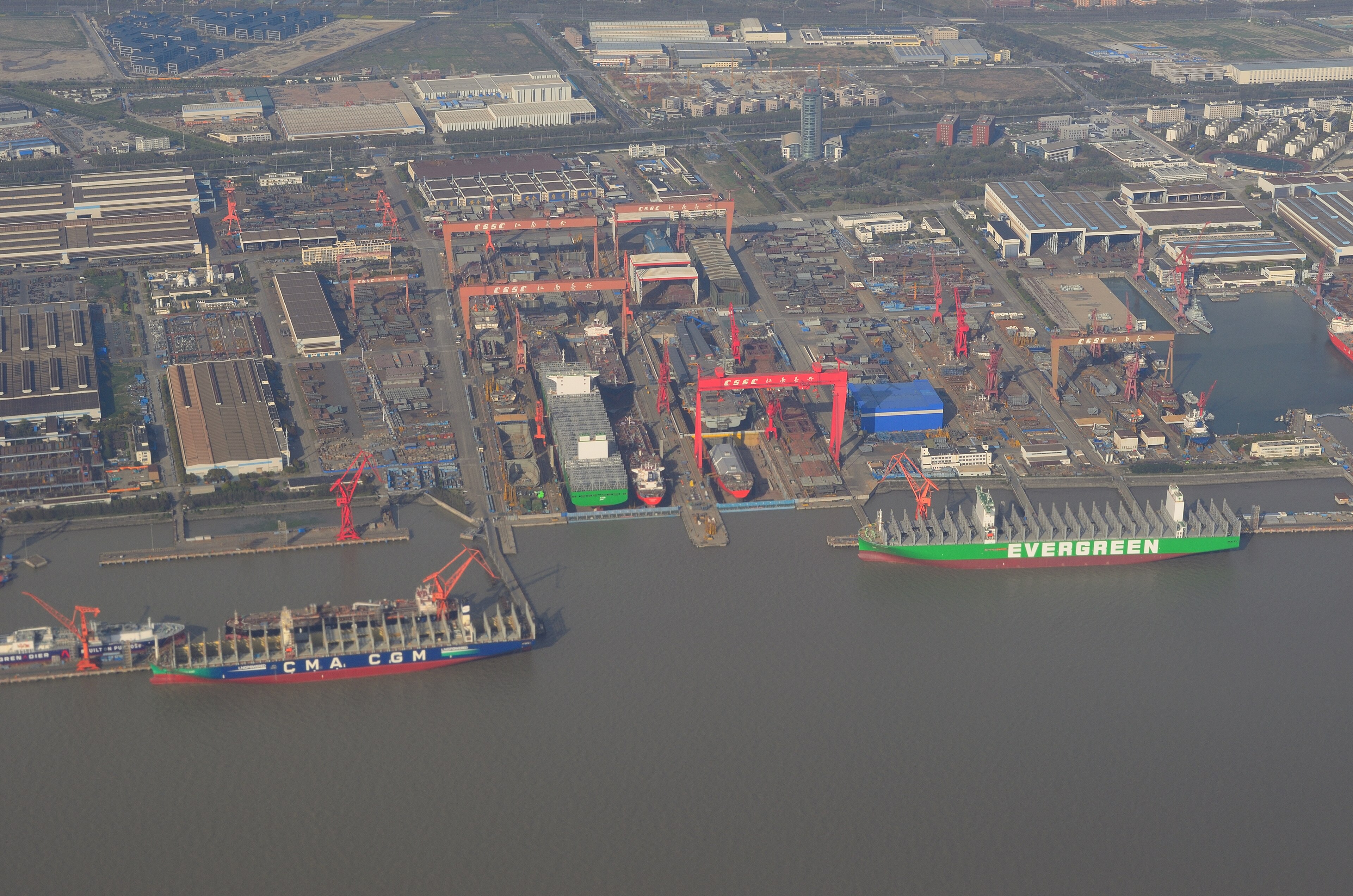
Jiangnan Shipyard on Changxing Island, Shanghai, one of the centres of China’s vast shipbuilding industry. The industrial depth behind China’s military expansion shipyards, steel, electronics, machinery and skilled labour , could become a decisive advantage in a prolonged war of attrition. Photo: Raysonho
打不起、补不上、耗不过
Make the enemy unable to afford the fight, unable to replace what it spends, and unable to endure longer than you can.
It represents something more sophisticated than the familiar argument that China can manufacture cheap drones while America builds expensive missiles. The emerging Chinese proposition is that modern warfare can be treated as a system of economic exchanges in which the objective is to force a technologically superior opponent to consume scarce resources faster than its industrial system can replace them.
If that analysis is correct, the decisive question in a future Pacific war may not be which country possesses the finest aircraft, missile or warship, but which can continue generating combat power after both have expended thousands of weapons.
How America changed the economics of war
The irony is that the vulnerability emerged partly from America’s extraordinary military success.
The transformation was demonstrated spectacularly during the 1991 Gulf War, when stealth aircraft, precision-guided weapons, satellites, electronic warfare and sophisticated command systems dismantled much of Iraq’s military at extraordinary speed. Precision appeared capable of replacing mass, and during the following three decades the United States perfected that model.
Aircraft became more capable, missiles more accurate and sensors able to locate targets hundreds or thousands of miles away. Computers connected reconnaissance, weapons and commanders into increasingly elaborate networks, giving relatively small numbers of American platforms destructive power that earlier generations could scarcely have imagined.
But technological sophistication brought another consequence. Precision required complexity, complexity increased cost, and cost eventually produced scarcity.
An F-35 is incomparably more capable than a wartime fighter, but it cannot be manufactured on anything resembling a wartime production line. Modern air-defence interceptors contain sophisticated seekers, electronics, propulsion and guidance systems supplied by specialised industrial networks that can take years to expand. The same difficulty applies to long-range anti-ship missiles, cruise missiles, submarines and many of the weapons on which American power projection now depends.
America had created an extraordinarily lethal military, but also one whose most valuable components could become difficult to replace during a prolonged war.
Chinese military writers appear to have identified the contradiction.
THE CHINESE EQUATION
打不起 â Unable to afford the fight
Force the opponent to exchange expensive defensive weapons and resources for inexpensive threats.
补不上 â Unable to replace what it spends
Consume ammunition and equipment faster than the opponent’s industrial system can replenish them.
耗不过 â Unable to outlast the opponent
Turn battlefield attrition into a competition between national industrial systems.
The ant and the elephant
On July 9, 2026, Chinese military media published an unusually revealing discussion of asymmetric attrition under a title that translates roughly as “How does the ant swallow the elephant?”
The argument was not that inexpensive weapons automatically defeat sophisticated ones. Instead, the authors asked how disparities in cost, production and consumption could be manipulated until the stronger opponent found itself trapped in an unfavourable exchange.
Consider a relatively inexpensive one-way attack drone approaching an American airbase. It may never reach its target, yet the defender must detect it, classify it and decide whether it represents a genuine threat. Aircraft may be dispersed, operations interrupted, defensive radars activated and an interceptor assigned to it.
If a missile costing hundreds of thousands or millions of dollars destroys the drone without anything on the ground being damaged, the conventional calculation records a successful interception. The Chinese calculation asks a different question: what did the defender have to spend to achieve it?
This is the crucial change in perspective. The revolution is not that a $20,000 drone can necessarily destroy a $100 million aircraft; it is that the $20,000 drone can force the defender to behave as though it might.
The attacker has purchased defensive expenditure.
That advantage is magnified because the attacker chooses when and where to strike while the defender must maintain surveillance and protection continuously. An inexpensive weapon can therefore impose costs even when it destroys nothing.
When 95 interceptions may not mean victory
Quantity transforms the equation further.
Chinese military writing during the summer examined attacks involving hundreds or potentially thousands of autonomous systems approaching from different directions and altitudes. A September analysis identified three finite thresholds inside any defensive architecture: fire channels, ammunition stocks and information-processing capacity.
This exposes the weakness in asking simply whether Patriot, Aegis or another defensive system “works”. An interceptor may have an excellent probability of destroying its target, but the system surrounding it is not infinite. Radars have tracking limits, combat-management systems have engagement limits, launchers contain finite ammunition, warships possess a fixed number of vertical-launch cells and communications networks have finite capacity.
The attacker’s problem consequently changes from defeating American technology to presenting American technology with more simultaneous problems than it can process.
If 100 inexpensive autonomous weapons attack an installation and 95 are destroyed, the immediate result appears overwhelmingly favourable to the defender. Yet if achieving that result consumes scarce interceptors, exposes defensive positions and disrupts operations, while another hundred weapons can arrive the following day, the interception percentage tells only part of the story.
The more important measurement becomes the exchange ratio.
THE SATURATION PROBLEM
Modern air defence contains several hard limits:
Fire channels: how many targets can be engaged simultaneously.
Magazine depth: how many defensive weapons are immediately available.
Information capacity: how many threats sensors, networks and commanders can identify and process.
Reload time: how quickly exhausted launchers can return to combat.
Mass attacks do not necessarily have to defeat an interceptor technologically. They can attempt to exceed one or more of these thresholds.
The empty launcher
This leads directly to the second part of the Chinese equation: make the opponent unable to replace what it spends.
An American destroyer can carry an extraordinary concentration of firepower, but its vertical-launch cells remain finite. Every interceptor fired defending the ship or another asset exchanges some of tomorrow’s combat power for survival today, and eventually the ship must replenish.
The same arithmetic applies ashore. Patriot interceptors, THAAD missiles, Tomahawks and long-range anti-ship weapons cannot be replenished from an unlimited warehouse.
Washington has recognised the danger and is investing heavily in additional production. PAC-3 MSE output has risen substantially, Tomahawk production is being expanded, 155mm ammunition capacity has increased sharply, and billions of dollars are flowing into rocket motors, energetics, factories and vulnerable supply chains.
This should not be portrayed as an America oblivious to the problem. Quite the opposite: the scale of the Pentagon’s response demonstrates how seriously it now takes the problem.
The critical measurement in prolonged war is no longer simply how many missiles America possesses on the first morning, but how quickly it consumes them compared with how quickly American industry can replace them.
A launcher need not be destroyed to lose much of its combat value. Empty it faster than it can be replenished and, until the ammunition returns, much of the capability represented by the launcher disappears with it.
Ukraine exposes the arithmetic
Ukraine has provided the most extensive modern laboratory for this new economy of war, although it would be wrong to treat the conflict as a miniature simulation of America fighting Russia or China.
The United States possesses capabilities Ukraine does not, including stealth bombers, attack submarines, enormous intelligence networks, sophisticated tactical aviation and far greater logistical resources. What Ukraine has demonstrated, however, is the voracious consumption produced by sustained industrial warfare.
Artillery ammunition disappears in quantities peacetime procurement systems were never designed to replace. Air-defence interceptors become strategic assets, while drones and electronic warfare systems can pass through several generations of adaptation during the time a conventional Western procurement programme might still be completing its paperwork.
American 155mm production consequently had to be expanded from a peacetime base measured in the low hundreds of thousands of rounds annually toward capacity exceeding one million.
Ukraine did not create America’s industrial problem. It exposed it.
It also demonstrated why the economics cannot be separated from technology. A cheap drone defeated by electronic warfare or a burst of inexpensive gunfire creates no favourable exchange for the attacker. Ukrainian forces have therefore experimented constantly with jamming, guns and inexpensive interceptor drones rather than relying exclusively upon costly surface-to-air missiles.
The lesson is not simply that cheap defeats expensive, but that cheap, sufficiently capable, networked and mass-producible systems can impose disproportionate costs upon sophisticated systems that exist in limited numbers.
The factory returns to the battlefield
The Chinese analysis becomes most interesting when it leaves the battlefield altogether.
The July essay asks what happens when military stockpiles begin running down and turns immediately to steel, chemicals, electronics, machinery and civilian manufacturing. A prolonged war, its authors argue, requires an economy capable of converting civilian industrial capacity into military production while maintaining redundant facilities so that the destruction of one production centre does not cripple the whole system.
The factory therefore becomes part of the order of battle.
This brings the argument full circle to America in 1941-45, when an enormous civilian industrial economy was converted into an arsenal. Automobile manufacturing, shipbuilding, steel, aluminium, chemicals and machine tools were redirected toward war production while American factories remained largely beyond the reach of German and Japanese attack.
Today’s United States remains vastly richer and technologically more sophisticated than the America that entered the Second World War, but its industrial architecture is different. Decades of specialised procurement, consolidation among defence suppliers, just-in-time production and global supply chains have created vulnerabilities poorly suited to sudden wartime expansion.
The Pentagon has acknowledged this. Its first National Defense Industrial Strategy, published in 2024, called for resilient supply chains, larger stockpiles and production capacity capable of expanding during crisis.
But appropriating money and creating industrial capacity are different things. Congress can approve another billion dollars overnight; it cannot create skilled workers, explosives plants, rocket-motor production lines or specialist suppliers overnight.
THE INDUSTRIAL WAR
Second World War America: mass civilian industry converted rapidly into military production while the continental industrial base remained largely beyond enemy attack.
The modern US model: exceptionally sophisticated weapons produced through specialised supply chains and relatively concentrated defence industries.
The Chinese proposition: force those expensive systems into sustained consumption, then allow production rates and industrial depth to decide which side can continue.
China’s industrial hinterland
China is fundamentally different from the opponents against which the United States has conducted its major post-Cold War expeditionary campaigns because behind the People’s Liberation Army stands an enormous civilian manufacturing economy.
Shipbuilding provides the most visible example. China’s share of global commercial ship construction dwarfs America’s. It would be misleading to equate commercial tonnage directly with naval capabilityâa container ship is not a nuclear submarineâbut shipbuilding ecosystems contain precisely the assets prolonged maritime warfare requires: steel, welders, engineers, electrical systems, dry docks, cranes, suppliers and skilled labour.
The same broader question applies to electronics, chemicals, machine tools and many other industrial sectors.
China’s military thinkers are therefore returning to an idea American strategists once understood intimately: national industrial endurance can itself become a weapon.
Then comes the Pacific
The industrial comparison becomes more serious when geography is added.
A war over Taiwan would occur immediately off China’s coastline and thousands of miles from the continental United States. Chinese aircraft would operate principally from home territory and its missiles from a continental logistical system, while replacement equipment could move toward the theatre through domestic infrastructure.
American combat power has to cross the Pacific.
That requires tankers, transports, ships, ports, fuel facilities, ammunition depots, communications networks and forward airbases, creating a long chain whose individual components can themselves become targets.
For much of the post-Cold War period the logistical architecture behind American expeditionary warfare was comparatively secure. China has spent decades developing missiles and sensors capable of challenging that assumption.
The Pentagon’s own assessments say Chinese ballistic and cruise missiles can threaten American and allied airfields, ports, communications and logistics installations across the western Pacific, including Guam.
This is where China’s thinking about systems destruction warfare meets its thinking about resource exchange. An F-35 does not exist independently of its runway, fuel, weapons, maintenance, communications, intelligence and aerial refuelling. A carrier depends upon escorts, satellites, communications, replenishment ships, ports and ammunition.
An opponent therefore need not destroy every aircraft or sink every ship if it can sufficiently disrupt the system that allows those platforms to generate combat power.
Distance does not merely slow American reinforcement. It multiplies the resources America must spend simply to remain in the fight.
Can America reverse the exchange?
The United States is already trying.
The Air Force’s Agile Combat Employment concept disperses aircraft rather than concentrating them at a handful of vulnerable installations. The services are developing cheaper counter-drone weapons, guns, lasers and high-powered microwave systems intended partly to escape the economics of firing multimillion-dollar interceptors at inexpensive unmanned aircraft. Missile production is expanding, stockpiles are receiving greater attention and contested logistics has moved towards the centre of American planning.
America also possesses an advantage sometimes overlooked in simple US-China comparisons: allies. Japan, Australia, South Korea, the Philippines and other partners potentially provide geography, infrastructure and industrial capacity that Beijing cannot easily reproduce.
China has vulnerabilities of its own. Its industrial economy depends upon enormous flows of energy, raw materials and trade, while a major Pacific war could devastate the commercial system upon which Chinese prosperity depends. Its military has not fought a major war for decades, and industrial capacity cannot compensate automatically for operational mistakes, poor leadership or battlefield losses.
Nor is there anything inevitable about cheap weapons defeating sophisticated ones. If a $20,000 drone can be destroyed with inexpensive gunfire, electronic warfare or another cheap drone, the exchange turns back in the defender’s favour.
That may become one of the central technological contests of the coming decade: not simply who possesses the most advanced weapon, but who can make the opponent spend more to attack or defend than the action costs to initiate.
America’s old weapon
None of this proves that China would win a war over Taiwan. War cannot be reduced to an industrial spreadsheet, and American forces could inflict catastrophic damage upon China. Simulations of a Taiwan invasion have repeatedly produced scenarios in which Beijing fails, albeit sometimes at enormous cost to the United States, Japan and Taiwan.
The more important question is whether America’s traditional technological superiority can still reliably produce decisive victory when a major opponent combines mass, precision, industrial depth and the geographic advantage of fighting close to home.
That brings the argument back to 1944.
America once confronted Germany and Japan with an unbearable proposition: whatever they destroyed, American factories could replace. Aircraft returned from assembly lines, ships emerged from yards and ammunition continued crossing the oceans until the enemy could no longer match the scale of production behind American military power.
Eight decades later, Chinese military thinkers appear to be studying that lesson from the opposite side.
They do not necessarily need to construct a superior version of every American weapon, destroy the entire US military or project an equivalent force across the Pacific. Their objective can be more economical: make sustaining American combat power close to China cost progressively more than China must spend challenging it.
Their emerging formula captures the strategy:
Make the enemy unable to afford the fight, unable to replace what it spends, and unable to endure longer than you can.
For much of the twentieth century, that was America’s equation.
The great question hanging over a future Pacific war is whether America has allowed it to reverse.
SOURCES AND FURTHER READING
Chinese military writing
PLA Daily / China Military Network, 9 July 2026 — “How Does the Ant Swallow the Elephant? Exploring the Attrition Logic of Asymmetric Warfare.”
The central source for this article. It describes modern war as an unequal exchange of resources and industrial capacity designed to push an adversary into the condition 打不起、补不上、耗不过 — unable to afford the fight, unable to replenish what it consumes, and unable to outlast its opponent. It also discusses civilian industrial mobilisation, production speed, supply-chain resilience and imposing disproportionate costs through attacks on strategic nodes.
Read the original Chinese article
PLA Daily / China Military Network, 8 July 2026 — “Unmanned Combat Technology Accelerates its Evolution.”
Examines low-cost drones, decentralised swarms and saturation attacks. It argues that hundreds or thousands of drones arriving from different directions can fill the “fire channels” of existing air-defence systems even if most of the attacking aircraft are ultimately destroyed.
Read the original Chinese article
PLA Daily / China Military Network, 15 December 2022 — “Defending Successfully Costs Enormously; Failing to Defend Causes Enormous Losses.”
An important precursor to the 2026 argument. It describes “value-asymmetric consumption”: relatively inexpensive suicide drones can compel defenders to consume air-defence missiles costing hundreds of thousands or millions of dollars, creating an increasingly unfavourable exchange.
Read the original Chinese article
National Defense University / RAND — “Systems Confrontation and System Destruction Warfare.”
A detailed study based on Chinese-language military sources explaining the PLA concept that modern war is fought between operational systems rather than simply individual platforms. The objective is to preserve one’s own system while attacking critical nodes whose disruption can degrade or paralyse the adversary’s wider combat system. The study also cautions that some PLA concepts remain aspirational rather than fully fielded capabilities.
Read the study
National Defense University Press — “Toward a More Joint, Combat-Ready PLA?”
Traces the PLA’s reaction to American operations in the Gulf War and Kosovo and its subsequent emphasis on informationised warfare, precision strike and attacking critical nodes. It describes Chinese military thinking in which paralysing key links can cause an entire combat system to lose effectiveness.
Read the NDU analysis
National Defense University Press, 2025 — “A New Step in China’s Military Reform.”
Examines the continuing importance of “system destruction warfare” in contemporary PLA organisation: the force best able to preserve its own information and operational systems while disrupting the enemy’s is considered more likely to prevail.
Read the NDU analysis
US defence, industrial-base and operational sources
US Department of Defense — 2024 China Military Power Report and Pentagon briefing.
The Pentagon’s principal annual assessment of PLA strategy and capabilities. It documents China’s expanding missile, naval and long-range strike capabilities and the growing vulnerability of American and allied infrastructure in the western Pacific.
Pentagon briefing on the China Military Power Report
US Department of Defense — National Defense Industrial Strategy, January 2024.
The Pentagon’s first National Defense Industrial Strategy calls for resilient supply chains, flexible acquisition, workforce readiness and an industrial base capable of meeting much greater wartime production requirements.
Read the Pentagon summary
US Government Accountability Office — “Defense Industrial Base: Actions Needed to Address Risks Posed by Dependence on Foreign Suppliers,” July 2025.
GAO found that the Pentagon depends upon a network exceeding 200,000 suppliers while possessing limited visibility into much of the lower-tier supply chain. The report also examines foreign and single-source dependencies and efforts to increase ammunition production.
Read the GAO report
US Government Accountability Office — “Ukraine: Status and Challenges of DOD Weapon Replacement Efforts,” 2024.
Documents production lead times and supply-chain bottlenecks exposed by replacing weapons supplied to Ukraine, including sharp increases in lead times for some electronic components and billions of dollars committed to expanding production capacity.
Read the GAO report
Congressional testimony on US munitions production, June 2025.
Records approximately $29.8 billion in FY2025 munitions procurement and investments intended to raise 155mm artillery capacity toward 100,000 rounds a month and PAC-3 MSE production capacity from 550 to 650 missiles annually, alongside expansion of other missile programmes.
Read the congressional testimony
US Department of Defense — Strategy for Countering Unmanned Systems, December 2024.
The Pentagon acknowledges the growing military importance of inexpensive unmanned systems and the need to address the imbalance between the low cost of drones and the substantially greater cost of many existing countermeasures.
Read the Pentagon strategy summary
US Army / Joint Interagency Task Force 401, 21 August 2026.
Brigadier General Matt Ross describes the same cost-exchange problem examined in the Chinese literature: the United States does not want to fire an expensive interceptor at an inexpensive drone because large-scale attacks can leave the defender on the wrong side of the cost curve.
Read the Army roundtable transcript
US Army — Directed-energy counter-drone programme, 2026.
Army material describes lasers as offering low cost per shot and deep magazines against drone attacks, illustrating Washington’s effort to reverse the unfavourable exchange ratio identified by both American and Chinese analysts.
Read the Army analysis
US Department of Defense — “The Future Character of War.”
Then-Deputy Defense Secretary Kathleen Hicks describes the return of “precise mass”: inexpensive, attritable autonomous systems combining quantity with precision. She contrasts this with the earlier American model in which technological advances allowed the United States to trade mass for precision.
Read the Pentagon speech
US Department of Defense — Replicator.
The Pentagon’s programme to field large numbers of affordable autonomous systems demonstrates that the United States itself is moving toward attritable mass rather than relying exclusively upon exquisite platforms. Replicator 2 focuses on countering small unmanned aircraft.
Read the Pentagon Replicator update
US Air Force — Agile Combat Employment and the 2025 Indo-Pacific Department-Level Exercise.
US forces practised dispersed operations across more than 50 locations spanning roughly 3,000 miles, illustrating the Air Force response to vulnerable concentrated bases and the requirement to sustain distributed forces in contested environments.
Read the Air Force account
US Navy — Tomahawk production agreement, 17 August 2026.
The Navy announced a $22.9 billion Tomahawk contract intended to accelerate production. The programme is part of the wider American effort to rebuild magazine depth and industrial capacity for prolonged high-intensity warfare.
Read the US Navy announcement
RTX / Raytheon — Munitions production expansion, February 2026.
Framework agreements call for annual production capacity of more than 1,000 Tomahawks, at least 1,900 AMRAAMs and more than 500 SM-6 missiles, alongside expansion of SM-3 production.
Read the RTX announcement
Source note: PLA Daily and China Military Network articles are evidence of ideas being discussed and developed within China’s military intellectual establishment. Individual articles should not automatically be treated as formal PLA doctrine or proof that China possesses the operational capability to execute every concept described. US government and military sources are included both to test the Chinese propositions and to identify areas in which the Pentagon itself acknowledges similar problems.