A Pentagon inspector general report has reopened scrutiny of one of the deadliest civilian casualty incidents of the war on Iran: the destruction of Shajareh Tayyebeh Elementary School in Minab. The report does not mention the school directly. It does something potentially more damaging. It documents the degradation of the United States military’s civilian harm mitigation system at the precise moment American forces were accused of killing large numbers of children in a strike that Congress itself later demanded be investigated publicly.
The report is technical. The implications are not.
On May 13, 2026, the Department of War inspector general issued Evaluation of the DoW’s Implementation of the Civilian Harm Mitigation and Response Action Plan, report number DOWIG-2026-084. Its stated objective was to assess whether the Pentagon had properly implemented the Civilian Harm Mitigation and Response Action Plan, known as CHMR-AP. That plan was created after years of civilian deaths in America’s post-9/11 wars, and was meant to give the military the personnel, procedures, databases and institutional discipline needed to prevent, track, investigate and learn from civilian casualties.
The inspector general found that the plan contained 11 objectives and 133 implementing actions. None of those objectives had been fully implemented by the end of fiscal year 2025. The report also found that components had ended funding for the CHMR data management platform, stopped steering committee meetings, lost or reassigned many civilian harm personnel, and lost personnel and leadership at the Civilian Protection Center of Excellence.
The report can be read here: Pentagon Inspector General Report DOWIG-2026-084.
That last point matters. The Civilian Protection Center of Excellence was not an ornament. It was the institutional memory of America’s long record of civilian deaths in the global war on terror, a body intended to assess civilian harm, draw lessons from past failures, and embed those lessons into future military operations.
The report did not accuse the United States of war crimes. It did not refer to Iran. It did not mention Minab.
But within Washington, lawmakers and former Pentagon officials immediately understood the problem.
The report described the weakening of precisely the systems designed to prevent catastrophic civilian casualty events during wartime operations. And by the time the report appeared, Minab had already become impossible to ignore.
The strike occurred on the morning of February 28, 2026.
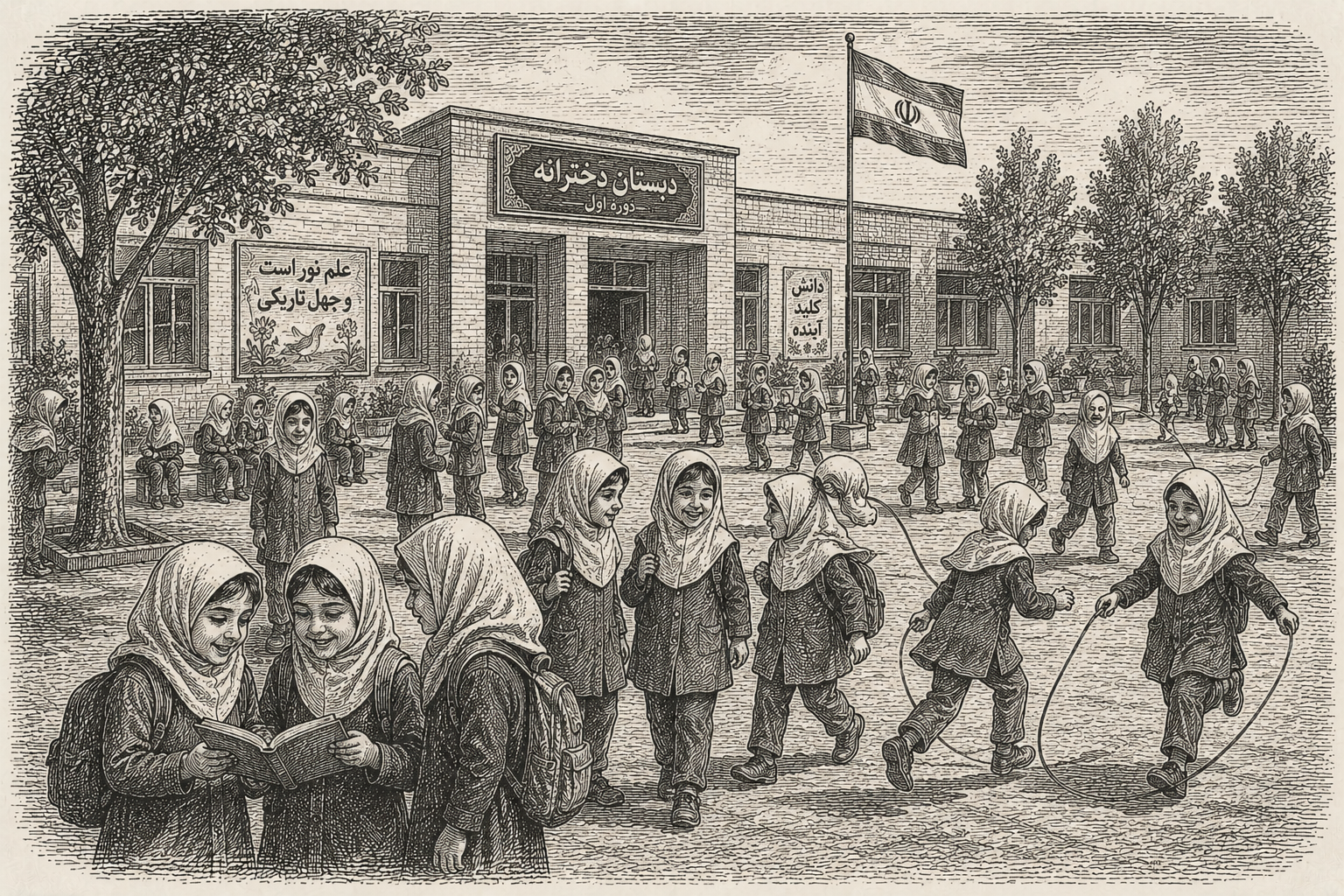
Shajareh Tayyebeh Elementary School stood in the southern Iranian city of Minab, near an IRGC naval compound close to the Strait of Hormuz. Iran said the strike killed large numbers of children. Preliminary reporting later suggested US forces may have relied on outdated targeting data that did not distinguish adequately between the school and the adjoining military base. Video and other evidence suggested the school was hit by a Tomahawk cruise missile, a precision guided munition closely associated with US forces.
The school was not a hidden structure in a remote battlefield. It had a years long public online presence, including photographs of students gathered in the yard. Satellite imagery showed the building had been walled off from the military base and appeared to have operated as a school for years, with school markings visible on or around the site.
The strike came during the school morning. Teachers and staff were reportedly trying to move children as the wider attack unfolded. Then the missile hit.
Iran said 168 children were killed. Other accounts have given different figures, but every serious report points to mass child casualties. Even at the lowest cited numbers, Minab stands among the gravest school casualty incidents linked to American military action in decades.
The physical facts are what make the case so severe.
A functioning school. Children present. A known location. A site with public records, photographs and visible school markings. A precision weapon. A preliminary account pointing to obsolete targeting data.
That is not merely a battlefield tragedy. It is an institutional failure allegation.
Witnesses described explosions tearing through the school building while children and staff were still inside or attempting to flee. Rescue workers later reported classrooms collapsing under blast pressure and fragmentation.
Images from the aftermath showed the ordinary objects of school life inside a battlefield ruin: children’s shoes in rubble, burned school bags, shattered desks, collapsed walls and blood stained notebooks lying in concrete dust and glass.
Several witnesses later alleged there was a second or follow up strike after survivors and rescuers gathered elsewhere in the compound. Analysts examining video evidence reported repeated impacts in the area over less than a minute. Whether that legally constitutes a deliberate double tap remains disputed. The existence of repeated impacts in the immediate area is central to the allegation.
The Pentagon publicly maintained that the incident was under investigation. Hegseth declined to comment on preliminary findings, saying the department would not let reporting force its hand. A higher level investigation, led by a general officer outside US Central Command, was reportedly ordered, and such an administrative investigation could form the basis for disciplinary action if warranted.
But Congress did not treat the Pentagon’s formula as sufficient.
On April 30, during Senate questioning, Senator Kirsten Gillibrand put the issue directly. She cited reports that 22 schools, hospitals and civilian facilities had been hit in Iran, then asked whether the military was implementing the laws and targeting requirements designed to minimise civilian death. Admiral Brad Cooper replied that every operation had been conducted consistently with the law of armed conflict and that civilian casualties were “a particular passion” of his. Gillibrand’s response was simple: if civilians had been warned, “how did we then bomb 22 schools?”
The same hearing placed the cuts directly at Hegseth’s door.
Gillibrand asked Hegseth: “What is your response to targeting that has resulted in the destruction of schools, hospitals, civilian places? Why did you cut by 90% the division that’s supposed to help you not target civilians?” Hegseth replied that the Pentagon had an “ironclad commitment” to do more than other countries to prevent civilian deaths. Republican Senator Mike Rounds then continued the line of questioning, asking whether the Pentagon still had the resources necessary to protect civilians. Hegseth said it had “every resource necessary.”
The congressional question was not abstract. It was not a seminar about military ethics. It was put against the background of dead children, reported strikes on schools and hospitals, and a Pentagon inspector general report showing that the civilian harm system had lost staff, funding, leadership and operational machinery.
Gillibrand’s question went to causation and institutional responsibility: why cut the office designed to prevent civilian targeting failures while civilian sites were being destroyed?
Rounds’s question went to capacity: did the Pentagon still have the resources to protect civilians?
Hegseth’s answer was categorical. The department, he said, had every resource necessary. The inspector general report makes that answer difficult to sustain without further evidence.
The April letter from Senators Chris Van Hollen, Elizabeth Warren, Kirsten Gillibrand and others went further. It accused Hegseth of degrading civilian harm prevention programmes, firing personnel at the Civilian Protection Center of Excellence and slashing CHMR staff at combatant commands by more than 90 percent. The senators wrote that attacks on Iranian civilian infrastructure had led to more than 1,700 confirmed civilian deaths and specifically identified the Minab girls’ school strike as having killed children and teachers.
Their letter framed the issue in terms that now sit directly beside the inspector general report. Civilian harm mitigation was not merely morally desirable. It was central to operational effectiveness, US interests and legal compliance. Congress had codified reforms into law, including the formal creation of the Civilian Protection Center of Excellence, precisely to institutionalise processes for preventing and responding to civilian harm.
The Pentagon’s defence is familiar. It says it does not deliberately target civilians. It says the Minab incident is under investigation. It says the United States follows the law of armed conflict. It says it retains every resource necessary to protect civilians.
The evidence now available creates a harder record.
First, the inspector general says the civilian harm action plan was not fully implemented. Second, the same report says funding, meetings, personnel and leadership were lost or reassigned. Third, Congress says Hegseth cut the relevant staffing by more than 90 percent. Fourth, the Minab school strike produced mass child casualties. Fifth, preliminary reporting points toward outdated targeting data and possible US responsibility.
The report does not prove that the degradation of civilian harm safeguards caused the deaths at Minab. It does not make that finding, and the article should not pretend that it does.
But the report supplies official evidence that the Pentagon’s civilian harm architecture was incomplete, weakened and possibly non-compliant with federal law at the same time the United States was accused of striking a school full of children.
That is enough to make Minab more than an isolated tragedy.
It makes Minab the test case for whether America’s post-9/11 civilian protection system still exists in substance, or only on paper.
And if Hegseth says the Pentagon has every resource necessary, the burden now shifts back to him.
To explain how a school with public markings, photographs, children and years of visible existence came to be struck at all.
Key Sources and Congressional References
-
Evaluation of the DoW’s Implementation of the Civilian Harm Mitigation and Response Action Plan, Department of War Inspector General, Report DOWIG-2026-084, May 13, 2026.
Source: media.defense.gov -
Senators Demand Answers From DoD on Elementary School Strike and Civilian Casualties in Iran, letter led by Senator Tim Kaine and others to Defense Secretary Pete Hegseth, March 11, 2026.
Source: kaine.senate.gov -
Letter to Secretary Hegseth on Civilian Harm and Minab School Strike, Senators Chris Van Hollen, Elizabeth Warren, Kirsten Gillibrand and others, April 2026.
Source: vanhollen.senate.gov -
Watch: Gillibrand Presses Pentagon on Bombing of Schools and Hospitals in Iran, Senate Armed Services Committee questioning of Admiral Brad Cooper and Pete Hegseth, April 30, 2026.
Source: gillibrand.senate.gov -
Pentagon Elevates Investigation Into Iran School Strike, Reuters, March 13, 2026.
Source: reuters.com -
Bombed Iranian Girls’ School Had Vivid Website and Years Long Online Presence, Reuters investigation, March 12, 2026.
Source: reuters.com -
Pentagon Civilian Harm Programme Quietly Shut Down, The Guardian, May 15, 2026.
Source: theguardian.com -
Iran: Those Responsible for Deadly and Unlawful US Strike on School That Killed Over 100 Children Must Be Held Accountable, Amnesty International, March 2026.
Source: amnesty.org -
Video Shows US Tomahawk Missile Strike Next to Girls’ School in Iran, Bellingcat analysis, March 2026.
Source: bellingcat.com -
Lawmakers Question Hegseth on Cost of Strike Linked to Iranian School Incident, Anadolu Agency, April 2026.
Source: aa.com.tr