Trump’s South Pars Warning Signals the Iran War Is Now Being Fought Through Energy Systems
by Jaffa Levy
·
The United States is attempting to contain a war it has already helped escalate, and in doing so has revealed that Gulf energy infrastructure is no longer peripheral to the conflict but central to it.
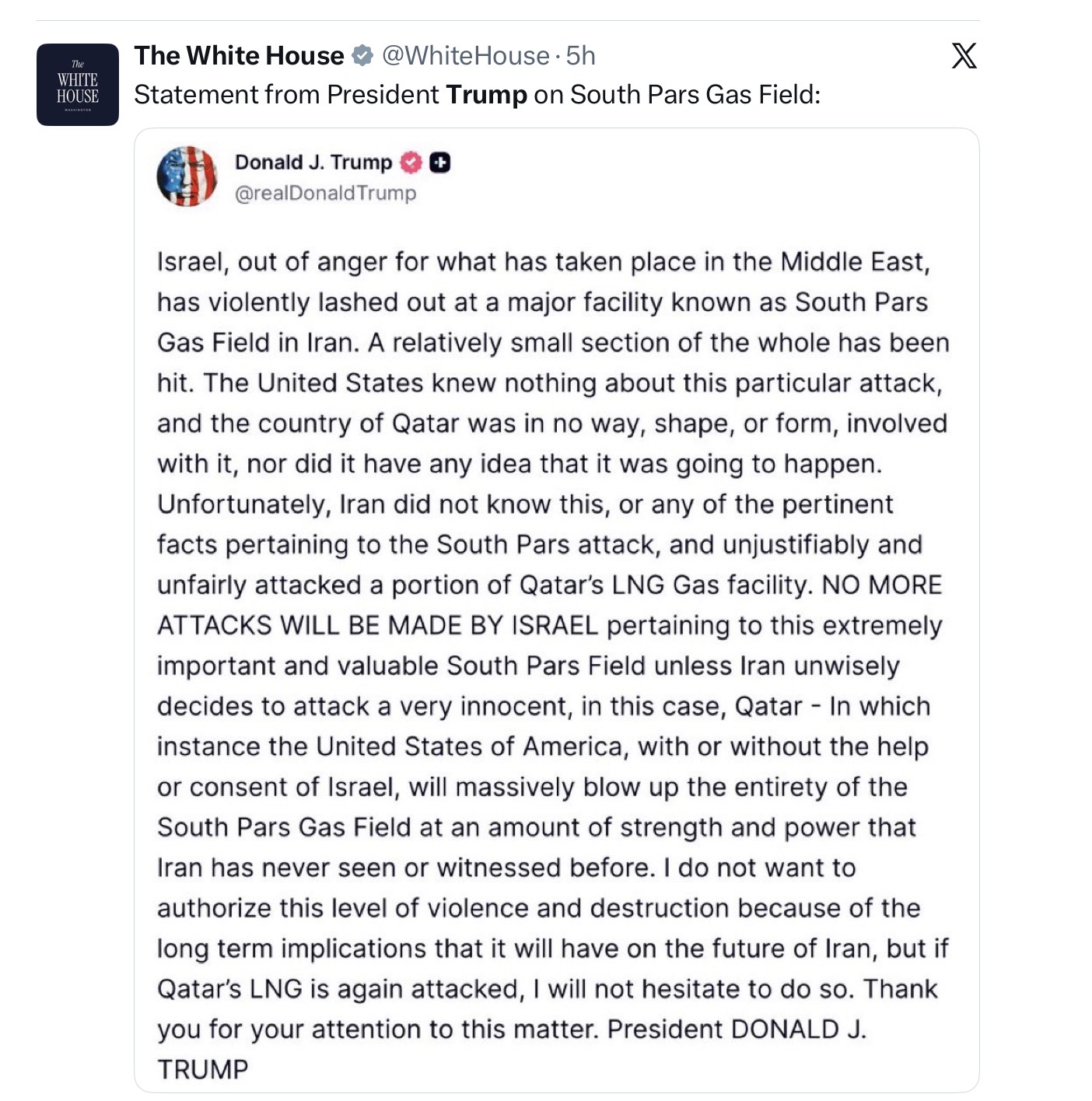
Public statement outlining escalation conditions tied to South Pars and Qatar LNG infrastructure.
Donald Trump’s statement on the South Pars gas field is not a routine warning. It is a public attempt to redraw escalation boundaries after they have already been breached, exposing the war’s shift from military exchange to systemic pressure on global energy.
The strike on Iran’s South Pars gas field marked a structural break in the war. Until now, escalation largely followed a recognisable pattern: strike, interception, retaliation, and containment. Energy infrastructure sat in the background, exposed but not central. That assumption has now collapsed.
South Pars is not a peripheral asset. It is the largest gas field in the world, shared between Iran and Qatar, and forms the backbone of Qatar’s LNG exports. Once it is struck, the war moves from military exchange into economic coercion. The battlefield does not expand geographically. It deepens systemically.
Trump’s statement is revealing precisely because it tries to separate what can no longer be separated. “The United States knew nothing about this particular attack,” he said, describing Israel’s strike as limited and driven by “anger.” At the same time, he issued a direct escalation threat: if Iran targets Qatar’s LNG infrastructure again, the United States, “with or without Israel,” would “completely destroy the gas field with unprecedented force.”
This is not a neutral position. It is an attempt to impose an asymmetric rule set after the threshold has already been crossed. Israel has struck a critical energy asset. Iran is now warned not to retaliate against comparable targets. The enforcement mechanism is explicit and disproportionate.
The credibility of the statement is immediately contested. Trump’s claim that Washington had no knowledge of the strike sits alongside reports from US and Israeli officials indicating that the operation was coordinated and approved in advance. That contradiction is not a detail. It is central to how the statement will be read in Tehran. Iran will not assess the wording. It will assess the sequence.
That sequence is straightforward. A major energy asset was struck. The United States did not prevent it. It now threatens overwhelming retaliation if Iran responds in kind. From Iran’s perspective, that is not deterrence. It is an attempt to lock in a strategic advantage while denying reciprocal escalation.
The Iranian response suggests that interpretation has already taken hold. Following the South Pars strike, Iran launched ballistic missiles at Qatar’s Ras Laffan LNG complex. The IRGC framed the escalation explicitly: “If repeated, our response will be far more severe.” This was not framed as signalling. It was framed as entry into a new phase of the war.
That phrase matters. A “new phase” is not rhetorical escalation. It is a declaration that the domain of conflict has changed. Energy infrastructure is no longer adjacent to the war. It is one of its primary instruments.
The escalation ladder is now visible. South Pars is struck. Ras Laffan is hit in response. Iranian messaging expands the target set, warning that energy facilities across Saudi Arabia, the UAE, and Qatar could be considered legitimate targets if the pattern continues. Trump responds by drawing a red line around Qatari LNG and threatening destruction of the shared gas field itself.
This is not containment. It is managed escalation within an expanding system.
What has actually changed in this war
Energy infrastructure is now a primary target class, not collateral risk.
LNG and gas flows have become instruments of strategic pressure.
Gulf states are no longer insulated; their economic systems are inside the conflict.
Markets, insurance, and shipping are now active transmission channels of the war.
The market reaction reflects that shift. Brent crude has moved toward $110 to $112 per barrel. European gas prices have reportedly surged by more than 30 percent. US diesel has pushed above $5 per gallon. These are not marginal moves. They are early repricings of systemic risk.
The key variable is not immediate supply loss. It is repeatability. Once energy infrastructure is targeted once, it becomes targetable again. Markets price not just damage, but the probability of recurrence. LNG flows, shipping routes, insurance premiums, and refinery operations begin to adjust to a new baseline of risk.
This is the deeper transformation underway. The war is no longer primarily about degrading military capability. It is about manipulating exposure to interconnected systems. Energy flows, transport corridors, and industrial supply chains are now instruments of pressure.
Trump’s statement should therefore be read as escalation management under deteriorating conditions. It is an attempt to firewall one part of the system — Qatar’s LNG infrastructure — while preserving the strategic effects of the initial strike. In doing so, it implicitly concedes that the war has moved into a domain where uncontrolled expansion would carry global economic consequences.
There is also a secondary signal embedded in the statement. By indicating that Israel will refrain from further strikes on South Pars unless Iran escalates again, Washington is asserting control over the next phase of the conflict. This suggests that the United States is not merely supporting Israel, but actively managing escalation boundaries.
Whether that control is real or retrospective remains unclear. The fact that the strike occurred in the first place suggests that escalation boundaries are being defined after they are crossed, not before.
A sympathetic reading would argue that Trump is restoring deterrence. A clear red line is drawn. A protected asset is identified. A credible threat is issued. Iran is warned off expanding the war. The Gulf is reassured.
That argument has surface coherence but weak foundations. Deterrence depends on consistency. If one side is permitted to strike a critical asset while the other is warned against responding in kind, the system is not stabilised. It is distorted. Over time, such distortions tend to produce indirect, deniable, and less controllable forms of retaliation.
The more plausible reading is less comfortable. The war has entered a phase where control is being asserted after the fact, not maintained in advance. Each new threshold crossed requires a new warning, a new red line, and a new threat. The structure becomes layered, reactive, and increasingly unstable.
South Pars is now both target and hostage. Qatar’s LNG system has been elevated to protected status. Gulf energy infrastructure is being recast as leverage within a broader strategic contest. Once that transformation occurs, the conflict is no longer bounded by traditional military objectives.
It becomes a system.
And systems, once activated, are harder to stop than wars.