China’s bonds are acting like a haven because the inflation shock is hitting the West harder
by Jaffa Levy
·
China’s bond market is acting as a relative shelter in the current inflation and energy shock, but it is not replacing the dollar system. The explanation is structural, not mystical. China entered this period with lower inflation, weaker domestic demand, a looser policy bias, meaningful energy buffers, and a government bond market still shaped far more by domestic institutions than by volatile foreign flows.
The core shift
China does not need to replace the dollar to matter more in global markets. It only needs to behave differently enough from Western sovereign debt to attract capital when inflation shocks hit the West harder than they hit China.
China’s government bond market has shown a degree of resilience that Western sovereign debt has not. While US Treasuries, gilts and parts of the euro area bond complex sold off as energy risk, fiscal strain and inflation expectations were repriced higher, Chinese yields moved far less. In practical terms, that has allowed Chinese sovereign debt to behave as a relative haven inside this particular shock.
The significance of that divergence lies in what it says about the structure of the global economy. China is not being treated as a full replacement for the Treasury market, and the renminbi is not displacing the dollar as the central reserve currency. But China is offering something increasingly valuable in a fractured system: a sovereign bond market shaped by a different inflation cycle, a different policy stance, and a different ownership structure from those in the United States and Europe.
A bond market moving to a different rhythm
The bond move itself is the starting point. Chinese government yields have remained anchored close to the low 1.8 percent range while US and several European sovereign yields moved materially higher as markets absorbed the inflationary consequences of energy turmoil and geopolitical escalation. That contrast is the factual basis of the story. It is not a matter of rhetoric. It is a matter of market behaviour.
In bond markets, relative calm matters. Prices and yields move inversely. When sovereign debt is sold heavily, prices fall and yields rise. When Chinese yields remain comparatively steady while Western yields surge, the market is signalling that China is sitting inside a different set of assumptions about inflation, policy and economic risk.
Lower inflation changes the whole calculation
The first reason is inflation. China is not dealing with the same inflation profile as the United States or much of Europe. Consumer price pressures remain comparatively subdued, which means investors are under less pressure to demand sharply higher nominal yields to compensate for eroding purchasing power. That alone gives China a different starting point from the West.
Inflation is the hinge on which much of the recent global bond sell off has turned. An economy facing a strong inflation shock forces markets to consider tighter policy, higher term premia and greater fiscal stress. An economy facing lower inflation and softer nominal pressure does not produce the same repricing. China’s lower inflation has therefore acted as a stabiliser in its sovereign bond market at precisely the moment when inflation has destabilised others.
Inflation matters more than narrative
Markets do not need a theory of civilisational superiority to explain China’s bond resilience. Lower inflation, softer demand and different policy expectations are enough.
Weak demand is supporting bonds even as it weighs on growth
The second reason is less flattering, but no less important. China’s bond stability is partly a byproduct of weak domestic demand. The property crisis, subdued household confidence and slower nominal momentum have all limited inflationary pressure. That has kept yields low and strengthened the expectation that Beijing will preserve easier monetary conditions rather than confront the bond market with a tightening shock.
This is one of the central ambiguities of China’s position. A country can have stable sovereign bonds because it is strong, or because growth is soft and inflation is absent. China’s current market profile contains elements of both. Its bond market is benefiting from the fact that domestic weakness suppresses the very inflation pressure now punishing Western debt markets.
That makes Chinese bonds more attractive in a specific environment, but it also imposes a limit on triumphalist interpretations. Low yields do not automatically signal confidence in a dynamic growth model. Sometimes they signal the opposite: an economy that is not running hot enough to frighten the bond market.
Policy divergence is reinforcing the difference
Policy divergence is the third part of the story. Western bond markets have had to absorb the risk that inflation, energy prices and larger borrowing needs will keep policy tighter for longer, or at least force higher long term borrowing costs. China is confronting a different problem. Its policymakers are more concerned with weak demand, liquidity support and stabilising activity than with stamping out an inflation surge.
That difference matters because bond markets are forward looking. If investors believe Beijing is more likely to preserve loose liquidity conditions than to engineer a hawkish repricing, long dated yields face less upward pressure. In the United States and Europe, where inflation risks and fiscal burdens are higher, markets have been far less willing to grant that stability.
China’s sovereign market is therefore benefiting not only from a softer inflation backdrop, but from the expectation that policy will remain geared toward support rather than restraint. In a period of global bond stress, that distinction becomes decisive.
The energy buffer is real, but it is not immunity
Energy is another important part of the explanation. China is not insulated from the oil shock. It still imports large volumes of crude and remains exposed to disruption in the Middle East. But it entered this phase with meaningful cushions. It built inventories heavily, retains a broad industrial base, and has diversified parts of its energy sourcing more than some of its peers.
Those buffers change the shape of the shock. They do not eliminate it. Stockpiles buy time. Sourcing diversity reduces immediate vulnerability. Strong coal output and expanding renewable capacity soften some of the secondary pressure that would otherwise pass directly into inflation expectations. In a bond market context, that matters. Systems with greater buffer stock and substitution capacity experience shocks differently from systems that are more immediately exposed.
China’s energy position should not be romanticised. It is better understood as partial resilience. The country may be less immediately vulnerable than economies whose inflation and bond markets react more violently to the same commodity shock. That is enough to support Chinese sovereign debt without proving any grander claim.
Buffer stock, not invulnerability
China’s advantage in this shock lies in inventories, supply diversity and a different inflation profile. It does not lie in escaping global energy dependence altogether.
Domestic ownership gives the market a different character
The final structural reason for China’s relative stability is ownership. Foreign participation in China’s government bond market remains modest compared with the sovereign debt markets of the major Western economies. That means global capital flows exert less direct influence on pricing. The market is shaped far more by domestic banks, insurers, state institutions and local policy expectations than by international funds moving in and out at speed.
In calmer periods, critics treat that structure as a weakness. They see a market that is less open, less international and less trusted. In a shock, the same structure can look like resilience. A bond market that is less exposed to sudden foreign exits is less vulnerable to the violent feedback loops that drive panic selling elsewhere.
This is not evidence that China has surpassed the West financially. It is evidence that China’s bond market is built on different plumbing. In the present environment, that different plumbing has made it steadier than more globally exposed alternatives.
Why this still falls short of a dollar replacement
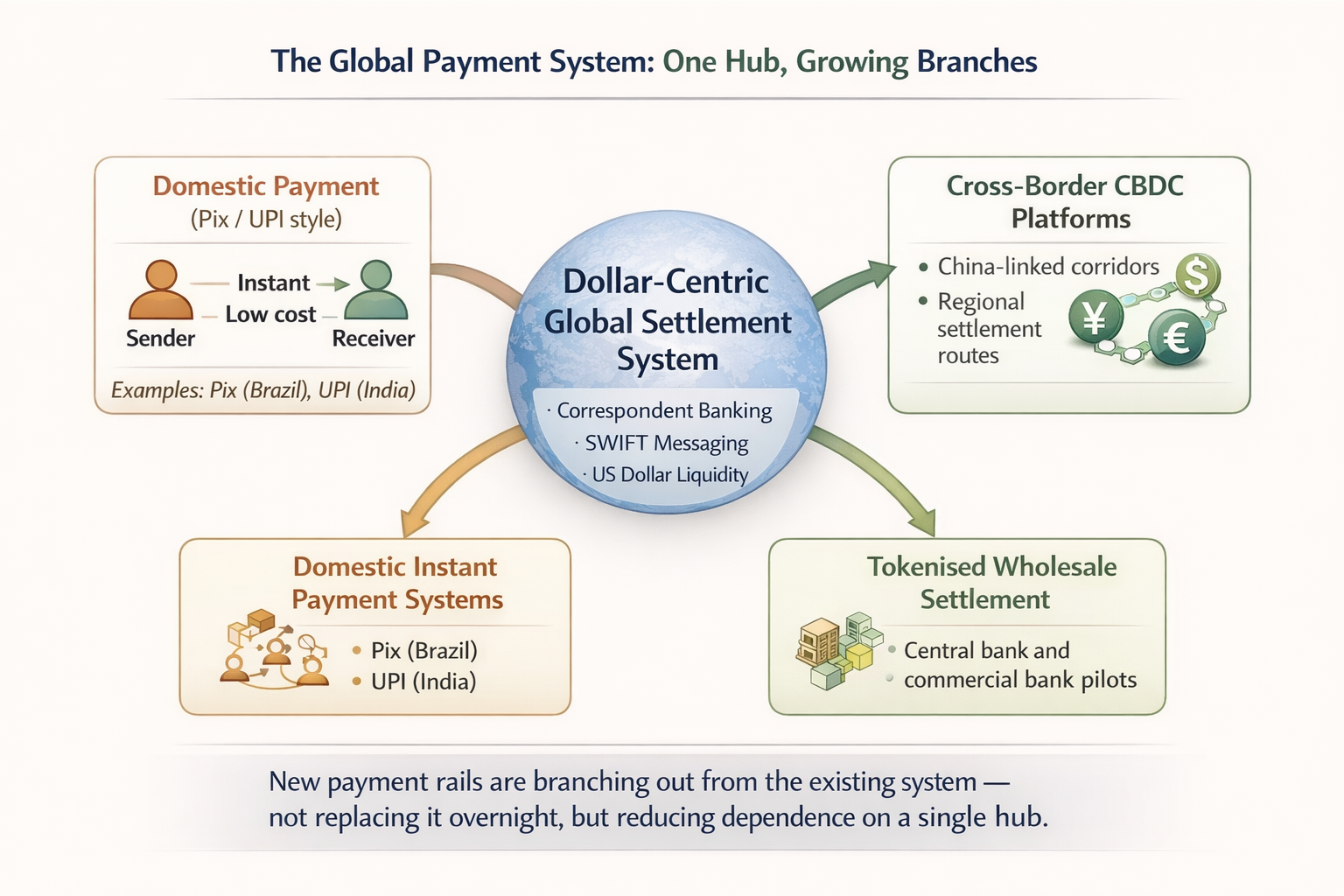
Even so, the limits are clear. A relative haven is not the same thing as a reserve hegemon. The dollar system remains dominant because it is not merely a bond market. It is the deepest collateral system in the world, the central settlement system in global finance, and still the core reserve framework for institutions across continents. China has not reproduced that architecture.
The renminbi still occupies only a small share of global reserves. China still operates with capital controls. Global reserve managers, pension funds and sovereign institutions continue to distinguish sharply between the legal predictability, convertibility and custody conditions available in the United States and those available in China. None of that disappears because Chinese government bonds performed better during one stretch of turmoil.
That is why China’s present success should be understood as tactical rather than hegemonic. It has become more useful to investors precisely because it behaves differently from the dollar system, not because it has supplanted it.
The real significance is fragmentation
The deeper significance of this episode is that the global system is fragmenting into economies with increasingly different inflation paths, energy vulnerabilities, policy instincts and capital structures. In that kind of world, relative haven status becomes more valuable even without full reserve currency status.
China’s bond market matters more because it offers differentiation. It offers investors a large sovereign market that is not moving in lockstep with the United States, Britain or the euro area. That differentiation is increasingly useful in a world of sanctions, energy shocks, strategic blocs and divergent monetary cycles.
The market is therefore sending a narrower but still consequential message. China has not built a new Treasury market for the world. It has built something more limited, but increasingly relevant: a partially insulated sovereign bond market that can outperform when the inflation shock hits the West harder than it hits China.
That is enough to matter. In a fractured financial order, investors do not need a new hegemon every time the old one comes under pressure. Sometimes they only need somewhere else to stand.