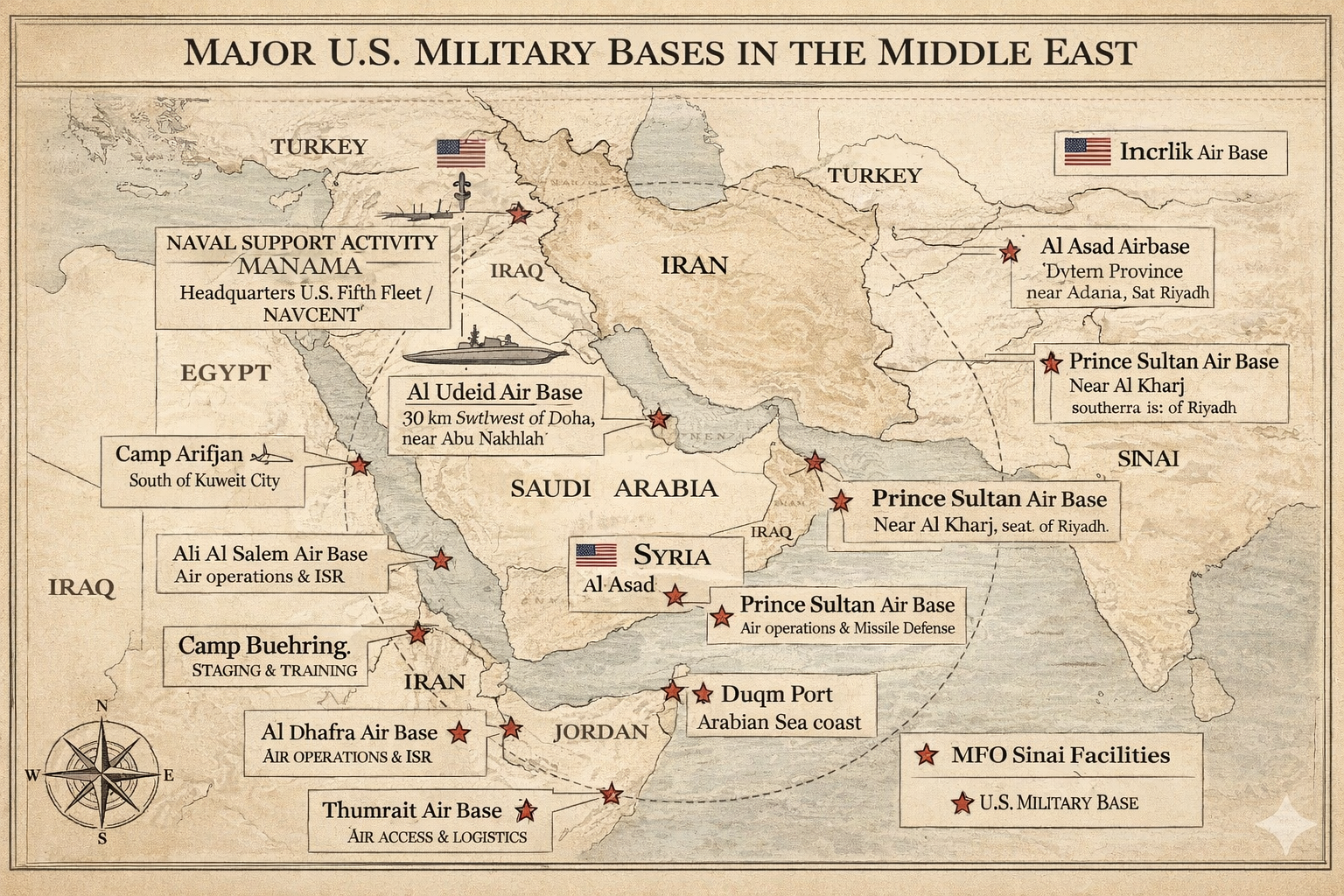
At America’s Middle East Air Hub, the Machinery of Escalation Is Quietly Assembling
by Jaffa Levy
·
Published
· Updated
Preparing for war as leverage.
The evidence points to preparation, not a decision: the United States is positioning for the possibility of conflict with Iran, without yet committing to one.
At Al Udeid Air Base in Qatar, the largest American military installation in the Middle East, some personnel were advised to leave in mid January. In the days that followed, US fighter aircraft deployed forward, an aircraft carrier entered the region, and airlift activity increased. Taken together, these developments establish a higher level of US military readiness around Iran, while stopping short of demonstrating that a decision to use force has been made.
The Base Where American Air Wars Are Directed
Al Udeid Air Base sits on the edge of the Qatari desert, its scale difficult to grasp without context. It is not a peripheral outpost. It is the principal hub from which the United States conducts and coordinates air operations across the Middle East.
An aerial view of Al Udeid Air Base in Qatar, the primary hub for US air operations across the Middle East. Source: Wikimedia Commons.
The base hosts the forward headquarters for US Central Command’s air component, integrating strike aircraft, intelligence platforms, refuelling tankers, and missile defence. Roughly ten thousand American personnel are stationed there. In past conflicts, including Iraq and Syria, operational decisions taken at Al Udeid translated directly into sustained combat sorties across the region.
For that reason, changes in posture at Al Udeid carry significance even when they fall short of overt mobilisation.
A Precautionary Move, Not an Evacuation
On January 14, diplomats and US officials confirmed that some non essential personnel were advised to leave Al Udeid. Commercial flights continued. The base remained operational. No formal evacuation order was issued.
The distinction matters. Advisories of this kind are routinely issued when threat assessments change, even if no immediate action follows. They indicate heightened concern, not inevitability. Similar measures were taken during earlier periods of regional tension, including in 2025, when Iran signalled its willingness to retaliate against US assets.
Subsequent satellite imagery showed additional defensive preparations around the base. US officials separately confirmed the activation of a regional air and missile defence coordination cell at Al Udeid, linking Patriot and THAAD batteries across the Gulf. These systems are designed to mitigate incoming threats. Their presence does not, by itself, indicate an intent to initiate hostilities.
What Al Udeid Represents
Built with Qatari funding and operated by the United States, Al Udeid is the largest US military installation in the Middle East. It combines long runways, extensive fuel storage, and hardened command infrastructure. Iranian officials publicly referenced the base during the 2025 escalation as a potential target, underscoring its central role in any regional contingency.
Forward Aircraft, Shortened Timelines
Between January 18 and 21, F 15E Strike Eagles based at RAF Lakenheath in the United Kingdom deployed forward into the Middle East. US Central Command released imagery confirming the movement.
Open reporting suggests that between approximately twelve and thirty five aircraft were positioned at Muwaffaq Salti Air Base in Jordan, though the Pentagon has not publicly confirmed a precise figure. What is not in dispute is the type of aircraft involved. The F 15E is optimised for long range precision strike against defended targets.
Forward deployment of such aircraft does not constitute an order to strike. It does, however, materially reduce the time required to execute one if political authorisation were given.
A Carrier Returns to the Region
The most visible escalation marker followed on January 26, when the USS Abraham Lincoln entered the US Central Command area of responsibility. The nuclear powered aircraft carrier arrived with its full strike group, restoring a US carrier presence in the region after a brief gap.
The aircraft carrier USS Abraham Lincoln (CVN 72) underway, a mobile strike platform that does not rely on host nation basing. Source: Wikimedia Commons.
Defence reporting and US Navy disclosures indicate that the carrier is operating alongside Arleigh Burke class guided missile destroyers including the USS Spruance, USS Stockdale, and USS Gridley. These vessels provide air defence, missile interception, and land attack capability, forming a layered protective screen around the carrier.
The guided missile destroyer USS Gridley (DDG 101), one of the surface combatants that can screen a carrier and contribute to air and missile defence. Source: Wikimedia Commons.
Aircraft carriers offer Washington a specific form of leverage. They provide strike capacity without reliance on host nation basing, and they can be repositioned or withdrawn without the political friction associated with permanent infrastructure.
Beyond the carrier group, the US Navy maintains additional surface combatants and patrol craft across the Gulf and Arabian Sea. Defence reporting places the total number of US warships operating in the broader regional theatre at approximately ten.
Readiness Exercises and the Logistics of Contingency
On January 27, US Air Forces Central announced a multi day readiness exercise focused on the ability to deploy, disperse, and sustain combat airpower. The phrasing was explicit. It described capabilities required for contested operations, not routine training.
Logistics activity reinforced that posture. Flight tracking data and open source analysis show a marked increase in aerial refuelling and heavy airlift into Qatar. Roughly nineteen KC 135 and KC 46 tankers were observed at Al Udeid, alongside an estimated seventy C 17 cargo flights since mid January.
These movements demonstrate capacity. They do not, on their own, establish intent. Refuelling and airlift are prerequisites for both defensive posture and offensive action.
Confirmed US Military Posture, Late January 2026
• USS Abraham Lincoln Carrier Strike Group with escorting destroyers Spruance, Stockdale, and Gridley
• Forward deployment of approximately 12 to 35 F 15E Strike Eagles to Jordan
• US Air Forces Central readiness exercise beginning January 27
• Precautionary personnel advisory and enhanced missile defence coordination at Al Udeid
• Sustained surge in aerial refuelling and heavy airlift activity
Separating Signal from Speculation
The buildup has generated intense online scrutiny. Some of it is grounded in verifiable data. Much of it is not. Social media commentary frequently treats the absence of public transponder signals from naval vessels as evidence of concealment or imminent action.
In practice, US warships routinely limit publicly visible tracking for operational security. Tanker counts and cargo flights establish readiness, not strike schedules. Logistics enable options. They do not announce decisions.
Claims Circulating Publicly Without Independent Confirmation
• Forward basing of US strategic bombers in the Middle East
• Fixed strike timelines inferred solely from refuelling activity
• Aircraft and ship counts beyond those acknowledged in official imagery
• Assertions that legal or political authorisation for war has already been issued
Capability Is Not Commitment
What the current posture establishes is the ability of the United States to act, defend, and absorb retaliation. It does not establish that a decision to do so has been taken.
President Trump has framed the situation publicly as a choice between renewed agreement and escalating pressure. The military configuration now in place supports that framing. It maximises leverage while preserving the option not to use force.
The risks of miscalculation remain substantial. Iranian officials have repeatedly warned that US bases in the region would be considered legitimate targets in any conflict. Any exchange would likely extend beyond the initial point of contact, potentially affecting shipping lanes and energy infrastructure. Approximately one fifth of global oil flows through the Strait of Hormuz.
For now, the most defensible conclusion is limited. The United States is preparing for the possibility of war with Iran. It has not yet demonstrated that it has decided to fight one.
At Al Udeid, the runways remain open and the command centres active. Whether the aircraft lifting off in the coming days are exercises, deterrent signals, or the opening phase of something larger will depend on political decisions that have not yet been made public.
You might also like to read on Telegraph.com
NATO Did Not Fail in Ukraine. Why the Alliance No Longer Works
An examination of how the Ukraine war exposed structural limits inside NATO, from industrial capacity to political coordination, and why alliance cohesion no longer guarantees effectiveness.
The Economic Tripwires Shaping Asia-Pacific Security in 2026
How defence policy, trade controls, sanctions and supply chains are converging into a new security architecture across the Asia-Pacific, reshaping deterrence without open conflict.
Official military statements and releases
US Central Command (CENTCOM) press releases and imagery on force posture, aircraft deployments, and carrier movements; US Air Forces Central announcements on readiness exercises; US Navy public affairs statements on the deployment of the USS Abraham Lincoln Carrier Strike Group.
Open-source intelligence and flight tracking
Aggregated analysis from open-source intelligence researchers using publicly available flight tracking data, satellite imagery, and maritime monitoring tools to assess airlift surges, refuelling aircraft presence, and naval positioning in the Middle East.
Satellite imagery
Commercial satellite imagery reviewed by independent analysts showing changes in force protection measures and defensive infrastructure at Al Udeid Air Base during January 2026.
Think tanks and specialist analysis
Commentary and assessments from defence and foreign policy institutions including the Middle East Institute, Responsible Statecraft, the International Institute for Strategic Studies, and the Atlantic Council on US posture toward Iran and regional escalation dynamics.
Defence and security reporting
Coverage from specialist defence outlets and correspondents tracking carrier strike group movements, aircraft deployments, and regional force posture, including Defence News, Janes, and Naval News.
Regional and international press
Reporting from Reuters, Associated Press, Al Jazeera, and regional Gulf media on diplomatic advisories, base posture changes, and Iranian official statements regarding US military activity.
Historical context
Comparison with documented US force postures preceding earlier periods of escalation, including the January 2025 exchange involving Iranian retaliation against regional targets, to distinguish preparation from authorisation.