Russia Has Taken Most of Donbas. What Remains Are Two Fortresses And a Decision.
Most of Donbas is now under Russian control.
What remains at the core of Ukrainian defence in northern Donetsk is the fortified axis centred on Kramatorsk and Sloviansk.
Other towns such as Kostiantynivka and the Lyman approaches still matter operationally, but they no longer function as independent defensive centres. Their role is increasingly to delay, not to hold.
These are not ordinary cities. Kramatorsk and Sloviansk are the last major Ukrainian military fortresses in Donbas. For years they have been fortified with trenches, concrete shelters, hardened artillery positions, ammunition depots, and layered defensive lines. Ukraine has poured men, equipment, and time into them for nearly a decade.
As Russian forces advance, surrounding defensive positions begin to fail first. When pressure becomes overwhelming, surviving Ukrainian units do not vanish. They withdraw.
They withdraw into the places prepared to receive them.
Kramatorsk and Sloviansk.
As these surrounding positions fall or become untenable, the surviving defenders concentrate inside the fortress belt. Over time, this funnels the remaining Donbas field army into just two cities.
In that scenario, the combined garrison of Kramatorsk and Sloviansk would (and this unverified) swell toward forty to fifty thousand soldiers. Not because Ukraine chooses to mass them there, but because there is nowhere else left to go after the nearby towns and villages fall
At that point, the fate of Donbas depends entirely on whether these fortresses can still be supplied from Western Ukraine .
Russia does not appear to want to storm these fortifications head on. A direct assault would be costly. A classical encirclement would also carry risk.
Instead, Russian forces are tightening pressure on something far more vulnerable than concrete and trenches.
The supply lines.
That is the method now unfolding.
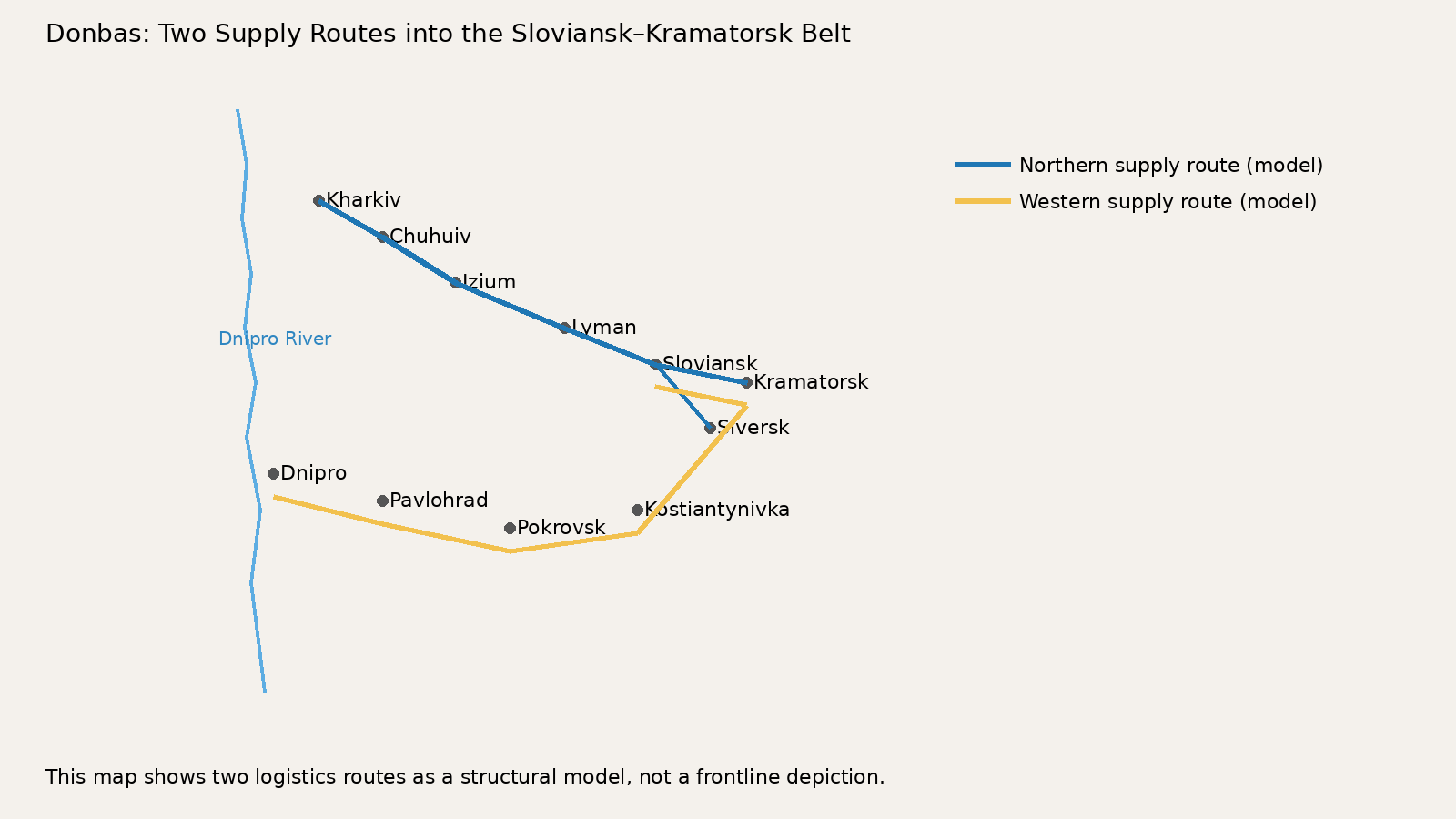
Two principal supply routes feeding the Kramatorsk and Sloviansk fortress belt shown as a structural logistics model for reference.
Why these two cities become decisive
As other defensive towns lose their ability to hold, Kramatorsk and Sloviansk stop being just strongpoints and become reservoirs.
They absorb not only territory but units, equipment, command staff, and exhausted formations retreating from across northern Donbas. What begins as a defensive belt becomes the final container for the surviving field army.
Put simply. Once the Donbas army is compressed into these two cities, losing supply does not mean losing ground. It means losing the army itself.
The two lifelines that keep the fortresses alive
Despite their strength, the Kramatorsk and Sloviansk fortress belt depends on just two supply arteries capable of sustaining such a concentration of forces.
The first runs from the west. Supplies move from across the Dnipro River into the Dnipro rear area, then east through Pavlohrad, and finally converge on Pokrovsk.
Pokrovsk is the main western rail and road hub feeding the entire fortress belt. From there, supplies are pushed onward toward Kostiantynivka, Druzhkivka, Kramatorsk, and Sloviansk.
The second supply route descends from the north. From the Kharkiv region, supplies move through Chuhuiv and Izium, pass through the Lyman approaches, and then descend toward Sloviansk and Kramatorsk along a network of roads and rail lines.
The same supply routes shown again for reference while explaining how their degradation affects the fortress line.
What is happening at Pokrovsk now
Russian military statements, Russian mapping projects, and Russian operational commentators describe Russian forces operating in and around Pokrovsk.
Whether Pokrovsk is fully captured matters less than whether it can function. Russian pressure has placed the railhead and approach roads under growing fire control.
If Pokrovsk fails as a logistics hub, the consequences follow a clear sequence. Kostiantynivka becomes harder to supply. When Kostiantynivka becomes unreliable, Druzhkivka follows. From there, pressure rolls inward to Kramatorsk, and finally to Sloviansk.
There are smaller alternative western roads, but they are narrow, indirect, and incapable of sustaining the volume required to supply forty to fifty thousand troops. They can supplement a functioning hub. They cannot replace it.
This is the turning point. When Pokrovsk fails as a logistics hub, the fortress belt does not collapse evenly. It loses specific capabilities in sequence.
Artillery ammunition is hit first, because shells must be moved in large volumes by rail and heavy transport. Secondary roads cannot sustain this flow under constant drone surveillance. Guns fall silent or are rationed.
Fuel follows. Tankers and fuel trucks become priority targets on narrow routes. Armoured movement slows, generators are rationed, and recovery operations stop.
Heavy repair and medical evacuation degrade next. Vehicles accumulate as losses. Casualties wait longer. Morale erodes.
Food may still arrive. Ammunition does not. At that point, the fortresses are still occupied, but they can no longer fight as fortresses.
Why the northern route cannot compensate
In theory, the northern corridor could offset a failing western route.
In practice, it cannot.
Ukraine does not control this corridor cleanly along its entire length. Sections pass through exposed terrain, forest belts, and river crossings that come under artillery and drone observation.
Russian pressure around the Lyman approaches is aimed at making this route unreliable. It can move limited supplies under risk. It cannot sustain the entire Donbas force now compressed into the fortress belt.
Why withdrawal leads only to the Dnipro
Geography leaves Ukraine with no intermediate option.
Between Kramatorsk and the Dnipro River there is no dense urban belt where a retreating army can regroup and build a new defence. Towns thin out. Defensive depth disappears.
The next place where a large scale defensive stand is realistic is the Dnipro River itself.
The Dnipro is wide and difficult to cross. It is a natural barrier. But it is far to the west.
The dilemma. If the Donbas army is destroyed before reaching the Dnipro, there may be little left to defend the river line at all.
Why Russia is taking its time
If Ukraine withdraws early, Russia would face another major defensive battle at the Dnipro.
By tightening supply lines slowly rather than launching a full assault, Russia keeps Ukrainian forces in place. Hope delays withdrawal. Time works against the defenders.
The objective is not speed. It is to ensure that when withdrawal comes, it comes too late.
The decision that must be made
This is the judgment now facing Ukraine’s leadership.
Withdraw early and lose territory but preserve the army.
Or wait and risk losing both the territory and the entire Donbas force as it tries to escape.
Conclusion
The fortresses of Kramatorsk and Sloviansk are strong. They have been built for decades.
But fortresses filled with the remnants of an entire field army cannot survive without ammunition, fuel, and movement.
Russia does not need to destroy them quickly. It only needs to close the roads patiently.
That is the method now on display.