Telegraph Online
Artificial Intelligence
As debate in the West remains fixated on which artificial intelligence models are smartest, Chinese companies are pursuing a different strategy altogether. This article explains why China is not racing to build superior intelligence, but to embed AI into the interfaces through which people shop, pay, communicate, and work, and why that shift may prove more consequential than any benchmark result.
For the past several years, artificial intelligence has been discussed as a technological arms race, measured by reasoning tests and claims of who is ahead by months or years. That framing is now obscuring what matters. Inside China, the most significant developments in artificial intelligence are not about making machines think better, but about making them disappear into the systems people already use.
The objective is not to build a smarter chatbot. It is to control the doorway through which everyday digital life happens.
The model is no longer the product
In much of the West, artificial intelligence is still treated as a destination. A user opens a website or an app, asks a question, receives an answer, and then moves elsewhere to act on it. In that world, the model itself is the product, so intelligence becomes the obsession.
Chinese companies are building something different. In Chinese language technology reporting and developer forums, artificial intelligence is increasingly discussed as an agent rather than an assistant. An agent does not merely respond. It selects tools, breaks tasks into steps, executes those steps, and delivers outcomes that can be acted on immediately.
This difference is visible in how systems are evaluated domestically. Coverage focuses on whether a system can complete work end to end, not on how elegantly it explains its reasoning. Intelligence becomes an input. Execution becomes the goal.
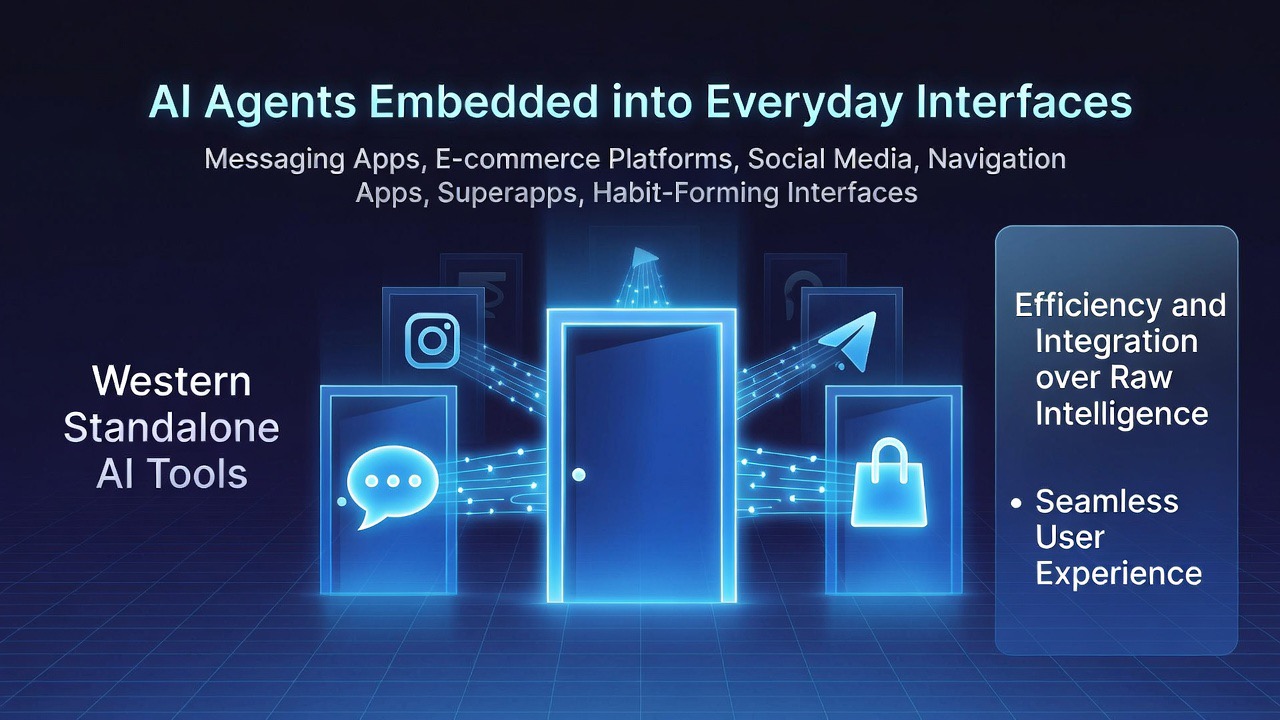
From chat to action inside the same screen
This approach becomes concrete when looking at how Chinese platforms deploy artificial intelligence. Instead of asking users to adopt new tools, companies are embedding AI into applications people already use at scale.
Alibaba has integrated its Qwen based assistants directly into Taobao, allowing users to search, receive recommendations, place orders, and pay without leaving a single conversational flow. The intelligence is not presented as a separate service. It is embedded in the act of shopping itself.
Similar logic applies across Chinese superapps. Messaging, booking, payments, and customer service are being fused into single action layers. A conversation turns into a transaction. A request becomes a completed task without the user leaving the interface.
From the user’s perspective, nothing dramatic has happened. They are still using familiar apps. From a systems perspective, something decisive has changed. The interface has absorbed functions that once required multiple steps and multiple applications.
Artificial intelligence stops being a destination. It becomes the doorway.
Cost and openness as distribution strategy
Much Western commentary treats the lower cost and greater openness of many Chinese systems as a weakness, as if cheapness implies inferiority. Chinese commentary suggests the opposite. Lower cost is not a concession. It is a deliberate distribution strategy.
Low cost models such as DeepSeek have demonstrated how quickly adoption accelerates when access barriers are removed. Developers build without hesitation. Local adaptations proliferate. Habits form. Over time, the interface becomes familiar, and switching away becomes inconvenient, even if another system is marginally more capable.
In this model, intelligence is not the moat. Usage is.
Constraint shapes design rather than stopping it
Chinese developer communities are unusually candid about constraints. Discussions openly describe rate limits, throttling, and shortages of computing power. Demand often exceeds capacity.
These limits do not undermine the strategy. They shape it. Scarcity discourages spectacle and rewards efficiency. Instead of chasing perfect intelligence, companies focus on placing artificial intelligence where it produces immediate practical value.
Rather than pausing deployment, they refine integration.
In plain terms
Replacing the interface means users stop thinking about artificial intelligence as a tool they consult and start experiencing it as part of how things get done. The system that controls that experience gains influence regardless of which model is marginally smarter.
Why this matters beyond China
This strategy travels well. In emerging markets where Western AI services are expensive, restricted, or poorly localised, low cost and adaptable Chinese systems are being adopted rapidly. Developers build on what is available. Businesses deploy what integrates easily. Standards follow usage.
This is not without tradeoffs. Deep integration raises questions about surveillance, data governance, and privacy. Chinese systems tend to prioritise efficiency and coordination, while Western regulators emphasise consent and constraint. These differences matter, particularly as Chinese AI systems are exported.
But none of this changes the central point. The competition is not primarily about who has the smartest model. It is about who controls the layer through which people act.
Technological influence does not spread because a system is the smartest available. It spreads because it becomes normal, present, and default. China’s artificial intelligence strategy reflects that understanding.
The risk for the West is not that China suddenly unveils a dramatically smarter system. The risk is that artificial intelligence elsewhere becomes embedded in daily routines in ways Western systems struggle to match, not because they are worse, but because they remain harder to inhabit.
The artificial intelligence race is no longer being decided in laboratories. It is being decided at the point where people enter the system, and whether they ever feel the need to leave it.