Strategic Miscalculation: The Faulty Assumptions Behind the War With Iran
The war with Iran is not simply exposing military danger. It is exposing a chain of strategic errors that began before the first missile was fired. The more closely one examines the assumptions behind the campaign, the clearer it becomes that the conflict was built on a false reading of the Iranian state, a false reading of modern missile warfare, a false reading of alliance stability, and a false reading of how economic pressure now travels through a tightly connected global system.
The war was supposed to restore control. It is revealing the opposite.
The first point is this: the conflict appears to have been launched on the assumption that force, applied with speed and technological superiority, would produce strategic clarity. That assumption now looks badly flawed. A campaign that was meant to degrade Iran, reinforce deterrence, and reassert authority is instead exposing the fragility of the security architecture that Washington and Tel Aviv built across West Asia after the Cold War. What is unravelling is not only an operation. It is a model of power.
The second point is broader and more important. The real subject of this war is not only Iran. It is strategic miscalculation itself. It is the belief that a large state can be frightened into political collapse by decapitation strikes. It is the belief that missile defence can absorb sustained attritional pressure without depletion. It is the belief that allies will carry the burden indefinitely, that energy shocks can be managed, that public opinion can be steered after the event, and that escalation can be started by choice and ended by command. This article examines those assumptions one by one, because the war is already becoming a case study in how great powers damage themselves when they confuse tactical violence with strategic control.
Core argument
The central error was not merely the decision to strike. It was the strategic worldview behind that decision: that Iran was brittle, that escalation would remain manageable, that defensive systems could absorb prolonged pressure, and that the political and economic consequences would remain secondary. Each of those assumptions is now under strain.
The illusion of the short war
Modern Western military planning has repeatedly been seduced by the idea that speed, surveillance, and precision can compress war into a short, decisive event. Iraq in 2003 was supposed to be rapid and transformative. Afghanistan in its early phase was supposed to be manageable. Libya was supposed to demonstrate the efficiency of remote destruction. Each campaign carried the same concealed belief: that technology can substitute for political understanding.
The war with Iran appears to have inherited that same illusion. The early language around the campaign suggested that decisive strikes could quickly disorient the Iranian command structure, suppress retaliation, and create a new political environment. Yet wars do not become short because one side wants them to be short. They become short when the adversary lacks resilience, lacks preparation, lacks strategic depth, or lacks the means to impose cost. Iran lacked none of those things.
Iran is not a small expeditionary target. It is not a fragmented occupation zone. It is not an insurgent theatre. It is a large state with roughly ninety million people, difficult terrain, distributed command structures, long war memory, and a security establishment that has spent decades preparing for confrontation with stronger powers. To imagine that such a state could be shocked into rapid strategic compliance was not realism. It was projection.
The regime collapse fantasy
One of the clearest signs of strategic miscalculation lies in the apparent expectation that pressure at the top would produce fracture below. The targeting of senior political and military figures suggests that some planners believed a decapitation strategy could unsettle the regime, trigger disorganisation, and perhaps create political rupture inside the state. That theory is always attractive to powers that prefer surgical language to historical memory.
History, however, is not kind to that assumption. External attempts to break a state through leadership strikes often produce the opposite of the intended effect. Political factions narrow their differences. Criticism gives way to solidarity. The leadership is recast as the vessel of national survival. Even opponents of the government can rally to the state when the country is seen to be under foreign assault.
That dynamic matters enormously in Iran. The Islamic Republic has lived for decades under sanctions, threats, sabotage, and periodic covert action. External coercion is not interpreted there as a passing diplomatic quarrel. It is absorbed into a political memory of siege and interference. In that context, leadership targeting does not naturally lead to liberal collapse. It can just as easily harden the state.
Strategic error number one
The assumption that leadership strikes would weaken Iran ignored one of the oldest patterns in state behaviour: external attack often consolidates internal legitimacy. A decapitation strategy against a large, prepared, ideological state is not automatically paralysis. It can be mobilisation.
The intelligence problem was not only evidence but interpretation
Strategic blunders are rarely born from a total absence of intelligence. More often they arise from the misuse of intelligence, the politicisation of intelligence, or the transformation of uncertain inputs into confident policy. In this case, public claims surrounding imminent threat, nuclear urgency, and regional danger appeared at various moments in inconsistent forms, often without the kind of stable evidentiary scaffolding that serious war planning should require.
The problem was not merely whether specific claims were true or false. The deeper problem was interpretive. When political leaders already want to act, intelligence can become less a discipline of restraint than a vocabulary of permission. Warning signs are elevated. ambiguity is reduced. worst case possibilities are treated as operating facts. A state that thinks it may be attacked convinces itself that it must attack first.
That is the corridor through which many bad wars enter history. The risk is not simply deception. It is decision makers selecting the interpretation that fits the desired course of action. When that happens, intelligence ceases to function as a brake and becomes a decorative justification.
The misunderstanding of modern missile warfare
Perhaps the most material miscalculation concerns military arithmetic. Modern air defence systems are formidable. They are also constrained. They depend on intact radar, reliable communications, layered command networks, and above all a continuous supply of interceptors. In a sustained exchange, those conditions can be strained. In a saturation environment, they can be broken.
The old fantasy of missile defence is that it can create a durable shield. The real condition is more fragile. A defender often needs multiple interceptors for a single incoming target. Offensive systems, by contrast, can be produced more cheaply and in greater numbers. Over time, attritional pressure reverses the economic logic of defence. The side protecting infrastructure may spend vastly more than the side attacking it, while also depleting stocks that are slower to replace.
This matters because the present war is not simply about striking targets. It is about exhausting defensive capacity. Cheap drones, layered volleys, decoys, and repeated barrages force defenders into hard choices. If planners assumed that advanced missile defence would provide a stable umbrella over time, they misunderstood the war they were entering. They assumed a shield. What they actually had was an expensive, finite, degradable system.
The vulnerability of the base network
For decades, the United States built a regional architecture of power through bases, airfields, logistics nodes, radar sites, fuel depots, and command centres stretching across the Gulf. These facilities were presented as instruments of deterrence and reassurance. In a different military age, that may have been enough. In a missile age, the same fixed geography can become a liability.
Large bases cannot hide. Their coordinates are known. Their runways are visible. Their energy and communications dependencies are traceable. Once war begins, the question is not whether these sites matter but whether they can survive repeated pressure without becoming strategic hostages. A base network built for projection can become a target set for attrition.
That changes the meaning of alliance. A host state no longer sees an American facility only as protection. It begins to see it as a magnet. If the presence of that base exposes the country to missile attack, political pressure inside the host state will shift. Security guarantees start to look like security risks.
Why the base question matters
The regional American position depends on a network of host countries. Once those governments begin asking whether foreign bases attract danger rather than reduce it, the whole architecture of deterrence changes meaning. This is not a tactical issue. It is a structural one.
The alliance calculation was too static
There is a recurring habit in great power planning: allies are treated as constants. Their domestic politics, economic pain thresholds, reputational anxieties, and regime insecurities are acknowledged in briefing papers, then quietly subordinated to operational assumptions. Yet alliances are not fixed assets. They are living bargains. When the cost of the bargain rises, the bargain changes.
The Gulf monarchies were expected to remain within the American security orbit. Formally, that assumption still holds. Substantively, the war is forcing new questions upon them. If their territory can be used as a platform for attacks on Iran, and if that role invites retaliation, then hosting American infrastructure becomes a much more dangerous proposition. If energy, finance, shipping, and internal stability are all endangered by the war, then the old model of dependence starts to look expensive.
This is why strategic miscalculation cannot be measured only by what happens to the adversary. It must also be measured by what happens to your coalition. A war that weakens trust among your own partners is not simply costly. It is self corrosive.
The economic consequences were not secondary. They were central.
One of the great errors of modern military planning is the assumption that economics can be managed after the fact. This is especially dangerous in a conflict centred on the Gulf. Energy markets do not wait for the diplomatic post mortem. They move immediately. Insurance rates move. shipping routes move. trader expectations move. Industrial planning moves. Political anger moves.
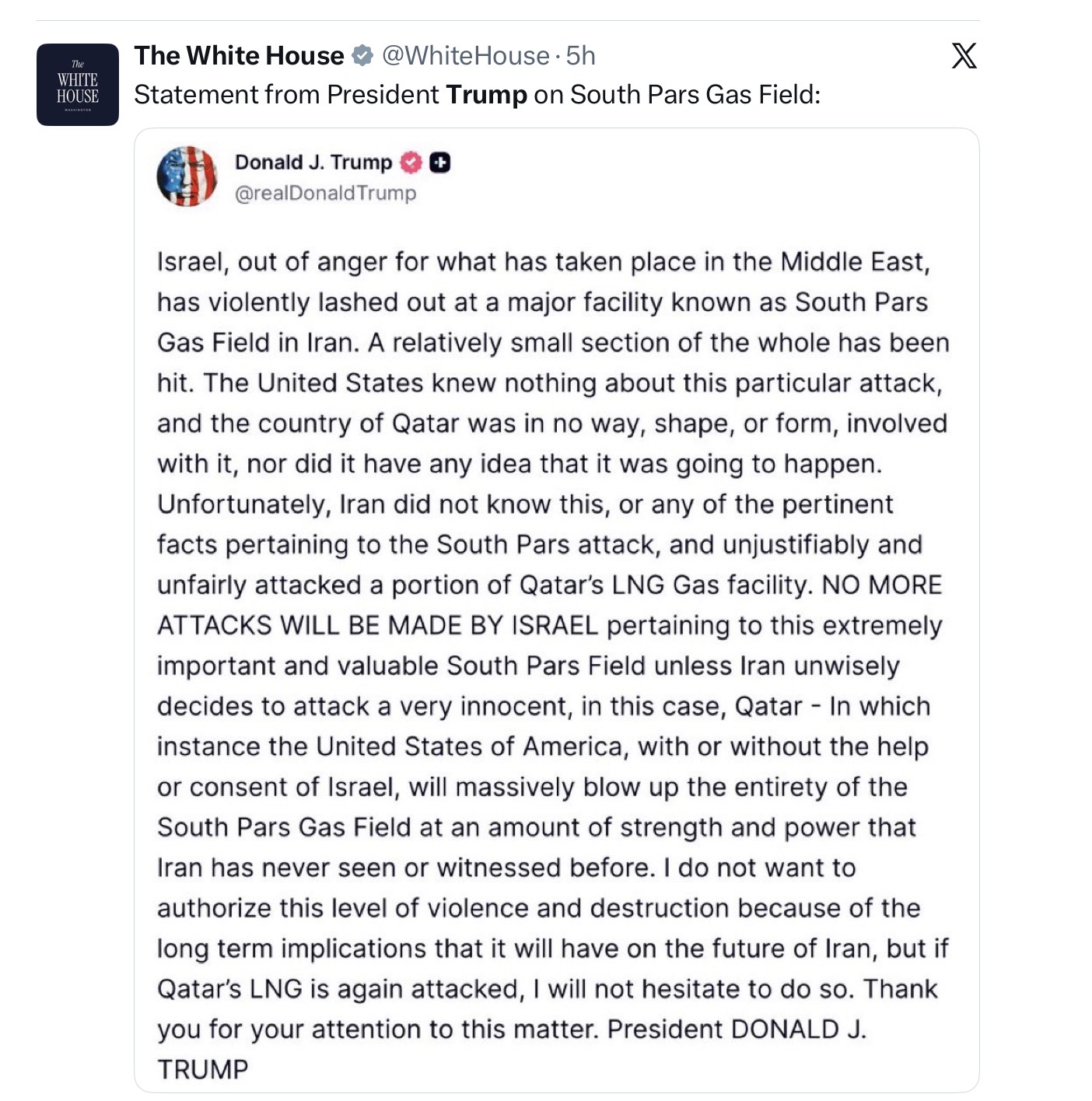
The Strait of Hormuz is not merely a line on a map. It is one of the world economy’s most sensitive pressure points. Even partial disruption reverberates through crude prices, LNG flows, fertiliser markets, transport costs, food prices, and industrial inputs. The point is not simply that the price of fuel rises. The point is that the logic of inflation spreads through systems that are already politically fragile.
That matters for Europe, for Asia, and for the United States itself. A war that raises energy prices while supply chains remain tense and public trust remains brittle is not strategically compartmentalised. It moves directly into domestic politics. Leaders who begin such wars while speaking as if markets can be reassured by personal confidence are not thinking strategically. They are improvising around consequences they did not price in.
The war contradicts the larger American strategic hierarchy
The most revealing contradiction may lie at the level of grand strategy. For years, American planners have argued that the principal long term challenge to the United States is China. The policy language of the past decade has revolved around the Indo Pacific, peer competition, industrial capacity, semiconductor resilience, naval posture, and alliance management in East Asia. By that measure, the strategic hierarchy should be clear.
And yet a major war around Iran pulls precisely in the opposite direction. Missile defence systems, diplomatic energy, command attention, naval assets, and alliance bandwidth are all drawn back into West Asia. The very resources that are supposedly needed for the Pacific are consumed in a theatre that American strategists claim is secondary.
This is not a minor contradiction. It is a serious one. A state that says China is the central challenge, then repeatedly diverts capacity into wars elsewhere, is not pursuing a coherent hierarchy of interests. It is being pulled by forces stronger than its own stated doctrine.
The most dangerous error is the exit problem
Every war looks most manageable at the start. That is when leaders still imagine they control the escalation ladder. Yet once casualties mount, markets shake, allies become nervous, and prestige becomes tied to persistence, the problem changes. The question is no longer how to begin. It is how to leave.
This is where strategic miscalculation becomes fully visible. If the war was launched without a clear political end state, then every later decision becomes reactive. If the stated objective was to restore deterrence, what counts as success. If the unstated objective was regime fracture, what happens when the regime consolidates instead. If the military campaign can continue indefinitely but the political basis for the war weakens by the week, then air power solves nothing. It merely lengthens the trap.
Wars are often described as failures when they are lost on the battlefield. That is too narrow. Many wars fail long before that point. They fail when the assumptions that made them appear reasonable begin to collapse. By that standard, the war with Iran is already revealing something much larger than a dangerous confrontation. It is exposing a strategic worldview that overvalued coercion, undervalued resilience, mistook technology for control, and treated politics as an afterthought.
The deeper lesson
Great powers rarely admit that they misread a war at the start. They prefer to adjust rhetoric, shift aims, and redefine success. But the evidence accumulates. A conflict meant to restore dominance can instead expose limits. A campaign meant to frighten an adversary can instead harden it. A war meant to reassure allies can instead alarm them. That is the shape of strategic miscalculation.
Conclusion
The most important fact about this war is not only that it is dangerous. It is that it reveals how danger was misjudged from the beginning. The planners appear to have assumed that Iran would be politically brittle, militarily containable, economically manageable, and regionally isolatable. They appear to have assumed that missile defence would hold, that alliances would remain stable, that energy markets would absorb the shock, and that escalation could be started with confidence and stopped at will.
That is a large number of assumptions for any war. It is an intolerable number for a war in the Gulf.
The result is that the conflict is exposing not merely the volatility of the region, but the fragility of the American Israeli security model itself. That model was built for deterrence, intimidation, rapid strike capacity, and the maintenance of a favourable order. It was not built for prolonged attritional contest against an adversary that prepared for exactly this form of confrontation. Nor was it built for a world in which economic choke points, alliance politics, missile saturation, and information disorder all operate at once.
That is why this war matters beyond Iran. It is revealing the limits of a strategic culture that has too often treated force as clarity. It is showing that precision does not abolish consequence, that technological superiority does not erase political reality, and that the most serious battlefield in any modern war may be the space between what leaders assume will happen and what the world actually does.
In the end, strategic miscalculation is not a dramatic single mistake. It is a chain. It begins with the wrong premises, gathers confidence from power, and only later meets reality. The war with Iran may come to be remembered in precisely those terms: not simply as a violent episode in a volatile region, but as the moment when an entire architecture of assumptions was tested under pressure and found less solid than its authors believed.
You might also like to read on Telegraph.com
- Iran War Day Five: Full Situation Report — A detailed reconstruction of how the conflict expanded from an opening strike into a regional confrontation.
- Missile Arithmetic and the Battle of Interceptors — Why interceptor inventories and missile production may shape the outcome of the war.
- Iran’s Strategy of Missile Attrition — How sustained missile and drone attacks place pressure on defensive systems.
- Iran’s Radar War: Blinding Missile Defence — The strategic importance of radar systems in modern missile warfare.
- The Conflict Expands Into a Regional War — How the initial strikes began drawing the wider Middle East into the confrontation.
- The Second Decapitation Strike — Leadership targeting and the risks of escalation.
- The Strait of Hormuz and the Global Supply Shock — Why the narrow maritime corridor matters for world energy markets.
- Oil, Power and the Global Financial System — The financial architecture behind the confrontation with Iran.
- Does Anyone Still Have the Power to Stop the War? — The difficulty of controlling escalation once a conflict begins.
- Iran, Nuclear Policy and Regional Security — An overview of the strategic tensions shaping the crisis.
- Why a War With Iran Would Be Difficult to Contain — How regional alliances complicate military planning.
- The Strategic Importance of the Persian Gulf — Energy routes, naval power and regional security.
- Iran and the Changing Balance of Power in the Middle East — How regional geopolitics are evolving.
- China, Russia and the Iranian Question — Why global powers are closely watching the conflict.
- Europe’s Energy Exposure to Middle East Conflict — The economic risks of disruption in Gulf energy flows.
- The Economic Front of the Iran War — Markets, shipping and insurance respond to rising risk.
- Missile Stockpiles and the Logic of Attrition — Industrial production and the balance of firepower.
- Industrial Warfare in the Modern Middle East — Why manufacturing capacity matters in long conflicts.
- The Global Economic Consequences of War With Iran — How the conflict spreads through financial systems.
- Energy Markets and the Future of the Gulf — The geopolitical importance of oil and shipping routes.