The Quiet Freeze: How Texas’ Latest Winter Storm Exposes Deeper Vulnerabilities
He woke earlier than usual, not because of noise but because of the quiet.
Plano is rarely silent. Even before dawn there is the low, constant movement of a city warming itself up: engines starting, doors slamming, tyres on concrete. This morning there was none of that. The air felt padded. He sat on the edge of the bed for a moment, then went to the window.
Overnight, the world had been filled in.
Snow lay across the flats opposite as if someone had taken a brush and swept everything flat. The roofs of parked cars were rounded and anonymous, their shapes softened, their colours erased. A row of crepe myrtles stood frozen mid-gesture, each branch traced in white. It looked, for a moment, like a postcard version of winter, the kind people frame rather than live inside.
Yesterday he had driven out to buy propane. Not because anyone told him to, but because he remembered 2021. If the electricity went out and the stove went cold, at least he would be able to cook something hot. The tank sat by the kitchenette now, unused, a quiet insurance policy.
He pulled on a jacket and went downstairs. The lobby was empty. Outside, the illusion broke immediately.
The snow was not snow anymore. It had compacted into something darker, slicker. The road had the dull sheen of glass. At the curb, footprints had already failed, each one ending in a scuff where someone had caught themselves. A car passed slowly, tyres whispering rather than rolling.
He stood there long enough to feel the cold work its way through his shoes. This was not a morning for walks. He went back inside.
Later, as the washing machine filled and began its steady churn, he glanced out again. Across the lot, a pickup truck sat at an angle it should not have been able to hold. The driver was inside, engine revving, wheels spinning uselessly. Snow sprayed and fell back in place. The truck did not move.
Five minutes passed. Ten. The engine noise rose and fell, frustrated, mechanical. He could imagine the smell of hot rubber, the driver’s breath fogging the windshield.
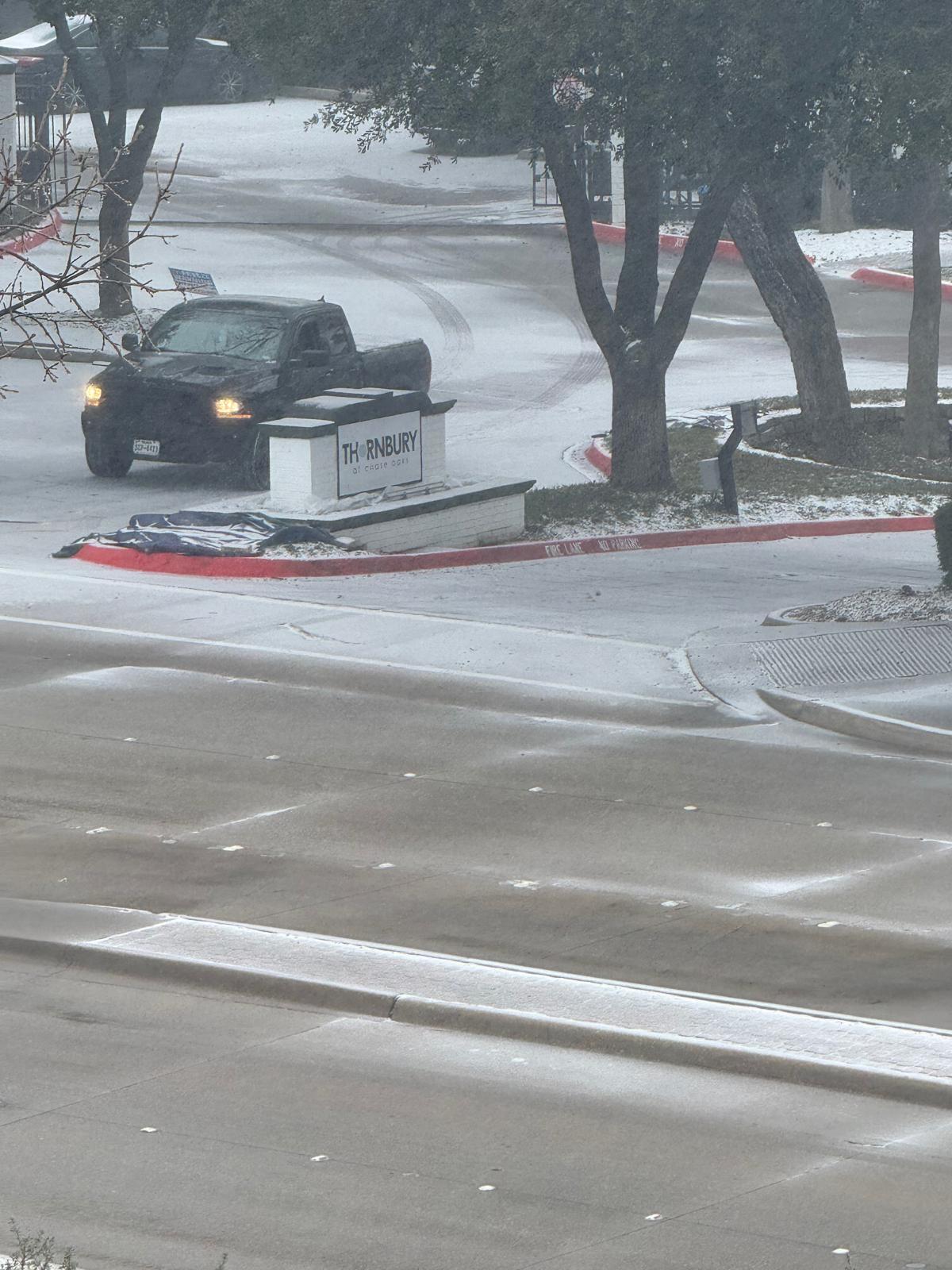
A pickup truck spins helplessly on ice in a Plano apartment complex, wheels revving but unable to gain traction.
Half an hour later, there were fire engines.
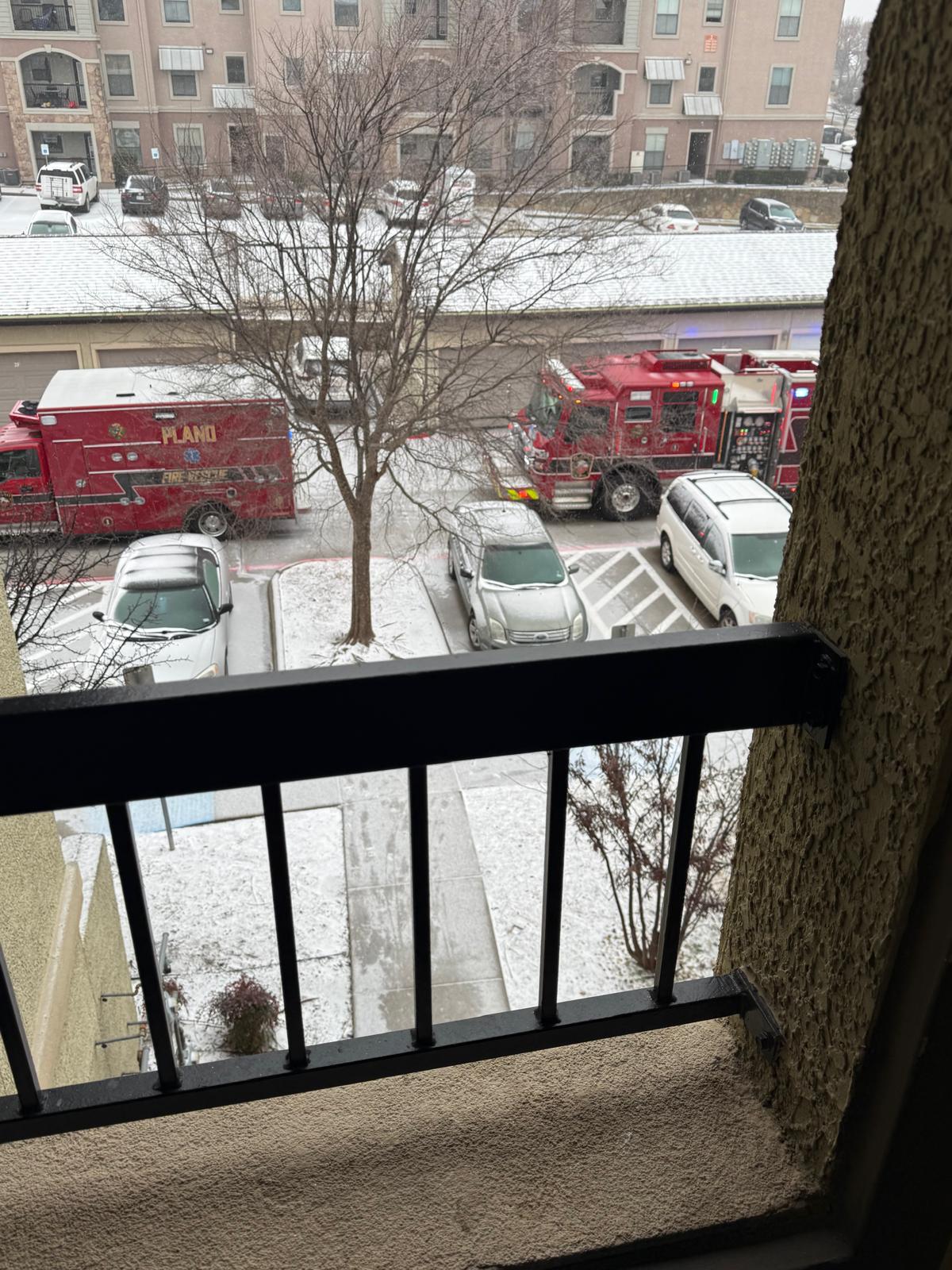
Fire trucks arrive as icy conditions spread across Plano during the winter storm.
He did not go to the window when he heard the sirens. He had already seen enough. He knew what would be happening across the city: people stepping out confidently, then suddenly not; a slip, a fall, the shock of it; someone calling for help. He knew the emergency rooms would be filling up, orthopaedics first, then hypothermia, then the quieter cases of people who had tried to wait it out and lost heat faster than they expected.
By mid-morning, Plano looked calm from above. Snow on roofs. Cars tucked under white blankets. But at ground level the city had changed character. Everything depended on balance now. Everything moved slowly or not at all.
This is how winter storms in North Texas actually work. Not as spectacle, but as constraint.
They arrive quietly, carried on a temperature profile rather than drama. A shallow layer of Arctic air settles close to the ground while warmer air moves above it, bringing moisture that freezes on contact. What falls looks gentle. What forms underneath is not. Snow decorates. Ice decides.
The danger is not the moment it falls, but the hours that follow. The cold holds. Roads do not reset. Pipes remain brittle. Crews move cautiously or not at all because the routes between failures have themselves become hazards. Nothing recovers quickly once the surface turns to glass.
North Texas infrastructure is not built to collapse. It is built to slow, then stop.
The roads are designed for flow, not grip. The grid is hardened for heat because heat is expected. Cold, sustained cold, layered with ice and accidents, produces a different kind of failure. Lines go down not because power disappears, but because weight accumulates and poles tilt. Restoration becomes a question of access rather than supply.
This is why the radio changes tone early. Why flights are cancelled before the worst arrives. Why warming centres open while the snow still looks harmless. These are not signs of panic. They are acknowledgements of limit.
Since the freeze of 2021, Texas has added capacity, winterised parts of the system, installed batteries, written new rules. All of it helps at the margins. None of it alters the deeper reality that the state, like much of the country, was built around a climate distribution that assumed events like this were rare and brief.
The danger is not extreme weather.
The danger is infrastructure designed for yesterday’s probabilities, operating without buffers, in a world where edge cases now arrive routinely.
For decades, the bargain was simple. Rare events could be treated as rare. Systems could be optimised for efficiency, redundancy shaved away, because the outliers arrived once in a generation and could be managed as exceptions.
That bargain is breaking down.
Cold air has always reached Texas. Ice storms have always happened. What has changed is how often they arrive, how long they stay, and how little time there is between them. Each event presses on the same weak points. Each leaves less room for recovery.
For the man in the apartment, none of this is theoretical. It is present in the decision not to walk. In the propane tank by the stove. In the sound of an engine spinning helplessly across the lot. In the knowledge that emergency rooms will be busy long before the snow melts.
From the window, the city still looks peaceful. Snow on roofs. Cars waiting patiently. But the calm is deceptive. It rests on surfaces that no longer forgive mistakes, on systems that no longer bend easily.
This storm will pass. The ice will melt. Traffic will return.
What remains is the quieter lesson: a city does not need to be overwhelmed to be exposed. It only needs to be built for a world that is no longer reliably there.
You might also like to read on telegraph.com