After the Iran war, the dollar may still dominate, but it will dominate a smaller, less obedient world
The Iran war did not end dollar power. It exposed the costs of overusing it. The United States still sits at the centre of the global financial system, but repeated use of that system as a weapon is encouraging more states to hedge, improvise, diversify, and route around it.
The dollar is still first. The point is that first place no longer buys the same degree of obedience.
Example: The dollar still accounts for most allocated global foreign exchange reserves, while the renminbi remains a small reserve currency. That means the article is not arguing collapse. It is arguing erosion of leverage inside continued dominance.
That distinction matters because bad arguments now dominate both sides of the debate. One side says the dollar is unassailable because everyone still runs into it in a panic. The other says American overreach has already broken it. Both positions are lazy. The stronger claim is narrower. The Iran war showed that a world can still rely on the dollar in a crisis while becoming less willing to remain fully exposed to a system that Washington increasingly uses as a coercive instrument.
Short term dollar resilience does not refute long term adaptation against dollar coercion.
Example: Reserve managers still describe the dollar as the main safe haven in a crisis. At the same time, surveys now show geopolitics rising sharply as a top reserve management concern. Those two facts are not contradictory. They describe a world that still trusts the dollar in emergencies but trusts the steward of the system less fully than before.
The key mistake in much of the commentary is to confuse price action with power. A rush into dollars during war says something important about liquidity, scale, and habit. It does not settle the strategic question. The strategic question is whether states, banks, reserve managers, and trading blocs want to remain as dependent as they once were on a system whose operator has shown a growing willingness to politicise access. The answer to that question is increasingly no, or at least not without insurance.
The real test of sanctions is not whether they inflict pain, but whether they produce compliance.
Example: Iran has plainly suffered under sanctions. Its economy is more distorted, narrower, and more fragile than it would otherwise be. But the relevant question is whether years of sanctions delivered submission, deterrence, or strategic reversal. The war itself is evidence that they did not.
This is the point too often blurred by both advocates and critics of sanctions. To say that sanctions hurt is trivial. Of course they hurt. The question is whether they achieve the political outcome promised in their name. That is a harder test, and on that test the record is much less flattering. A state can be made poorer and still remain defiant. A state can be isolated from formal channels and still learn to survive through informal ones. A state can be squeezed and still refuse to bend.
Long sanctions do not merely punish. They teach.
Example: Repeated sanctions regimes tend to generate intermediaries, tolerated grey zones, alternative clearing habits, and a class of actors skilled in evasion. Over time, what begins as emergency improvisation hardens into shadow infrastructure.
That is one of the least discussed costs of overusing financial coercion. The target does not become immune. It becomes educated. Workarounds become routine. Informal channels gain depth. A culture of operating outside the clean visibility of the formal system develops. The sanctioned economy remains weaker than it would otherwise be, but it also becomes more practised at manoeuvre. That matters because a coercive system is strongest when its threat is enough. Once it has to be used repeatedly, the users of the weapon start teaching others how to live with it.
Trust in the steward matters almost as much as depth in the system.
Example: The dollar retains deep capital markets, the Treasury market, and unmatched liquidity. But if reserve managers increasingly treat geopolitics as a central risk, they are no longer thinking only about yield and safety. They are thinking about political exposure to the operator of the system.
The old assumption was that the dollar system was not merely large but broadly predictable. It was not neutral in any pure sense, but it was treated by many participants as sufficiently rules based to justify dependence. That assumption has weakened. Once access to the system begins to look more contingent, more punitive, or more arbitrary, states do not need to stage a dramatic exit for the damage to begin. They merely need to start treating dependence as a vulnerability rather than a comfort.
A weaker dollar order is more likely to emerge through fragmentation than through a single clean successor.
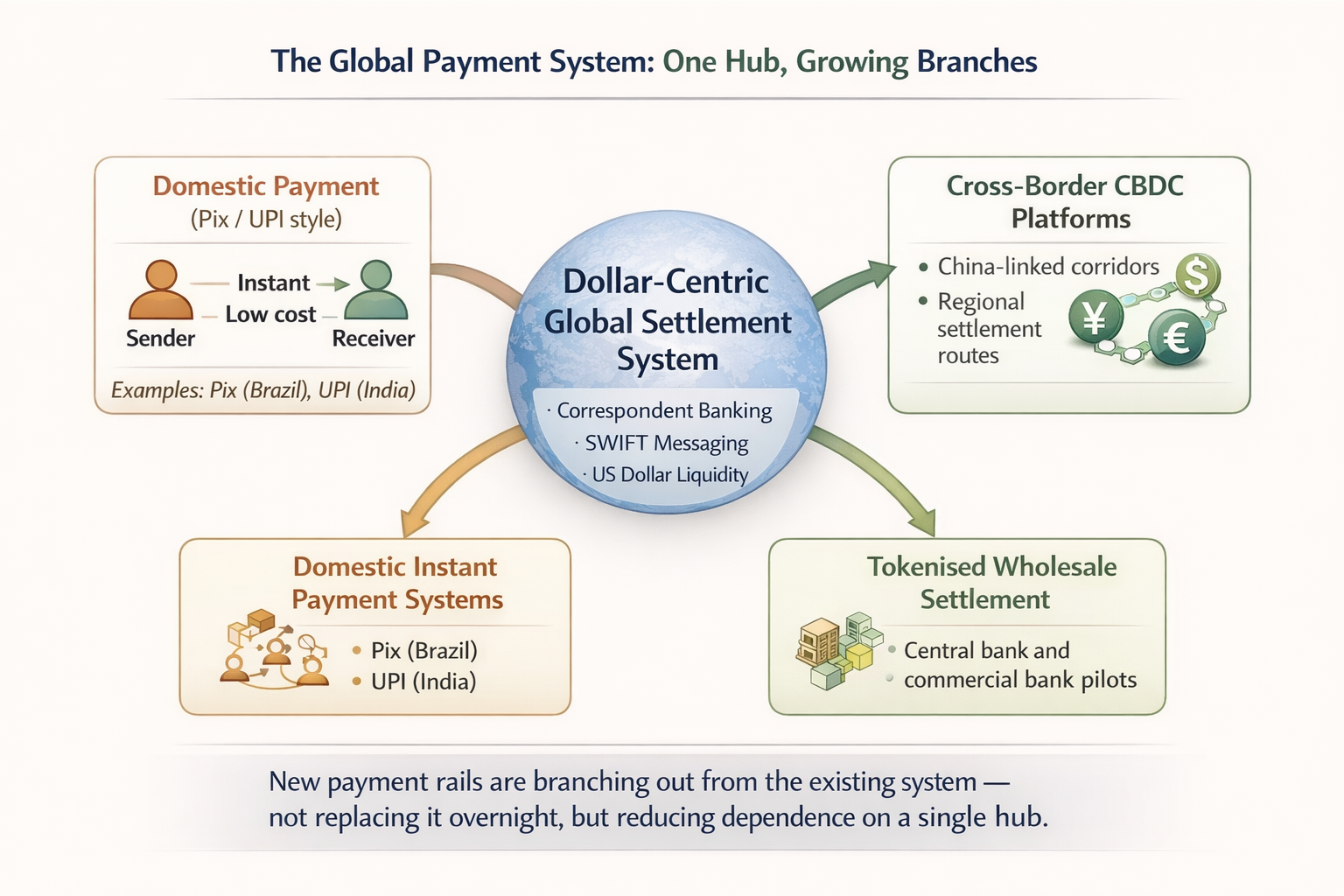
Example: There is no serious evidence that one rival currency is about to replace the dollar outright. What is more plausible is a patchwork world of more local currency settlement, more gold, more bilateral arrangements, more regional payment systems, and more technical interoperability outside the traditional Western core.
This is where much public debate remains trapped in an outdated frame. People still ask what will replace the dollar, as if the only meaningful change would be a singular successor. That is the wrong question. The better question is how much of the world can move outside the disciplinary reach of the existing system without needing to overthrow it. Once that becomes the frame, the threshold for meaningful change falls sharply. The dollar does not need to lose the crown to lose some of its command.
BRICS matters not because it has already built a new empire of payments, but because it is treating reduced dependence as a practical project.
Example: BRICS finance ministers and central bank governors have discussed cross border payments work and greater interoperability between payment systems. That is not a finished replacement for the present order. It is evidence of serious institutional preparation for a more plural one.
The same applies to China. The renminbi is not ready to inherit the world. Capital controls remain real. Trust in Chinese governance is limited. But China does not need to provide a perfect alternative in order to support a weaker dollar order. It only needs to provide enough trade weight, enough settlement capacity, and enough economic gravity to make diversification more feasible than it once was.
Crypto and stablecoins do not abolish American control, but they do create leakage that matters.
Example: US authorities can and do sanction digital currency addresses and pursue bad actors using digital rails. But digital channels still create opacity, speed, and workarounds that complicate the older model of neat exclusion through visible banking chokepoints.
The loudest claims on crypto are usually unserious. It is not true that digital assets have made the United States powerless. It is equally false that they change nothing. The right formulation is more modest and more useful. Crypto is not liberation from the dollar system. It is seepage from it. In a tightly controlled sanctions architecture, seepage matters. It weakens visibility. It multiplies enforcement problems. It gives actors at the margin another way to hedge against formal exclusion.
The Iran war therefore matters less as a story about immediate monetary replacement than as a warning about diminishing returns from coercion.
Example: A heavily sanctioned state did not need to topple the dollar system to challenge it. It only needed to show that, despite years of pressure, it could still survive, force adaptation around a key chokepoint, and remind the world that central financial power does not automatically produce strategic submission.
That is the real lesson. The United States still possesses the biggest financial stick in the world. The problem is that repeated use of that stick is shrinking the zone in which a threat alone is enough. Others are learning, diversifying, improvising, and preparing. Not because they believe the dollar is finished, but because they no longer trust its operator to remain restrained.
The future is not a post dollar world. It is a more fragmented dollar world.
Example: The dollar can remain the leading reserve currency, the default safe haven, and the centre of global finance while still governing a world that obeys it more grudgingly, trusts it less instinctively, and keeps more exit routes open in the background.
That is a smaller world, not in scale, but in submission. It is less obedient because fear of exclusion now produces not only compliance, but preparation. And for a state that has long converted financial centrality into geopolitical leverage, that is a more serious warning than any theatrical talk of collapse.
You might also like to read on Telegraph.com
War, oil and global chokepoints
- Trump’s 10 day Iran pause is not diplomacy. It is the market forcing Washington to confront the cost of war
- The Iran War Is Driving Oil Toward $200 And It Will Break Britain’s Poor and Pensioners Before Markets
- The Iran Conflict Is Rewriting the Operating Logic of Global Shipping
- Why Washington Is Quietly Allowing Iranian Oil to Flow
- War with Iran Turns Strait of Hormuz Into Global Supply Chokepoint, Triggering Oil, LNG and Fertiliser Shortages
The dollar, power and the changing global order
- The Exit Ramp: How Countries Are Reducing Their Dependence on the Dollar
- The Surplus Delusion: Why the Real Enemy Is Not Mercantilism but the Credit State
- Europe’s Strategic Reckoning: Capital, Energy and the Cost of Strategic Overextension
- The United States Is Replacing Market Pricing With Law in Critical Minerals Supply Chains
Britain, India and the economics of mismanagement
- Britain’s Rentier Economy Is Why a Coffee Now Costs £5
- Britain’s Economy Is Not Broken. It Is Being Quietly Mismanaged
- The Magnificent Indian People: Resilient, Ingenious and Let Down by a Bureaucracy Built to Control
- Why Western Theory Still Struggles to Explain the Chinese Economy
AI, productivity and the next economic disruption
- AI Is Raising Productivity. Britain’s Economy Is Absorbing the Gains
- AI Is Raising Productivity. That Is Not the Same Thing as Raising Prosperity
- The End of Rented Software: How Artificial Intelligence Breaks the Subscription Model
- Elon Musk Moves xAI Into SpaceX as Power Becomes the Binding Constraint on Artificial Intelligence
- Sadiq Khan Warns of Mass Unemployment. AI Poses a Deeper Threat to London
- Why the Fight Over Defining AGI Is the Real AI Risk