Telegraph Online long read
A war with Iran would not be decided by intent or rhetoric, but by logistics. The United States can sustain an intense campaign for only a few days before stocks thin, options narrow, and the initiative shifts.
War with Iran is being discussed as if it were a choice between force and restraint. That framing is juvenile. The real question is whether the United States can impose decisive effects before the clock runs out, and whether it can absorb what follows once inventories are spent and carriers are forced to pause to reload.
The naval buildup is often read as proof of dominance. In operational terms, it is better understood as proof of constraint. Carrier operating zones are narrow. The most consequential targets sit far inland. Air superiority is not guaranteed. And the window for sustained high-intensity operations is measured in days, not weeks.
Once that window closes, Iran does not need to win at sea or in the air. It only needs to remain operational, choose the timing of escalation, and redirect the battlefield toward the Strait of Hormuz, regional bases, and Israel.
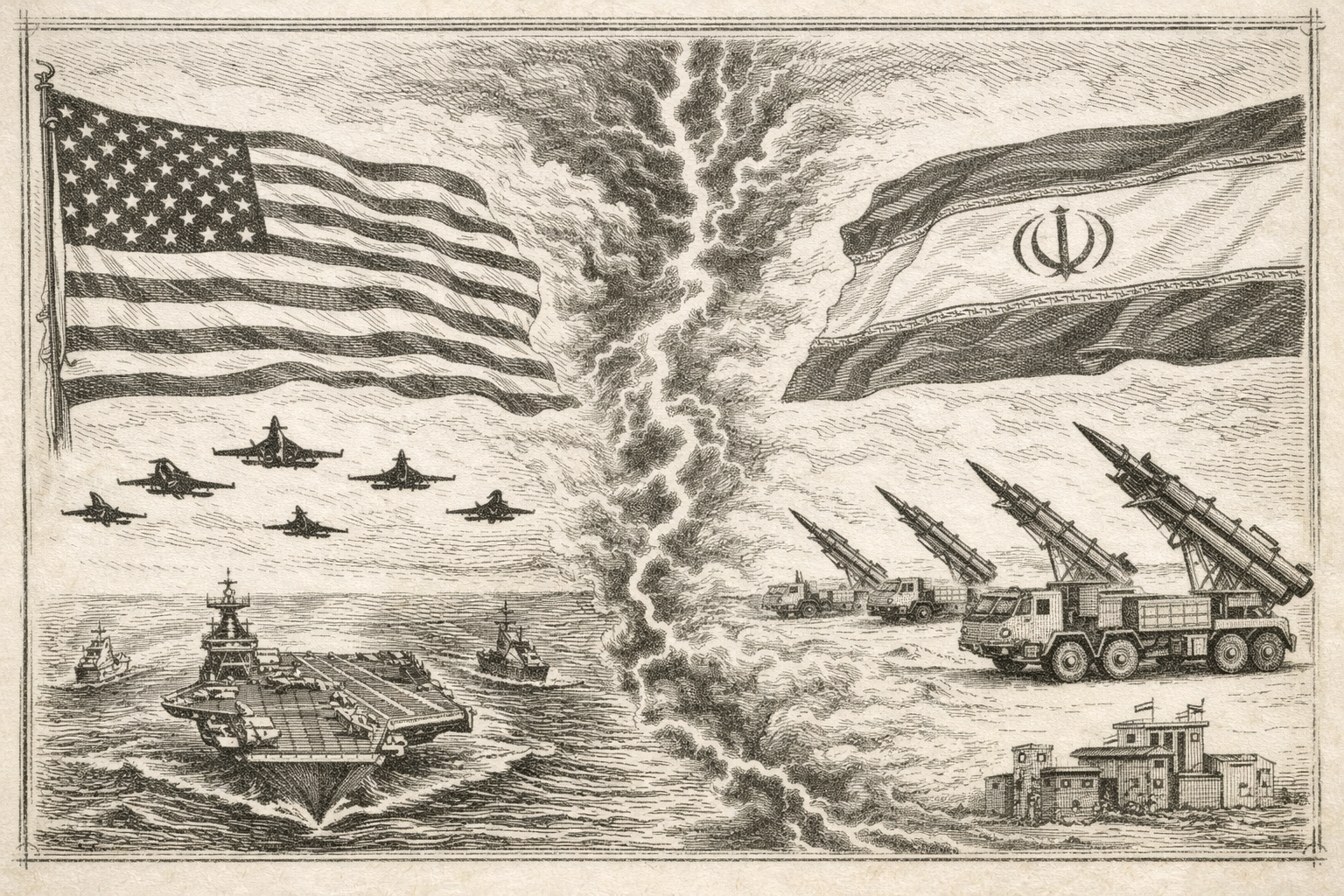
The Mainstream Media Framing is Inaccurate
This would not be a short war, not symbolic, and not controlled
The public picture rarely changes: a carrier on the horizon, a handful of destroyers on screen, and a president telling the world he hopes he will not have to use them. The implication is deliberate. America appears infinite. Iran appears local. The war, if it happens, is framed as a brief act of enforcement. A slap, not a struggle.
That framing is the first and most dangerous illusion.
The operational reality is colder and far more specific. This is not a Venezuela scenario. There is no plausible snatch and grab, no short raid that collapses political will, no clean symbolic strike that remains symbolic. Iran is large, mountainous, and structurally hardened. It has depth, dispersion, and redundancy. It absorbs punishment rather than magnifying it.
Once the fantasy of instant capitulation is stripped away, only one honest description remains. A strike on Iran is war initiation. Not signalling. Not enforcement. War.
The governing constraint is time.
The United States can sustain an intense naval, air, and missile campaign at meaningful tempo for roughly four to six days. That is not a political preference. It is a logistics and inventory reality, driven by finite cruise missile stocks in theatre, carrier sortie limits, reload timelines, and the exposure that opens once the opening inventory is expended without a compelled end state.
The paradox appears immediately. The United States can strike hard and fast, but only briefly. Iran is structured to absorb the opening phase and shape what follows. Accept the five day clock, and the rest of the analysis follows mechanically.
The Military Illusion
Why carriers and Tomahawks do not equal dominance
Begin with the steel on the water.
US naval forces in the CENTCOM maritime theatre
Public reporting and official imagery indicate the following US naval posture across the Red Sea, Gulf of Oman, Arabian Sea, and adjacent waters:
- Aircraft carrier: USS Abraham Lincoln (CVN 72), operating with a full carrier air wing.
- Guided missile destroyers (6): USS Spruance (DDG 111), USS Michael Murphy (DDG 112), USS Frank E. Petersen Jr. (DDG 121), USS Delbert D. Black (DDG 119), USS Roosevelt (DDG 80), USS Mitscher (DDG 57).
- Littoral Combat Ships (3): deployed within 5th Fleet waters for patrol and security tasks. Exact hulls and missile loadouts are not publicly disclosed.
The six destroyers together provide approximately 570 Mk 41 vertical launch system cells in theatre. These cells can be loaded with a mix of land attack cruise missiles, air defence interceptors, and anti submarine weapons. Some cells can be quad packed with smaller interceptors. The precise missile mix is not public and varies by mission.
The carrier itself does not carry vertical launch missile batteries at destroyer scale. Its strike capacity is delivered through embarked aircraft whose ordnance loadouts rotate continuously and are not itemised in public reporting.
Taken together, the deployment represents a large but finite concentration of naval firepower. Missile stocks, sortie rates, and reload timelines impose hard limits on how long maximum intensity operations can be sustained before pause and rearm become unavoidable.
Public reporting in late January 2026 described the aircraft carrier USS Abraham Lincoln moving into the broader region, escorted by destroyers (see above Grey Box).
A carrier group looks like dominance because it concentrates power. But concentration is not freedom of action.
A carrier does not operate wherever it chooses. It operates inside a constrained box shaped by distance, survivability, and permissions. Its position is dictated by threat envelopes and geography. Its sortie generation is dictated by distance. Its effectiveness is dictated by how far inland the decisive targets sit.
Tehran lies roughly 750 miles from likely carrier operating areas in the Gulf of Oman and the Arabian Sea approaches. That distance matters because a strike is not a graphic. It is a flight plan.
Once aircraft go feet dry, they are committed. Every additional mile burns fuel, compresses routing options, strains tanker support, and increases exposure to air defence. Attrition is not a rounding error. The loss of even a single aircraft introduces escalation pressure, recovery dilemmas, and political shock.
The same logic governs cruise missiles. A Tomahawk is not a magic wand. It is a subsonic, finite inventory system that must be loaded, fired, and replaced. Even generous estimates place available stocks in the relevant posture in the low hundreds. Against a country the size of Iran, that inventory can disrupt and damage. It cannot terminate a regime or collapse a dispersed military system.
This is where the rhetoric of overwhelming force collapses under geometry and arithmetic. A continental scale target set is not solved by a few hundred standoff weapons and a single carrier air wing.
The decisive issue is not whether the United States can strike effectively. It can. The decisive issue is duration. After four or five days of high tempo operations, inventories thin, aircraft fatigue, and reload cycles begin. Reloading is not a neutral pause. It is a lull, and lulls are where initiative shifts.
A dispersed system designed for endurance does not need to contest the opening phase symmetrically. It only needs to remain intact enough to exploit the second phase, when the attacker’s options narrow.
Even naval survivability follows this pattern. Conventional anti ship missiles are largely manageable through layered defences. The unresolved risk lies with ballistic or hypersonic systems requiring real time tracking and terminal guidance against a moving carrier. Absolute certainty is not required to impose restraint. Persistent uncertainty is sufficient.
The naval buildup therefore signals two realities at once: capability and constraint. It is power operating under a clock, with finite stocks, narrow envelopes, and no guaranteed termination mechanism.
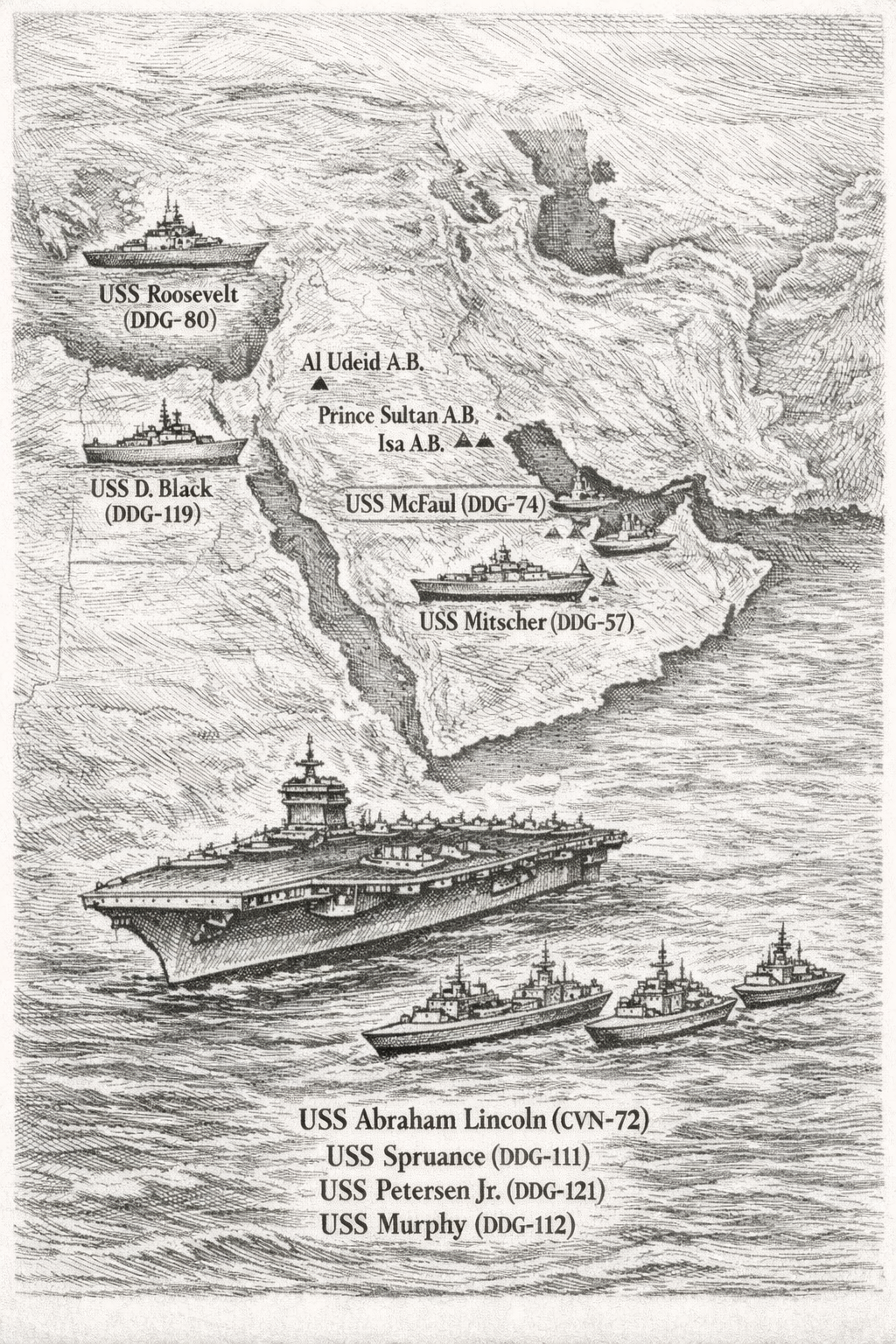
U.S. deployment of major warships in the Gulf as of 2nd February 2026
The Myth of Precedent
Why June does not apply
The hawkish argument leans heavily on precedent. Iran threatened escalation last time and did not deliver it. Therefore, it will not deliver it next time either.
That logic fails at the root.
The prior June exchange did not resemble an uncontrolled escalation ladder. Indicators pointed toward advance preparation, symbolic targeting, calibrated responses, and deliberate avoidance of casualties. It looked less like spontaneous restraint and more like a bounded episode designed to cap escalation.
If that interpretation is even broadly correct, the precedent is not “they backed down”. The precedent is “the exchange was managed”.
That distinction matters. A managed episode is not a template. It is an exception. Treating it as proof of future restraint risks misreading the escalation environment entirely.
Here the five day clock becomes dangerous. It tempts decision makers into believing they can fire a short burst, declare success, and step back. In reality, that moment is when exposure peaks: inventories spent, no end state compelled, and initiative shifting to the defender.
False precedent breeds false confidence. False confidence is how limited wars escape their boundaries.
Iran’s Real Deterrent
Geography, dispersion, succession, missiles
Iran’s deterrent is neither theatrical nor brittle. It is structural.
Geography comes first. The country’s size and mountainous terrain compartmentalise airspace, complicate targeting, and blunt linear strike plans. Depth allows space to be traded for time. That alone disqualifies theories of rapid collapse.
Dispersion follows. Missile forces, command nodes, storage sites, and launch infrastructure are fragmented by design. No opening salvo can reach enough of the system at once to make follow on operations unnecessary. Survivability is built in.
Underground facilities deny battle damage certainty. When an attacker cannot be sure what remains, it cannot be sure what comes next. Leadership continuity compounds this. Authority is distributed. Succession is planned. Decapitation is unreliable.
Missiles integrate these elements. They enable patience. Iran does not need to match opening tempo. It can conserve, wait, and respond when the operational balance shifts. Earlier reliance on older systems was not weakness but conservation.
This deterrent does not promise instant devastation. It promises the absence of a clean endpoint. Persistence, not surprise, governs outcomes.
The Regional Tripwire
Arab refusal, Shia mobilisation, Hormuz
The conflict does not remain bilateral. It widens by structure.
Regional basing and overflight assumptions no longer hold. Key Arab states have signalled reluctance or refusal to serve as launchpads or corridors. This is not diplomatic theatre. It is an operational constraint that compresses US options toward naval only operations, reducing sortie rates and limiting sustainment.
Naval only warfighting is possible, but it is inferior. It stretches timelines and magnifies the five day clock.
Religious framing adds a second tripwire. Once senior Shia authorities define the conflict as existential, mobilisation ceases to be discretionary. Proxy management gives way to obligation. The participation threshold drops across Iraq, Lebanon, Bahrain, and the Red Sea corridor.
Then there is Hormuz.
The Strait does not need to be closed to be disrupted. Its narrowness and traffic density mean even limited interference alters insurance pricing, routing decisions, and market expectations. Insurers respond to uncertainty, not confirmed losses. Premiums rise first. Shipping adjusts. Prices move.
This is not a binary switch. Pressure can be applied incrementally, selectively, and with plausible deniability. That flexibility creates leverage precisely when the attacker is most exposed: after the initial strike window closes and before a new equilibrium forms.
Escalation here is not linear. It is systemic. Stress introduced at one node propagates across the network.
The Political Choke Point
Financial stress, electoral risk, and the illusion of a cost free strike
The decisive constraint is not doctrine. It is political and financial survivability.
Short strikes can be sold. Prolonged uncertainty cannot. Energy disruption feeds inflation. Inflation feeds yields. Yields feed fiscal stress. Bond markets are not spectators. They are participants.
An oil spike is not merely a price shock. It tightens financial conditions, raises refinancing costs, and compresses political room for manoeuvre. That matters because US governance is tethered to market stability.
Global conditions amplify this fragility. Large debt holders are already under pressure to defend currencies as rates rise. Europe has limited capacity to absorb higher energy costs. The global economy enters this scenario brittle, not resilient.
This creates a perverse incentive. Leaders are tempted toward short, symbolic strikes precisely because deeper engagement appears unaffordable. Yet the structure of this theatre denies clean, cost free outcomes. The strike window is short. Retaliatory pathways are durable. Financial transmission is fast.
The decision becomes boxed by politics on one side and markets on the other. That does not prevent conflict. It increases volatility by pushing leaders toward actions the system cannot safely absorb.